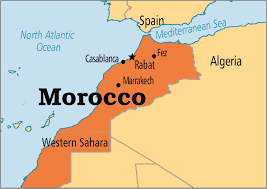
 Since our daughter had a gap between jobs in Jordan and Afghanistan, we met up for a hastily booked Morocco tour.
We had been to this North African country before, a brief side excursion. I remember exiting the tourist bus in Tetouan and saying, “Toto, we’re not in Kansas any more” – it was like stepping back in time a thousand years. But that was not representative of Morocco, whose modernity, this time, surprised me.
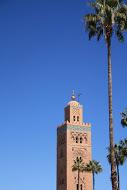
photo by Elizabeth Robinson
It’s overwhelmingly Muslim, with two main ethnic groups, the indigenous Berbers, and Arabs who came later. Ethnic tensions seem minimal. I asked our tour guide about this, in light of sectarian strife in other Islamic lands. “Those people aren’t Muslims,” he said, “they’re fanatics.”
Moroccans are bilingual, equally using Arabic and French (this was a French colony, 1912-56). The distinctive Berber script is seen occasionally; and of course there’s Globalspeak (English).

Berber script
Morocco is a constitutional monarchy, not what you’d call a free country; but while the King, Mohammad VI (since 1999), is really still the boss, he’s done a fair bit to modernize, liberalize and democratize Morocco.
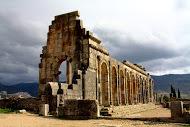
Volubilis – photo by Elizabeth Robinson
It was part of the ancient kingdom of Mauretania; later, of the Roman Empire. A nice surprise was visiting the extensive ruins of the Roman city of Volubilis – off my radar screen because (unlike the typical ancient city), Volubilis issued virtually no coinage.
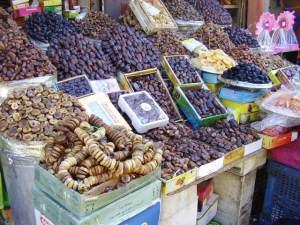
My wife wanted to try a sizable disk-shaped bread loaf. The quoted price was Two Dirhems – about 20 cents. But for that we actually received two loaves.
I wondered aloud how they all could sell enough to stay in business. But my daughter pointed out the obvious: they wouldn’t be there otherwise.
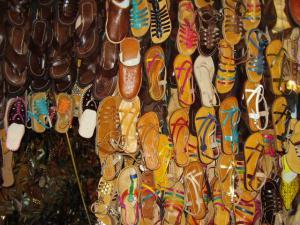
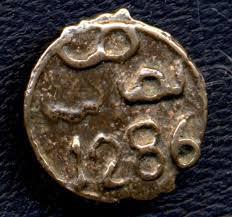
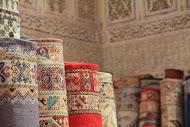
Photo by Elizabeth Robinson
We also had the obligatory tourist visit to a carpet emporium. Once on a similar excursion in Turkey, I made the mistake of agreeing to sign in with my phone number. I couldn’t believe how often those carpet pushers called me in subsequent years, despite my increasingly angry brush-offs.
The overall impression of Morocco was one of basic prosperity. There were, admittedly, a fair number of beggars. But many looked no scruffier than a typical seller in the souk. I suppose that holding one’s hand out is actually a more effective way of getting passersby to part with cash.
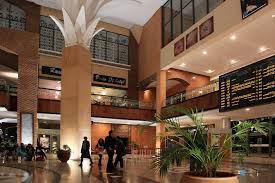
And the Moroccan economy is not all souk sellers flogging kitsch. Everywhere you looked it was evident that every sort of modern business was thriving. The roads were jammed with vans and trucks displaying a profusion of their logos. If not politically free, this is manifestly a very open, free economy. I am always energized visiting countries like this. It’s part of a worldwide phenomenon, of recent decades, which many people fail to grasp amid all the gloom and doom talk. Economic openness, free enterprise, and trade, are transforming, for the better, the lives of billions of people.