


 Tom Friedman’s latest book made my head spin. It’s Thank You for Being Late: An Optimist’s Guide to Thriving in the Age of Accelerations. He’s a bigger optimist than me.
The “accelerations” in question concern technology, globalization, and climate change, all transforming the world at breakneck speed. Faster, indeed, than human psychology and culture can keep up with.
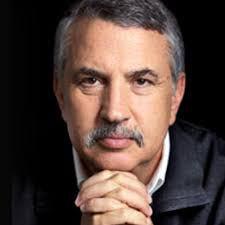
Friedman
What spun my head was Friedman’s rundown of technology’s acceleration. He sees 2007 as an inflection point, with the iPhone and a host of other advances creating a newly powerful platform that he calls not the Cloud but the “Supernova.” For instance there’s Hadoop. Ever heard of it? I hadn’t. It’s company, that also emerged in 2007, revolutionizing the storage and organization of “Big Data” (as best I understand it), making possible explosions in other technologies. And GitHub — 2007 again — blasting open the ability to create software.*
All this is great — for people able to swim in it. But that’s not everybody. A lot of people are thrown for a loop, disoriented, left behind. Bringing them up to speed is what Friedman says we must do. Otherwise, we’ll need a level of income redistribution that’s politically impossible.
The age-old fear (starting with the Luddites) is “automation” making people obsolete and killing jobs. It’s never happened — yet. Productivity improvements have always made society richer and created more jobs than those lost. But Friedman stresses that the new jobs are of a different sort now.
But schools aren’t teaching that. Our education system is totally mismatched to the needs of the Twenty-first Century. And I can’t see it undergoing the kind of radical overhaul required.
I’ve often written how America’s true inequality is between the better educated and the less educated, which have become two separate cultures. Friedman says a college degree is now an almost indispensable requirement for the prosperous class, but it’s something children of the other class find ever harder to obtain. All the affirmative action to help them barely nibbles at the problem.
Friedman talks up various exciting innovative tools available to such people not born into the privileged class, to close the gap. But to take advantage of them you have to be pretty smart and clued in. I keep thinking about all the people who aren’t, with no idea how they might thrive, or even just get by, in the new world whooshing up around them. I’ve written about them in discussing books like The End of Men and Hillbilly Elegy. It wasn’t just “hillbillies” Vance was talking about there, but a big swath of the U.S. population. A harsh observer might call them losers; throw-away people.
I’m enraged when charter schools are demonized as a threat to public education. That’s a Democrat/liberal counterpart to Republican magical thinking. These liberals who spout about inequality and concern for the disadvantaged are in denial about how the education system is part of the problem. Public schools do fine in leafy white suburbs; schools full of poor and minority kids do not. For those kids, charter school lotteries offer virtually the only hope.
But what Friedman keeps stressing is the need for culture, especially in politics, to change along with the landscape. He applies what he says is the real lesson of biological evolution: it’s not the strongest that thrive, but the most adaptable. In many ways America does fulfill this criterion. Yet in other ways we’re doing the opposite, especially in the political realm where so much of the problem needs to be addressed. The mentioned need for radical education reform is just one example. Our constitution worked great for two centuries; now, not so much. Our political life has become sclerotic, frozen. Add to that our inhabiting a post-truth world where facts don’t matter. Can’t really address any problems that way.

He concludes with an extended look at the Minnesota community where he grew up in the ’50s and ’60s. It echoed Robert Putnam’s describing his own childhood community in Our Kids. Both were indeed communities, full of broad-based community spirit. Friedman contrasts the poisonously fractious Middle East where he spent much of his reporting career. He also reported a lot about Washington — and sees U.S. politics increasingly resembling the Middle East with its intractable tribal conflicts.
I’ve seen this change too in my lifetime — remembering when, for all our serious political disagreements, adversaries respected each other and strove to solve problems in a spirit of goodwill. Most politicians (and their supporters) embodied civic-mindedness, sincerity, and a basic honesty.
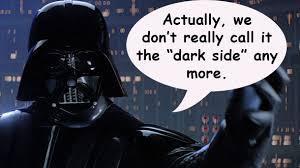
Friedman wrote before the 2016 election — where America turned its back on all he’s saying. Can we repent, and veer toward a better road, before it’s too late?
*Microsoft has just bought GitHub.
Advertisements






