 Alan Parker built his career on overwrought dramas that boil "important" issues into high-gloss exploitation. Today, Midnight Express (1978) is less shocking expose than xenophobic horror show. Mississippi Burning (1988) is even worse. Lauded in its day as a bold racial drama, it's less enlightened than In the Heat of the Night, which at least gave a black man a speaking part.
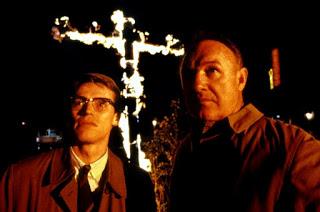
Three civil rights workers (two white, one black) go missing in Jessup County, Mississippi in 1964. FBI Agents Ward (Willem Dafoe) and Anderson (Gene Hackman) arrive, finding the townspeople uncooperative towards Yankee interlopers. Their presence initiates violence against blacks, which local authorities refuse to prosecute; grandstanding politicians complain about civil rights and the media turns everything into a circus. Eventually, Mississippi-born Anderson tires of Ward's bookishness and brings in a goon squad to fight the Klan on its own terms.
Let's start with the elephant on the room: Mississippi Burning bears little relation to the story it represents. Three civil rights workers were killed by the Klan, with the connivance of local authorities, in 1964 Mississippi. With J. Edgar Hoover's hostility, the FBI did nothing until pressure from civil rights groups, the victims' families and Northern congressmen forced their hand. The investigation was resolved as much by bribing witnesses as rough police work, helped by a conscience-stricken policeman who tipped off the Justice Department.
Parker and screenwriter Chris Gerolmo have bigger problems than historical accuracy. Their story depicts the South as a viper's nest, everyone a trigger-happy redneck. Parker ensures there's an outrage every five minutes: whether bombing churches, burning chicken coops or beating children, these Klansmen are incredibly industrious villains. When Anderson starts smashing hillbilly testicles and intimidating witnesses, the audience inevitably cheers. Like a high-minded Billy Jack, Mississippi Burning indulges an unholy coupling of liberal righteousness and reactionary bloodlust.
While channeling the audience's most primitive impulses, Parker can't bring himself to depict a black character. Instead there are crowds of faceless Negroes, enduring endless punishment with little more than baleful glares. Blacks march in the street, mourn their dead and sing endless spirituals, becoming lifeless symbols. Only Badja Djola's FBI enforcer, threatening R. Lee Ermey's Mayor with castration, evinces any personality. Better to plumb buddy cop clichés and a love triangle with Anderson and a deputy's conscience-stricken wife(Frances McDormand).
Parker's direction is fine, with competently staged action and some effective montages. His best device shows media interviewing local denizens, selling the message better than the million beatings. Gene Hackman makes Anderson a good ol' boy Popeye Doyle, preferring violence over persuasion; Willem Dafoe sports a Kennedy haircut and horn-rimmed glasses as the by-the-book Ward. Frances McDormand does well in a thankless part; R. Lee Ermey, Brad Dourif and Michael Rooker play assorted cartoon hicks.
Among its myriad sins, Mississippi Burning initiated a decade of tone-deaf racial dramas salving guilty Baby Boomer consciences. These from earnestly square (Ghosts of Mississippi) to offensively idiotic (A Time to Kill), all comforting bedtime stories of white liberals saving passive, grateful blacks from irredeemable rednecks. Watching them makes one appreciate Spike Lee, whose outrage and excess seems an appropriate response to condescending, saccharine pap passing as meaningful.