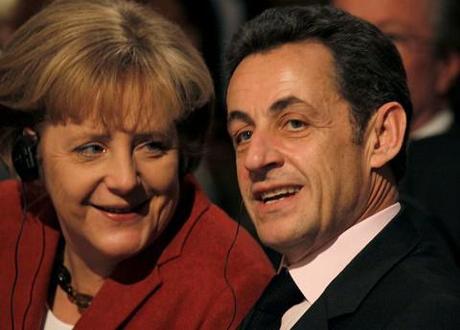
French President Nicolas Sarkozy and German Chancellor Angela Merkel. Photo credit: Sebastian Zwez
As the eurozone debt crisis deepens, French President Nicolas Sarkozy and German Chancellor Angela Merkel met once again to thrash out proposals for saving the monetary union. The most headline-grabbing result? A joint call for a change to the EU treaty to allow greater centralised fiscal control of national budgets. The plan would need to be endorsed by all 27 EU members. Unfortunately for UK Prime Minister Cameron, the phrase “treaty change” has unsettled some senior Tories, leading to renewed calls for a referendum on Britain’s EU membership.
But Conservative doubts aside, has ‘Merkozy’ finally come up with a way to shore up the ailing eurozone and unite its squabbling members?
Cameron: Yes, so long as it doesn’t affect Britain. “My job is to defend and protect the British national interest,” explained British PM Cameron, helpfully, in an article in The Times (£).Cameron said that he agreed with the German line: “There needs to be much tighter fiscal discipline and closer fiscal co-ordination within the eurozone.” However, he wrote, if the proposed treaty change were to be applied to the whole of the EU and not just eurozone members, he would demand protection for British industry, including financial services: “Our colleagues in the EU need to know that we will not agree to a treaty change that fails to protect our interests.”
EU won’t unite. Andrew Alexander argued in The Daily Mail that the plan is doomed to failure because EU governments will never endorse it in time for the benefits to be felt: “Getting them to agree a treaty that would undermine the right of governments to decide their own taxing and spending powers, if it is even possible, will take a very long time and unusually pliant politicians.” According to Alexander, if a vague agreement was reached at the forthcoming EU summit, that might give financial a temporary boost; but actual endorsement could take years rather than months.
Bookmakers William Hill are offering odds of 3/1 that the euro will cease to exist by the end of 2012.
Merkozy must go further. Merkel and Sarkozy are on the right track, said Peter Sparding in The Christian Science Monitor, arguing that the euro is fundamentally “flawed” because it “lacks the backing of a common fiscal policy among the 17 countries that use it”. But Sparding said that the Franco-German proposal would only ease the immediate crisis, and that larger-scale, long-term measures were crucial, such as issuing eurobonds and dealing with trade imbalances.
Merkozy plan would destroy democracy and economies. The Merkozy plan for centralised control of national budgets puts democracy in Europe in “headlong retreat”, argued Harold Meyerson on a Washington Post blog. What’s more, said Meyerson, the decision would damage individual countries’ economies: “If a country is in recession — and some European nations already are — it will not be able to make job-creating investments.” Meyerson wrote that the Merkozy plan would be a victory for global finance over individuals: “Public profligacy is punished; private profligacy goes unchecked.”