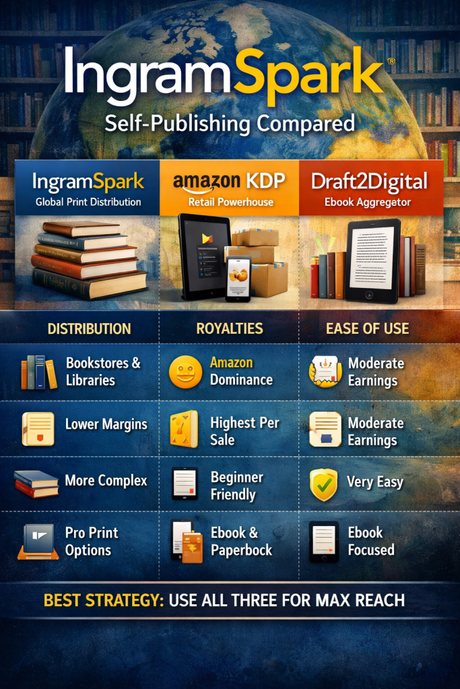
Introduction: The Modern Self-Publishing Ecosystem
Self-publishing has evolved into a sophisticated global industry, giving authors unprecedented control over production, distribution, and revenue. Today, three of the most influential platforms are:
- Ingram Spark – professional-grade print distribution
- Amazon KDP (Kindle Direct Publishing) – dominant retail platform
- Draft2Digital (D2D) – streamlined ebook aggregator
Each serves a different strategic purpose. Rather than competing directly, they often function best as complementary tools in a hybrid publishing strategy.
Part I: What Is Ingram Spark?
1. Overview
Ingram Spark is a self-publishing platform operated by Ingram Content Group, one of the largest book distributors in the world. Its primary strength lies in global print distribution to bookstores, libraries, and academic institutions.
Amazon KDP is a retailer-first platform. In contrast, Ingram Spark operates as a distribution network. It connects your book to thousands of third-party sellers.
2. Key Features of Ingram Spark
Global Distribution Network
- Access to 39,000+ retailers and libraries worldwide
- Integration with bookstore ordering systems
- Strong presence in academic and institutional markets
Print-on-Demand (POD)
- Paperback and hardcover (including dust jackets)
- High-quality printing standards
- Wide range of trim sizes and paper options
Ebook Distribution
- Distribution to Apple Books, Kobo, and other retailers
- Not as user-friendly as ebook-focused platforms
Returnability Option
- Books can be made returnable, increasing bookstore adoption
- However, authors bear the financial risk of returns
3. Costs and Royalties
- Setup fees: Historically ~$49 (often waived in recent years)
- Royalties: Typically 40–65% of list price (minus print cost and retailer discount)
- Wholesale discount required (usually 53–55%)
This structure reflects traditional publishing economics rather than direct retail sales.
4. Strengths of Ingram Spark
Professional Market Access
Ingram Spark is the only major self-publishing platform with true bookstore penetration. It integrates directly with industry catalogs used by retailers.
Print Quality and Flexibility
- Better print options than KDP
- Hardcover with dust jacket (not just case laminate)
Industry Credibility
Books listed through Ingram are more to be taken seriously by:
- Independent bookstores
- Libraries
- Academic institutions
5. Limitations of Ingram Spark
Complexity
- More technical setup
- Requires knowledge of publishing standards
Lower Margins
- Retailer discounts reduce profits
- Multiple intermediaries take a cut
Financial Risk
- Returnable books can result in losses if unsold
Part II: Amazon KDP – The Retail Powerhouse
1. Overview
Amazon KDP is the largest self-publishing platform in the world. It controls a dominant share of ebook sales. This share is often estimated around 80%.
It is both:
- A publishing platform
- A retail marketplace
2. Key Features
- Free to use (no setup fees)
- Direct access to Amazon’s global audience
- Ebook + paperback publishing
- Kindle Unlimited (subscription model)
- Built-in marketing tools (Amazon Ads)
3. Royalties
- Ebooks: up to 70% royalty
- Paperbacks: ~60% minus print costs
Higher royalties are possible because Amazon is both the distributor and retailer.
4. Strengths of KDP
Massive Audience
Amazon is the largest book retailer globally, making it essential for visibility.
Ease of Use
- Beginner-friendly interface
- Fast publishing (24–72 hours)
High Royalties
No wholesale discount model, meaning authors keep more per sale.
5. Limitations of KDP
Limited Distribution
- Primarily Amazon-focused
- Bookstores rarely stock KDP titles
Print Limitations
- Fewer format options
- Lower perceived “trade” quality
Branding Issue
Some bookstores avoid Amazon-published books.
Part III: Draft2Digital – The Ebook Aggregator
1. Overview
Draft2Digital (D2D) is a distribution platform focused primarily on ebooks, allowing authors to publish widely without managing multiple retailer accounts.
2. Key Features
- Free to use
- Distributes to:
- Apple Books
- Kobo
- Barnes & Noble
- Libraries
- Automated formatting tools
- Unified royalty payments
3. Royalties
- Authors typically get ~85% of net royalties (after retailer cut)
- Platform takes ~10% commission
4. Strengths of Draft2Digital
Simplicity
- Extremely user-friendly
- Minimal technical knowledge required
Wide Ebook Reach
- Ideal for “publishing wide” beyond Amazon
Marketing Tools
- Universal book links simplify promotion
5. Limitations
Limited Print Capabilities
- Primarily ebook-focused
- Print options are newer and less robust
Lower Control
- Less granular control compared to direct publishing on each platform
Part IV: Direct Comparison
1. Distribution
KDPAmazon marketplace dominance
Ingram SparkBookstores, libraries, global wholesale
Draft2DigitalWide ebook distribution
- KDP = retail dominance
- Ingram Spark = industry distribution
- D2D = multi-platform ebooks
2. Royalties
KDPHighest per sale
Ingram SparkLower due to wholesale discounts
Draft2DigitalModerate (aggregated model)
3. Ease of Use
KDPEasy
Draft2DigitalVery easy
Ingram SparkModerate to advanced
4. Print vs Ebook Focus
KDPEbook + Amazon paperback
IngramSparkProfessional print + bookstores
D2DEbook distribution
Part V: Strategic Analysis
1. The Hybrid Strategy (Industry Best Practice)
Most successful indie authors do not choose just one platform.
Instead, they combine:
- KDP → Amazon sales
- Ingram Spark → bookstores & libraries
- Draft2Digital → wide ebook distribution
This approach maximizes reach across all channels.
2. When to Use Each Platform
Use Ingram Spark if:
- You want bookstore presence
- You are building a professional publishing brand
- Print quality matters
Use KDP if:
- You want fast sales and visibility
- You focus on Amazon readers
- You are a beginner
Use Draft2Digital if:
- You want wide ebook distribution
- You prefer simplicity
- You avoid Amazon exclusivity
3. Common Mistakes Authors Make
- Relying solely on KDP (missing global distribution)
- Using Ingram Spark without understanding returns risk
- Ignoring wide ebook distribution (D2D)
Conclusion: Which Platform Is Best?
There is no universal “best” platform—only the best strategy.
- Amazon KDP dominates sales volume and visibility
- Ingram Spark dominates professional distribution and credibility
- Draft2Digital excels in ease and ebook reach
The most effective approach is not choosing between them—but integrating them intelligently.
In modern self-publishing, success comes from understanding that:
You are not just publishing a book—you are building a distribution system.