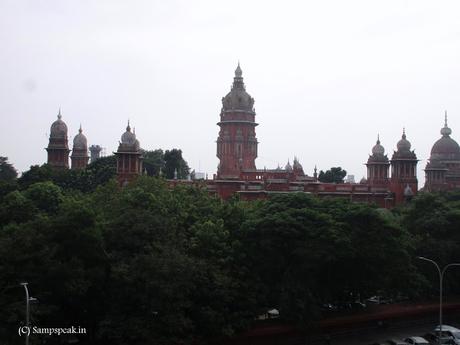
Recently, in 2017, for the first time in the 135-year history of the Madras high court, the prestigious first bench has become an all-woman bench. Headed by Chief Justice Indira Banerjee, it has Justice Bhavani Subbaroyan, who was sworn in on Wednesday , as junior judge. Justice Indira Banerjee herself is the only second woman chief justice of the high court -the first one being Justice Kanta Kumari Bhatnagar, who held the post for more than five months from June 1992. Sir Thiruvarur Muthuswamy Iyer KCIE (1832 –1895), a native lawyer became the first native Indian to be appointed as judge of the Madras High Court in 1877. He acted as Chief Justice for 3 months in 1893. Iyer was acclaimed for his sharp intellect, memory and legal expertise. The eye-capturing building of the High Court is an exquisite example of Indo-Saracenic style of architecture, built in 1892 with the design prepared by J.W. Brassington and later under the guidance of the famed architect Henry Irwin, who completed it with the assistance of J.H. Stephens. Though Madras has not seen many wars and not certainly the World Wars – the High Court building was damaged in the shelling of Madras by S.M.S. Emden on 22 September 1914, at the beginning of the First World War. It remains one of the very few Indian buildings to have been damaged by a German attack. The painted ceilings and the stained glass doors are masterpieces in themselves. The minars are quite attractive – they once housed the lighthouse of the city, which is decrepit now. According to some reports, the lighthouse used kerosene to produce light with an intensity equivalent to that emitted by about 18,000 candles ~ and perhaps that was one of the reasons for attracting the attention of the German warship SMS Emden. The Department of Posts has allotted a Postal Index Number (PIN) code of 600 104 to the zone occupied by the Madras High Court. The boundaries of the High Court complex are marked by namely, Prakasam Road (formerly Broadway), NSC Bose Road and Rajaji Road (the old North Beach Road) Of the many statues, the decade old statue is apt symbolism – it is the majestic one of Chozha, King Manuneethi Chozhan known to have ruled in the third century BC. This Tamil king is considered the embodiment of justice himself. Legend has it that he crushed his son under the wheels of the royal chariot just as his heir apparent had run over a calf ! Arising out of that deed of executing his own son, when the cow moved the kingdom bell, he became ‘Manuneethi Chozha’. Every year in Nov this strange ritual happens – last year it was on 28.11.2016 and this year it was on 19.11.2017 :: Madras high court was locked for 24 hours from 8pm on Saturday to 8pm on Sunday. Heavy locks and chains made sure that no one — judges, advocates or litigants — were allowed to enter the premises ! - what Court premises locked out ?
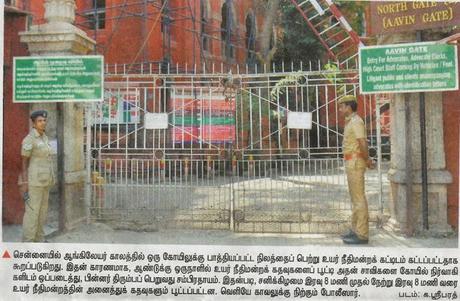 Photo credit : The Hindu Tamil.
No, justice was not
locked out. The court was closed in keeping with a pre-British era tradition,
one that requires the high court premises to be locked for 24 hours each year.
Senior lawyers said the land for the construction of the court was acquired
from a private person — whose name is lost with hoary antiquity — in the 1800s.
Though the land was initially taken on lease, the ownership deed was later
transferred to Lord Permual Temple on Parry's Corner. To ensure that no individual
or entity claims ownership of the edifice, the court's administrators lock the
court premises, hand over its keys to the chief priest of the temple and renew
the lease agreement on one day each year.
The State
Government continues to protect the building and site from bogus ownership
claims while maintaining its status as a public property/pathway. In sync with
the old tradition, the court's registry locks up the premises every last Sunday
of November after putting up notices on its six gates that it would reopen on
Monday. The current high court building moved to its brand new quarters from an
edifice near Beach Station on July 12, 1892. Sir Arthur Collins, chief justice
at the time, formally received permission to start proceedings in the new
building from Madras Presidency governor Beilby Lawley, 3rd Baron Wenlock.
~ .. .. .. strange it may sound that the Court was locked and
remained out of reach – closed, yet, neither delay nor denial of justice to those
who seek it in its corridors.
Sir Thomas Andrew
Lumisden Strange (1756 – 1841) Chief Justice in Nova Scotia, known for waging
"judicial war" to free Black Nova Scotian slaves from their owners, became the first Chief Justice of the
erstwhile Supreme Court of Madras (which has since become the High Court of
Madras) and in that capacity was also the first Chief Justice of the Madras
Presidency, British India from 1801 to 1817.
With regards – S.
Sampathkumar
Photo credit : The Hindu Tamil.
No, justice was not
locked out. The court was closed in keeping with a pre-British era tradition,
one that requires the high court premises to be locked for 24 hours each year.
Senior lawyers said the land for the construction of the court was acquired
from a private person — whose name is lost with hoary antiquity — in the 1800s.
Though the land was initially taken on lease, the ownership deed was later
transferred to Lord Permual Temple on Parry's Corner. To ensure that no individual
or entity claims ownership of the edifice, the court's administrators lock the
court premises, hand over its keys to the chief priest of the temple and renew
the lease agreement on one day each year.
The State
Government continues to protect the building and site from bogus ownership
claims while maintaining its status as a public property/pathway. In sync with
the old tradition, the court's registry locks up the premises every last Sunday
of November after putting up notices on its six gates that it would reopen on
Monday. The current high court building moved to its brand new quarters from an
edifice near Beach Station on July 12, 1892. Sir Arthur Collins, chief justice
at the time, formally received permission to start proceedings in the new
building from Madras Presidency governor Beilby Lawley, 3rd Baron Wenlock.
~ .. .. .. strange it may sound that the Court was locked and
remained out of reach – closed, yet, neither delay nor denial of justice to those
who seek it in its corridors.
Sir Thomas Andrew
Lumisden Strange (1756 – 1841) Chief Justice in Nova Scotia, known for waging
"judicial war" to free Black Nova Scotian slaves from their owners, became the first Chief Justice of the
erstwhile Supreme Court of Madras (which has since become the High Court of
Madras) and in that capacity was also the first Chief Justice of the Madras
Presidency, British India from 1801 to 1817.
With regards – S.
Sampathkumar
20th Nov. 2017.