


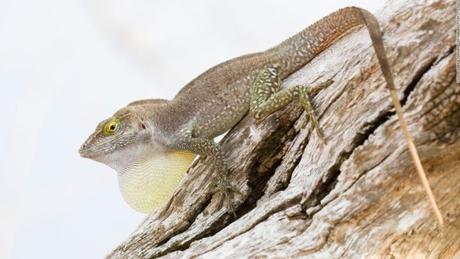
He examined lizard species on several Caribbean islands and found that the lizard's toe pads are larger and stronger on the islands where more hurricanes hit. In areas with fewer hurricanes, lizards don't have as big toe pads - because they don't need them, he said.
"It could have a much wider effect on many species," said Donihue. This could mean that trees, birds, mammals and insects might be capable of the same feat of tropical resilience.
The process started in 2017, while Donihue was studying lizard populations in the Turks and Caicos Islands, particularly on the Pine Cay and Water Cay Islands. A few weeks after his departure and that of his fellow researchers, these islands were pounded by hurricanes with winds reaching up to 170 mph - first Hurricane Irma then Hurricane Maria.
Back on the island a year later, he noticed that "the populations were different". The lizards he had seen after the hurricanes had larger toe pads than those he had examined the year before the hurricane.
He has now examined 12 island populations of the lizard species Anolis sagrei, or brown anole, and has separately analyzed 188 species of Anolis with populations ranging from Florida to Brazil. He and his team cross-examined the size of their toe pads with the frequency and severity of Caribbean hurricanes.
In the past 70 years of hurricane data, the trend has emerged: larger toe pads have been correlated with more severe hurricanes.
The study innovated in the sciences of evolution
The study offered new insights into how evolutionary processes are helping species adapt and become more resilient, even though global climate change threatens their long-term survival.


"It has long been known that anoles elsewhere have smaller toe pads than in the Caribbean," said co-author Jonathan Losos, professor at the University of Washington in St. Louis.biology department whose laboratory supervised the project.
He preferred the idea that the Caribbean lizards fight each other more and that the lucky winners of these battles were those with the biggest pads. In the past, hurricanes were simply not common enough to matter in an evolutionary timeline. Hurricanes here and there could cause occasional devastation, but Losos and others on the ground did not believe that adverse weather events amounted to lasting hammering which could prompt natural selection to intervene.
Losos was skeptical of Donihue's hypothesis and tried to dissuade him from returning to the Turks and Caicos Islands and embarking on what he considered a dupe race.
But Donihue still came down - and proved that his mentor was wrong in the process.

Hurricanes can sweep lizards that can't hold
Revisiting the Turks and Caicos Islands in 2018, Donihue saw that the new lizards, descendants of the hurricane survivors, had the same size toe pads.
"They looked exactly like their parents," he said.
This small change in anatomy gives us an important clue to how species change, as well as the environment around them.
"Some populations can be completely wiped out by hurricanes," said Donihue. But in the case of the lizards he studied, those who survived these severe storms were those with larger toe pads.
These larger toe pads are "advantageous for holding firmly," he noted, and that extra little edge can save lizards' lives.
"If it is thrown into the air, it is quite possible that it is thrown into the sea," says Donihue. Shaken by winds and rain caused by hurricanes, lizards with lower toes face a violent death, whether by drowning in the ocean, being thrown against rocks or being carried away in a tree.
Other species could also adapt to climate change in this way
This study could have implications for all Caribbean species. "We know that due to climate change, there will be more hurricanes," said Donihue.
In this case, it could give us clues to the species that have the capacity to survive in the longer term.
We don't know for sure yet, but Donihue and his colleagues have suggested that Caribbean birds may be able to adapt longer greenhouses to hang on tree branches and not be thrown into the howling winds.

Donihue felt that trees could be an important candidate for studying the same way. Tree populations that will withstand future hurricanes may have other adaptations that set them apart in the increasingly hectic 21st century.
Aside from reducing emissions and slowing global climate change, there is little that humans can do in the short term to reduce the frequency of severe hurricanes in the Caribbean, and thus preserve these species.
But a silver lining is that the species can adapt, and we can even see their adjustments on an annual basis.
"One of the discoveries that impresses me most is the resistance of these species," said Donihue.






