


Grace Thoughts
Living Christian In ‘This Present World’ (Part 12)
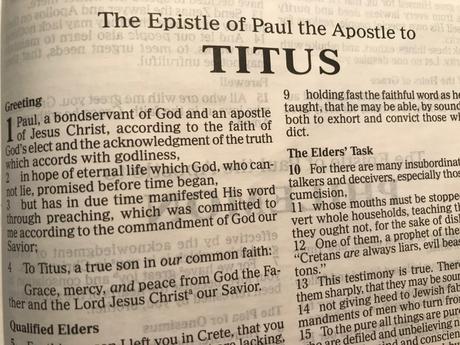
As we mentioned in the last part of our study, Crete was not an easy place for Christians to live. That’s true for most places on earth today, including the United States. Paul wrote to Titus in an “early-Christian” environment. The Gospel message Paul preached to the Gentiles living on Crete was very new – less than 35 years from Christ’s death and resurrection. Most Gentiles at that time were pagans and worshipped idols. They viewed the Christian life and message as ignorant, irrelevant and even oppositional to their pagan lifestyle.
We are living in what some people call a “post-Christian” environment. The Gospel has been preached for almost two-thousand years, but Christianity is no longer admired and desired by masses of people. They view the Christian life and message as ignorant, irrelevant and oppositional to their ‘modern’ lifestyle.
Practicing Christianity
Though Christianity is still listed as one of the world’s major religions, the number of people who practice what’s known as evangelical Christianity (people who believe in having a personal relationship with Jesus Christ and preaching of the Gospel of Christ to unbelievers) is small and eroding quickly. Unfortunately, a large number of evangelical Christians no longer accept central teachings of the Bible as true (e.g. Jesus Christ is Eternal God rather than a created being, rose from the dead, etc.). As one Christian leader stated – “Evangelicals are sadly drifting away from God’s absolute standard in Scripture” (Stephen Nichols, President of Reformation Bible College, Professor of Apologetics).
The number of people who practice Christianity today is an extremely small minority among those who claim to be Christians. While some surveys put the percentage at 20-25%, that is down from 45% in 2000 (Barna, 2020). However, based on the criteria used to determine a “practicing” Christian, the true number may be even lower.
It is possible to “practice” something incorrectly. The old saying “practice makes perfect” is not correct if what a person practices is wrong. In the martial arts world we say “perfect practice makes perfect.” That means the teacher and student are focused on doing right things right. Who determines what’s right? The founder of a martial system and those he or she trained to pass along the art. We need that desperately in Christianity. We need teachers and students focused on doing right things right. We need teachers who teach God’s Word according to the Founder ad those He trained to pass along the Truth of the Word. We call that rightly dividing the Word of Truth.
That’s practicing “biblical” Christianity. That means going back to the Word of God and inviting the Spirit of God who inspired the writing of the Bible to teach true Christianity. What do you do if the Spirit of God reveals that what your pastor has been teaching is wrong? What do you do if the Spirit of God reveals that what your denomination has been teaching is wrong? I hope that you would listen to the Spirit of God. Why do I say that? Because Jesus Christ, the Lord of the Church, said it:
I still have many things to say to you, but you cannot bear them now. However, when He, the Spirit of truth, has come,He will guide you into all truth; for He will not speak on His own authority, but whatever He hears He will speak; and He will tell you things to come. He will glorify Me, for He will take of what is Mine and declare it to you. All things that the Father has are Mine. Therefore I said that He will take of Mine and declare it to you. John 16:12-15
He who has an ear, let him hear what the Spirit says to the churches. Revelation 2 & 3
And because those who Jesus trained to pass along the truth said the same thing:
All Scripture is given by inspiration of God, and is profitable for doctrine, for reproof, for correction, for instruction in righteousness, that the man of God may be complete, thoroughly equipped for every good work. 2 Timothy 3:16-17
And so we have the prophetic word confirmed, which you do well to heed as a light that shines in a dark place, until the day dawns and the morning star rises in your hearts; knowing this first, that no prophecy of Scripture is of any private interpretation, for prophecy never came by the will of man, but holy men of God spoke as they were moved by the Holy Spirit. 2 Peter 1:19-21
Biblical Christianity
When we look at the criteria of companies that survey Christians about their beliefs, we often find that their view of a “practicing” Christian is based on a less than biblical view of Christianity. Here’s an example of how the head of one leading survey company views a practicing Christian:
A lot of religion research—even Barna’s—tracks single factors, such as church attendance. But the ‘practicing Christian’ measure is unique in that it combines three variables: calling oneself a Christian, strongly prioritizing faith and regular church attendance. David Kinnaman, President of Barna
Think about that for a moment. Practicing Christians –
- Identify as a Christian
- Strongly agree that faith is very important in their lives
- Have attended church within the past month
While those are certainly good points to mention when discussing what it means to be a practicing Christian, I hope you’ll agree with me that the criteria for being a devoted disciple of Jesus Christ is much deeper and broader than just those three. That’s what we are seeing in Paul’s letter to Titus – a deeply holy expectation of what it means to be a “biblical” Christian.
[Let me insert something here for just a minute so I’m not misunderstood. As a Christian journalist I appreciate what survey companies do. They do research and interpret and explain their research. Journalists also do their own research and report on that research in addition to research from survey companies. While I’m grateful for the work these companies do, my job as a journalist is to report more than just the data discovered in a research project. Journalists should dig deep into the data and ask tough questions about the methodology and criteria used in the process of presenting and interpreting the data.
Unfortunately, a deep dive perspective is often missing in how company researchers report their findings in public statements, news releases, on their websites, etc. That’s why I want to go to the heart of a research project (the full, unreacted script) and find the purpose that drove the process. That information is sometimes available to journalists, but is often not reported or made available to the public. Why? Maybe journalists aren’t given time to do thorough research .. maybe they don’t know how .. maybe they just aren’t interested in getting to the bottom of why a story is a story. That’s unfortunate because knowing all aspects of any story (e.g. who, what, when, where, how, why) is necessary to knowing the truth. Understanding what’s happening to the Lord’s Church seems like a very important story to get right.
Just like science is driven by scientists, research is driven by researchers. If you want to know if the findings of scientific research leads to information you can trust, look at how scientists do their job. If you want to know if a research project will lead to information you can trust, look at how researchers do their job. I often say that the process is “follow the people, follow the money.” Journalists should be curious and skeptical, accurate and objective. The more I know about the people involved in doing the research and the money behind the research (who’s paying for it?), the better I’ll understand the findings of a research project and whether I can trust research conclusions.
While I think some survey researchers do a good job, those of us who use the findings need to make sure we’ve done our due diligence to understand the people and money behind the research and the true meaning of the findings. It is because of the stated criteria for what determines a “practicing Christian” that I think the percentage of “biblical Christians” in churches is much lower – maybe as low as 10-15% (if not lower). Most survey companies use similar identifiers and criteria, but look closely at how they define various groups before comparing findings in one piece of research to another (apples to apples – or apples to oranges?). I hope that helps clarify both my concern and caution in using survey results and the reason I may report on surveys differently than some other journalists who use survey results to explain what’s going on in churches and denominations.]
Back To Crete
Okay, let’s get back to Crete and Paul’s letter to Titus.
The number of people who practiced biblical Christianity on the island of Crete was small, but for a different reason than today. The Gospel message was new to the people living on Crete. Paul and Titus had visited Crete for the first time just a year or two earlier. Paul left Titus on Crete to “set in order the things that are lacking” (Titus 1:5), which is the primary purpose of Paul’s letter. Paul wanted Titus to ordain qualified elders in each church, guard against false teaching in the churches, teach Christians to live godly in an ungodly society, and become effective in reaching people on the island with the Gospel of Christ.
That brings us now to the next part of Paul’s letter to Titus where the apostle emphasized the essentials for evangelizing cities and nations. Let’s all take note of what Paul wrote because we desperately need to hear these words in our own time.
The Past
For we ourselves were also once foolish, disobedient, deceived, serving various lusts and pleasures, living in malice and envy, hateful and hating one another. Titus 3:3
Paul started with the past. Every Christian has a past. Even people who were raised in Christian families and can’t remember a time when they didn’t believe in Jesus have a past. That’s because every person is born into sin. I know – it’s hard to look at the sweet face of a newborn child and think of them as sinners, but God says everyone is born with a sin nature.
Behold, I was brought forth in iniquity, And in sin my mother conceived me. Psalm 51:5
The wicked are estranged from the womb; They go astray as soon as they are born, speaking lies. Psalm 58:3
… for all have sinned and fall short of the glory of God. Romans 3:23
There is none righteous, no, not one; There is none who understands; There is none who seeks after God. They have all turned aside; They have together become unprofitable; There is none who does good, no, not one. Romans 3:10-12
Therefore, just as through one man sin entered the world, and death through sin, and thus death spread to all men, because all sinned. Romans 5:12
For we know that the law is spiritual, but I am carnal, sold under sin. Romans 7:14
So then, those who are in the flesh cannot please God. Romans 8:8
And you He made alive, who were dead in trespasses and sins, in which you once walked according to the course of this world, according to the prince of the power of the air, the spirit who now works in the sons of disobedience, among whom also we all once conducted ourselves in the lusts of our flesh, fulfilling the desires of the flesh and of the mind, and were by nature children of wrath, just as the others. Ephesians 2:1-3
The solution to this “sin” problem?
Most assuredly, I say to you, unless one is born again, he cannot see the kingdom of God. John 3:3
For by grace you have been saved through faith, and that not of yourselves; it is the gift of God, not of works, lest anyone should boast. Ephesians 2:8-9
For when we were still without strength, in due time Christ died for the ungodly. For scarcely for a righteous man will one die; yet perhaps for a good man someone would even dare to die. But God demonstrates His own love toward us, in that while we were still sinners, Christ died for us. Much more then, having now been justified by His blood, we shall be saved from wrath through Him. Romans 5:6-9
There is therefore now no condemnation to those who are in Christ Jesus, who do not walk according to the flesh, but according to the Spirit. For the law of the Spirit of life in Christ Jesus has made me free from the law of sin and death. Romans 8:1-2
Paul included himself in his statement to Titus – “For we ourselves were also once…” Every Christian leader needs to remember from where they came. As we preach the Gospel of God’s Love and Redemption, hearers of the Gospel need to know that the preachers and teachers are humble and aware of who they are in Christ – sinners at birth, saved by grace through faith.
- Every Christian was once foolish (anoétos – thoughtless, lacking understanding, mindless, dense).
- Every Christian was once disobedient (apeithés – unwilling to be persuaded, unbelieving, rejecting of God’s truth).
- Every Christian was once deceived (planaó – led astray, caused to wander, deviate from the correct course, go astray).
- Every Christian once served various lusts (epithymiais – evil passions) and pleasures (hēdonais – sensual pleasures, physical lusts).
- Every Christian once lived in wickedness (kakia – wickedness, vicious disposition, inherent evil) and envy (phthonos – corruption, grudge, jealous envy).
- Every Christian was once hateful (stugétos – abominable, disgusting, detestable) toward others.
- Every Christian once hated each other (miseó allélón – detested others, loved others less, elevated some people over others).
Paul said that’s the way people were. However, that’s in the past for someone who is a true Christian. Yes, we were born into sin and, yes, we were by nature “children of wrath.” However, God put that part of our life behind us when He demonstrated His great love for us:
But God, who is rich in mercy, because of His great love with which He loved us, even when we were dead in trespasses, made us alive together with Christ (by grace you have been saved). Ephesians 2:4-5
[Podcast version of this study.]
Next Time
We’ll look at Paul’s perspective of the present and future for Christians in the next part of our special series, Living Christian in the Present World.
Scripture taken from the New King James Version®. Copyright © 1982 by Thomas Nelson. Used by permission. All rights reserved.
GraceLife © 1990-2025
 Apostle PaulChristianityJesus ChristLiving ChristianTitus

Published by gracelifethoughts
Founder & Director of GraceLife Ministries View all posts by gracelifethoughts






