The biggest threat to life on Earth is the massive damage to the biosphere by humans. This damage comes from our heavy resource use, waste production, and severe global warming.
Human actions are pushing natural systems past their limits (Rogers 2025). This causes mass extinctions and loss of vital life support systems. The endless drive for economic growth is unsustainable. “A great change in our stewardship of the Earth is required. . .” (Ripple et al. 2017, Rogers 2026b). James Lovelock warned that overheating the planet is the single greatest danger to our world. He stated, “I cannot say too strongly that the greatest threat to life on Earth is overheating” (Lovelock 2019, 57).
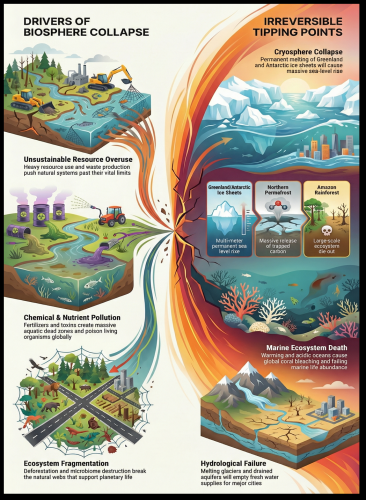
Most scientists doubt we can limit the global average temperature rise to 2o C. But even if we do, our damage to the biosphere will still be catastrophic. Even if we stop greenhouse emissions, it will take centuries for climate to stabilize at the new warmer level (Rogers 2026a). Moreover, if the human population remains in the billions, the damage we cause will keep growing. Here are some of the human wrought environmental changes that have already occurred or will begin to occur over the next 10-20 years.
- The ongoing loss of plant and animal species is breaking the living webs that support productivity and stability of the natural world (Richardson et al. 2023).
- Clearing forests and livestock grazing are destroying wild habitats, contributing to extinction, and ruining the healthy soils needed to support natural ecosystems and agriculture (Steffen et al. 2015).
- Human impacts on ecosystem networks break the Earth’s cognitive web that facilitates high biosphere diversity and productivity. This limits resources available to the technosphere and human cultural and social systems (Frank, Grinspoon, and Walker 2022, Milanese 2025). By destroying the microbiome with chemical fertilizers, deforestation, overgrazing, and more, we break the natural connections that create the environment that supports life (Gajbhiye 2025, Handte-Reinecker and Sardeshpande 2025).
- Flooding the environment with nitrogen and phosphorus fertilizers creates huge dead zones in our ponds, lakes, and oceans that kill aquatic life (Carpenter and Bennett 2011).
- Draining our rivers and underground aquifers to irrigate crops and run our cities removes the fresh water required by natural ecosystems and will empty the people from many large cities (Gleeson et al. 2020).
- Rising seas will increase salinity of lowlands, destroy coastal ecosystems, and displace hundreds of millions of people worldwide (Hansen et al. 2013).
- The increase of extreme weather events severely disrupts natural ecosystems, reduces the yields of crucial agricultural crops (Malhi et al. 2020), and damages critical energy and transport infrastructure (Forzieri et al., 2018).
- Warming seas combine with acidification from fertilizer runoff and CO2 absorption from the air to cause tropical coral reefs to die (Doney et al. 2009). Abundance of marine life is falling (Zahid et al. 2025) in a catastrophic loss of food for coastal communities.
- Industry, transportation, deforestation, farming, and desertification release soot and dust particles into the air, blocking sunlight and disrupting the rain patterns needed by natural ecosystems and human farms (Ramanathan et al. 2001).
- Toxic chemicals and plastics released into the environment poison the bodies of living things and damages the health of the entire global ecosystem (Persson et al. 2022).
- Air pollution causes breaks in the ozone layer and increases harmful solar radiation that causes cancer in humans and damages plant genetics (Solomon 2019).
- Irreversible tipping points have been or will be passed (Lenton et al. 2008). Here is a list of some of them:
- The Greenland Ice Sheet will slowly and permanently melt raising global sea levels by many meters (Boers and Rypdal 2021).
- The Amazon rainforest will die out.
- The West Antarctic Ice Sheet will fall apart and slide into the ocean causing massive coastal flooding for centuries (DeConto and Pollard 2016).
- Warm, acidic ocean waters will bleach and kill tropical coral reefs around the world, resulting in a devastating loss of diversity and productivity of marine sea life (Dixon et al. 2022).
- Rapid melting of northern permafrost will release huge amounts of trapped carbon creating even more global heating (Turetsky et al. 2020).
- The Barents Sea will rapidly lose its winter sea ice disrupting northern ecosystems and weather patterns (Onarheim et al. 2018).
- Mountain glaciers will melt away shrinking essential drinking water supplies for lowland ecosystems and human communities (Hugonnet et al. 2021).
- The ocean currents in the Labrador Sea will break down and cause major weather shifts across the North Atlantic region (Armstrong McKay et al. 2022).
References
Armstrong McKay, David I., Arie Staal, Jesse F. Abrams, Ricarda Winkelmann, Boris Sakschewski, Sina Loriani, Ingo Fetzer, Sarah E. Cornell, Johan Rockström, and Timothy M. Lenton. 2022. Exceeding 1.5 C global warming could trigger multiple climate tipping points. Science 377 (6611): eabn7950. https://doi.org/10.1126/science.abn7950
Boers, Niklas, and Martin Rypdal. 2021. Critical slowing down suggests that the western Greenland Ice Sheet is close to a tipping point. Proceedings of the National Academy of Sciences 118 (21): e2024192118. https://doi.org/10.1073/pnas.2024192118
Carpenter, Stephen R., and Elena M. Bennett. 2011. Reconsideration of the planetary boundary for phosphorus. Environmental Research Letters 6 (1): 014009. https://doi.org/10.1088/1748-9326/6/1/014009
DeConto, Robert M., and David Pollard. 2016. Contribution of Antarctica to past and future sea-level rise. Nature 531 (7596): 591-597. https://doi.org/10.1038/nature17145
Dixon, Adele M., Piers M. Forster, Scott F. Heron, Anne M. K. Stoner, and Maria Beger. 2022. Future loss of local-scale thermal refugia in coral reef ecosystems. PLOS Climate 1 (2): e0000004. https://doi.org/10.1371/journal.pclm.0000004
Doney, Scott C., Victoria J. Fabry, Richard A. Feely, and Joan A. Kleypas. 2009. Ocean acidification: The other CO2 problem. Annual Review of Marine Science 1: 169-192. https://doi.org/10.1146/annurev.marine.010908.163834
Forzieri, G., Bianchi, A., Silva, F. B. e., et al. (2018). Escalating impacts of climate extremes on critical infrastructures in Europe. Global Environmental Change, 48, 97-107. https://doi.org/10.1016/j.gloenvcha.2017.11.007
Frank, Adam, David Grinspoon, and Sara Walker. 2022. Intelligence as a planetary scale process. International Journal of Astrobiology 21 (2): 47-61. https://doi.org/10.1017/S147355042100029X
Gajbhiye, Sanjana. 2025. Microbial vault: The race to save Earth’s disappearing microbes. Earth.com. https://www.earth.com/news/microbial-vault-the-race-to-save-earths-disappearing-microbes/
Gleeson, Tom, Lan Wang-Erlandsson, Samuel C. Zipper, Miina Porkka, Fernando Jaramillo, Dieter Gerten, Ingo Fetzer, et al. 2020. The water planetary boundary: Interrogation and revision. One Earth 2 (3): 223-234. https://doi.org/10.1016/j.oneear.2020.02.009
Handte-Reinecker, Anna, and Mallika Sardeshpande. 2025. Microbiomes as Modulators of Human and Planetary Health: A Relational and Cross-Scale Perspective. Global Change Biology 31 (4): e70152. https://doi.org/10.1111/gcb.70152
Hansen, J., Kharecha, P., Sato, M., et al. (2013). Assessing Dangerous Climate Change: Required Reduction of Carbon Emissions to Protect Young People, Future Generations and Nature. PLoS ONE, 8, e81648. https://doi.org/10.1371/journal.pone.0081648
Hugonnet, Romain, Romain McNabb, Etienne Berthier, Brian H. Menounos, Christopher Nuth, Andreas Kaab, and Daniel Farinotti. 2021. Accelerated global glacier mass loss in the early twenty-first century. Nature 592 (7856): 726-731. https://doi.org/10.1038/s41586-021-03436-z
Lenton, T. M., Held, H., Kriegler, E., et al. (2008). Tipping elements in the Earth’s climate system. Proceedings of the National Academy of Sciences, 105, 1786-1793. https://doi.org/10.1073/pnas.0705414105
Lovelock, James. 2019. Novacene: The Coming Age of Hyperintelligence. London: Allen Lane.
Malhi, Y., Franklin, J., Seddon, N., et al. (2020). Climate change and ecosystems: threats, opportunities and solutions. Philosophical Transactions of the Royal Society B: Biological Sciences, 375, 20190104. https://doi.org/10.1098/rstb.2019.0104
Milanese, Steven. 2025. Planetary Intelligence: Earth as Information Processor. Rev. Steven Milanese Blog. https://stevenmilanese.com/blog/planetary-intelligence-earth-as-information-processor
Onarheim, Ingrid H., Tor Eldevik, Lars H. Smedsrud, and Julienne C. Stroeve. 2018. Seasonal and regional manifestation of Arctic sea ice loss. Journal of Climate 31 (12): 4917-4932. https://doi.org/10.1175/JCLI-D-17-0427.1
Rogers, Garry. 2025. Silent Earth. Agua Fria Open Space Alliance, Coldwater Press, Humboldt, AZ. 551 p.
Rogers, Garry. 2026a. Biosphere Collapse. Agua Fria Open Space Alliance, Coldwater Press, Humboldt, AZ. 259 p.
Rogers, Garry. 2026b. Manifesto of the Initiation. Agua Fria Open Space Alliance, Coldwater Press, Humboldt, AZ. 28 p.
Persson, Linn, Bethanie M. Carney Almroth, Christopher D. Collins, Sarah Cornell, Cynthia A. de Wit, Miriam L. Diamond, Peter Fantke, et al. 2022. Outside the safe operating space of the planetary boundary for novel entities. Environmental Science & Technology 56 (3): 1510-1521. https://doi.org/10.1021/acs.est.1c04158
Ramanathan, Veerabhadran, Paul J. Crutzen, Jeffrey T. Kiehl, and Daniel Rosenfeld. 2001. Aerosols, climate, and the hydrological cycle. Science 294 (5549): 2119-2124. https://doi.org/10.1126/science.1064034
Richardson, Katherine, Will Steffen, Wolfgang Lucht, Jørgen Bendtsen, Sarah E. Cornell, Jonathan F. Donges, Ingo Fetzer, et al. 2023. Earth beyond six of nine planetary boundaries. Science Advances 9 (37): eadh2458. https://doi.org/10.1126/sciadv.adh2458
Ripple, William J., Christopher Wolf, Thomas M. Newsome, Mauro Galetti, Mohammed Alamgir, Eileen Crist, Mahmoud I. Mahmoud, and William F. Laurance. 2017: 1026. World Scientists’ Warning to Humanity: A Second Notice. BioScience 67 (12): 1026-1028. https://doi.org/10.1093/biosci/bix125
Solomon, Susan. 2019. The discovery of the Antarctic ozone hole. Nature 575 (7781): 46-47. https://doi.org/10.1038/d41586-019-02837-5
Steffen, Will, Katherine Richardson, Johan Rockström, Sarah E. Cornell, Ingo Fetzer, Elena M. Bennett, Reinette Biggs, et al. 2015. Planetary boundaries: Guiding human development on a changing planet. Science 347 (6223): 1259855. https://doi.org/10.1126/science.1259855
Turetsky, Merritt R., Benjamin W. Abbott, Katey M. Walter Anthony, John C. Schuur, Paul T. Mann, Christopher C. Treat, Susan M. Natali, et al. 2020. Carbon release through abrupt permafrost thaw. Nature Geoscience 13 (2): 138-143. https://doi.org/10.1038/s41561-019-0526-0
Zahid, F., Gajdzik, L., Korsmeyer, K. E., et al. (2025). Asynchronous effects of heat stress on growth rates of massive corals and damselfish in the Red Sea. PLOS ONE, 20, e0316247. https://doi.org/10.1371/journal.pone.0316247