


In the world of technology, online learning has been one of the biggest beneficiaries in recent months, with people staying at home and away from their normal routines due to the coronavirus pandemic and using that time to expand their knowledge, or more critically, they figure knowing what to do next if they want to change careers or have found themselves unemployed.
Now, one of the startups building a business around virtual cyber education - teaching people sitting at home before it became a term - is announcing a large round of funding to capitalize on this demand.
Lambda School, which runs nine- and 18-month (part time) virtual computer courses for $ 30,000, currently covering data science and full-stack web development, with course payments based on a sliding scale that activates only after landing a job that makes at least $ 50,000, did he raise $ 74 million worth of shares in a Series C round.
The investment comes largely from Gigafund, the VC started by former Founders Fund partners in 2017 originally to invest more money in SpaceX, also with the participation of Tandem Fund and Y Combinator (where Lambda School was incubated). His list of other supporters includes GV, GGV, and Stripe. (Tommy Collison, Lambda's business development manager, is the younger brother of the two Collison brothers who co-founded Stripe.)
Lambda School hasn't disclosed its valuation, but CEO Austen Allred (who co-founded the company with Ben Nelson) confirmed it's more than the $ 150 million Lambda had achieved in its $ 30 million B Series. in January 2019. He also said that he hopes this is the latest funding Lambda will raise, not because he is planning an IPO but because he aims to become profitable. Allred confirmed that this is not the case yet.
Allred added that the plan will be to use the funds to help the startup meet increased demand for its courses.
"There is more demand than we can handle right now, even with fundraising," he said. "I don't know if that's good or bad." Currently the students enrolled are about 3,000, all of them attend live lessons (not on request) according to scheduled times for different time zones.
The money will be specifically used to continue expanding the range of what Lambda School offers, both in terms of content but potentially also in terms of developing its business model.
Case in point: Just yesterday, the startup was approved by the California Bureau for Private Postsecondary Education, after a prolonged period of hardship with the Bureau that saw Lambda cease teaching in the state and be fined.
But part of the approval agreement was that Lambda would no longer offer student income-sharing agreements, at least for now. With ISA as the cornerstone of how the company presents its deferred payment model, Allred said Lambda is still working on making ISAs available, but is also looking into "student-friendly substitutes" in the meantime.
To be clear, getting approval from that commission isn't the same as accreditation - Lambda School doesn't offer official degrees but certificates when students complete courses. There is currently no plan to obtain accreditation to offer degrees, Allred said.
"From a regulatory point of view we could receive accreditation and grant diplomas but [boards] require you to submit curriculum changes one year in advance and our students cannot afford this. Things like that aren't possible until accreditation bodies change their requirements, "he said, adding that accredited schools aren't always better than that.
"There are thousands of fully accredited schools that have a 20% graduation rate," he said. "It doesn't make you feel good. We have to prove our worth to students in other ways, usually through results. "
Lambda School's funding may come amid a surge in demand for its courses, but that doesn't mean it wasn't a tough time to start too.
In April, Lambda cut 19 employees and executives suffered a 15% salary cut due to market uncertainty due to the coronavirus pandemic (and possibly even to sharpen its accounts, which happens regularly when startups are in the process of raising funds). The company currently has a team of approximately 150 people, which includes both operational and support staff, as well as course teachers and team leaders (who are essentially teaching assistants). All of them are working remotely at the moment, Allred said.
But even before April, Lambda encountered many negative views on how it applies the deferred payment business model. Critics have described the income-based tax refund process as contract easement is predator. And they claim the business model is impractical because of how Lambda itself takes the risk when students do not make their expected salaries, as the ISA model offers reimbursements on a sliding scale based not only on salary, but also on a 24-month limit to reimburse taxes, which means that some students will refund the full amount of $ 30,000 and some will not:
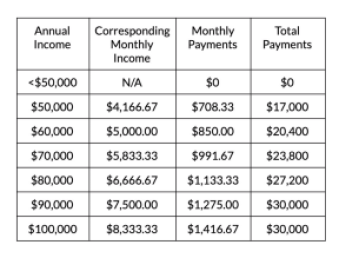
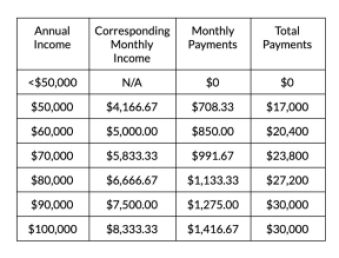
Allred did not disclose the number of payment defaults, but said around 15% of students drop out before the end of the first month, which means they pay nothing.
These may be pain points for some people, but not enough to limit the startup's growth or interest among investors.
"We were attracted to Austen as CEO," Stephen Oskoui, a Gigafund partner who joins the Lambda School board, said in an interview. "Gigafund is very focused on the strength of those we think will build for several decades, and the model for the operation of Lambda School has the potential for a huge impact. "






