


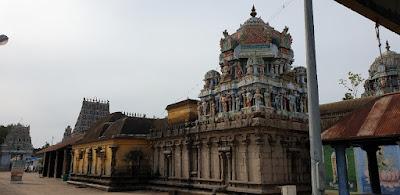
The Kolavamana Perumal Temple at Sikkal prior to Kumbabhishekam
Every year, through Aalayam Kanden Trust, we write and publish the Sthalapuram of a lesser known temple to enable it to gain visitors and patrons. This year, multiple temples in Nagapattinam had their consecration, so when Subash, a volunteer, requested if we could help print the collective sthalapuranam book that he had authored on Nagai Temples, we willingly agreed.
The books were released on Maasi Maham day at the Kayarohaneswarar Temple and the Sikkal Singaravelar shrine. While visiting the Sikkal temple, Subash took us to the Kolavamana Perumal temple within the same complex. Even though I had visited the Sikkal temple a few times before, had never noticed or visited this temple.
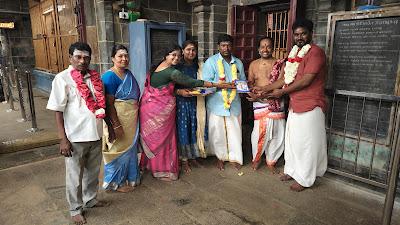
Release of the book Nagai Aalayangal at Sikkal Singaravelar shrine
That's probably because even though the main deity here is Lord Navaneetheswarar, the temple is more popularly known for Lord Muruga, who is called Singaravelar here. "சிக்கலில் வேல் வாங்கி செந்தூரில் சம்ஹாரம்" (Sikkalil Vel Vaangi Chenduril Samharam) they say. This phrase used during Kandha Sashti, describes the granting of Shakti Vel by Goddess Velnedumkanni (Parvathi) to her son Singaravelar to enable him to perform the samharam of Surapadma. Even to this day, the beading of sweat on the idol of Singaravelar for a few hours after he receives the Shakthi Vel (Spear), is a divine ethereal experience that attracts thousands of devotees to witness the event.
Apart from Lord Navaneetheswarar and Singara Velar, the temple features a seperate temple for Lord Kolavamana Perumal. This unique feature of co-existence of Vaishnavaite and Saivaite shrines with Navaneetheswarar, Velnedumkanni, Singaravelar, Kolavamana Perumal and Varada Anjaneyar makes it a unique power centre, capable of answering all fair prayers of devotees.
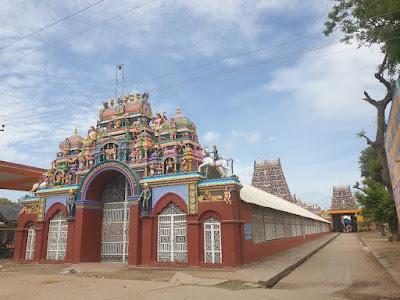
The temple complex after consecration
Sthalapuranam through inscriptions
Usually, the temple inscriptions in any temple would speak about grants given by kings and their subjects for various activities of the temple. They might often include government orders too. However, it is rare to find inscriptions that describe the Sthalapuranam of the temple. Here, we find an inscription with a Shloka that describes how Lord Vishnu came here and acquired the name of Kolavamana Perumal and its reference from the Skanda Puranam. This inscription has been featured in Annual Report on Indian Epigraphy - 102/1911 and has been further elaborated in Nagai Maavatta Kalvettugal published by the State Archaeology Department of Tamil Nadu.
The Shloka is as follows:
स्वस्ति श्री स्कन्दपुराणे कालिकाखण्डे तीर्थसंहितायां वसिष्ठाश्रम माहात्म्ये मल्लिकारण्य क्षेत्रप्रभावम् आरभ्यते।श्लोकः:
दया या दक्षिणगया यां यो वा श्राद्धं प्रकर्तव्यति। षष्टिवर्षसहस्राणि गया श्राद्धे न यत्फलम्॥तत्फलं समवाप्नोति नात्र कार्यविचारणम्। गया पश्चिमदिक्भागे देवदेवाति वन्दिता।माधवो वासमाक्रान्तो गया माधव इत्यभिः॥
The shloka translates as follows:
This is an excerpt from the Theertha Samhita in Kalika Kanda of Skanda Puranam which describes the Vashistashrama Mahatmya in the Mallikaranya Kshetra. This description is said to have been given by Lord Shiva to Kamadhenu, the celestial cow. Affected by a severe drought that lasted twelve years, Kamadhenu fed upon the carcass of a dog, as it could not find any grass to feed upon. This angered Lord Shiva, and he cursed it to acquire the face of a tiger. Repentant and ashamed, Kamadhenu sought a remedy. Lord Shiva asked her to go to Bhooloka and perform penance in a Jasmine forest.
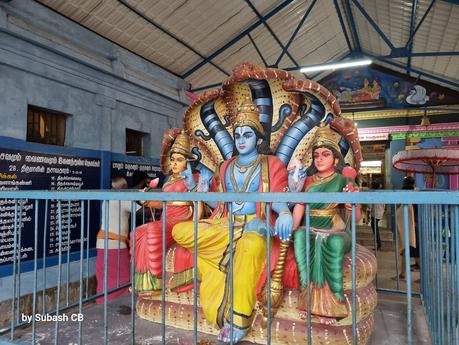
List of temples where Shiva and Vishnu co-exist mentioned in the temple
He described the Vaishistasrama and the Mallikaranyam (Jasmine Forest) as below:
This place is known as Dakshina Gaya and anyone performing the Sraadham (annual rites of ancestors) here with compassion will attain the merit of having performed Sraadham in Gaya for sixty thousand years. There is no doubt about it. In the Western part of this Gaya, resides Lord Madhava and hence it is also known as Gaya Madhava. Kamadhenu did as suggested. She reached the Mallikaranyam, worshipped Lord Gaya Madhava also known as Kolavamana Perumal, bathe in the pond near Sage Vashista's hermitage and do penance. And soon, her tiger face disappeared. Overjoyed, Kamadhenu bathed in the pond and offered her thanks to the Lord. Her milk filled the pond, turning it into a Ksheera Pushkarni. Sage Vashista churned the butter to make a Shivalinga. He placed it on the banks of the Pushkarni and started worshipping it. After his prayers were over, when he tried to remove the lingam he found that it had turned to stone (கல்) and stuck firmly (சிக்) to the ground. Therefore, the place came to be known as Sikkal and the Lord Navaneetheswarar or Vennai Piraan. Sage Vashista also made a Krishna idol out of the butter and worshipped it. Lord Krishna wanting to reside in this holy place came to the Mallikaranyam and ate the butter Krishna. Shocked, Sage Vashista started chasing him. Krishna ran towards what is known today as Thirukkannankudi, one of the five Krishnaranya Kshetrams and got bound by the love and affection of the sages worshipping him there.
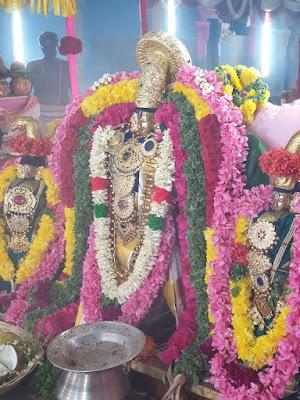
Kola Vamana Perumal Utsavar
How did Lord Kolavamana Perumal come here originally?Thirumangai Alwar who has done the Mangalasasanam of the Thirukannangudi temple has also described the Vamana Avatara that originated at the Kolavamana Perumal temple in one of his pasurams. Therefore, this temple also serves as an Abhimana Sthalam of Thirukkannankudi divya desam.
Mahabali, the Asura king and grandson of Prahalada, was a just king loved by his subjects. At one point, he acquired Amrut, the eternal nectar that brought Asuras back to life when they were defeated and killed by the Devas. Using the Amrut, King Mahabali slowly spread his kingdom all over the earth and skies. This made the Devas run from pillar to post, attempting to save themselves and their territories. They appealed to Lord Vishnu to save them from Mahabali. They pleaded that without his intervention, the Devas would soon become extinct.
Lord Vishnu was now in a difficult situation. On one hand, King Mahabali was a good king and more importantly his devotee. On the other hand, the Devas had approached him as the lender of last resort and he could not refuse them. So he came down to the Mallikaranyam, created a theertham called Gaya Theertham and started meditating to find the right solution to put an end to Mahabali. Soon, Lord Shiva appeared before him and with his advice, Vishnu took the form of Vamana, the dwarf. He approached King Mahabali, who was performing the Ashwamedha Yagna to declare himself as the Emperor of the World and the Skies, and in the process was giving away grants to those who visited him.
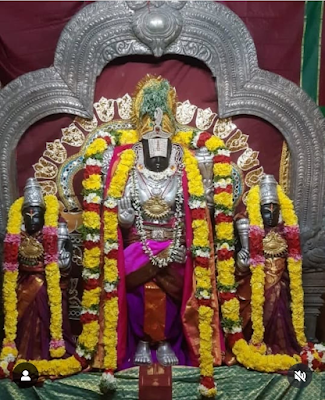
Kolavamana Perumal in Raja Alankaram
Vamana sought three steps of land to which Mahabali immediately agreed, even though his guru Sukracharya tried to prevent him. Vamana assumed Vishwaroopa, and measured the earth with one step and the skies with the second. When he asked Mahabali where to place the third step, the King graciously offered his head. Vamana's foot sent him crushing to Patala Loka. Pleased with his devotion, and for honouring his promise despite knowing it would bring about his end, Lord Vishnu agreed to grant Mahabali a boon. He sought to return to his kingdom once a year, which is celebrated as the Onam festival with great pomp and glory, even to this day.
Another version of the story says that Mahabali wanted Lord Vishnu to stay with him in Paathala Loka, for which Vishnu agreed to do four months in a year, during which time, his protection activities are handed over to Lord Shiva, which denotes the Chaturmasya period.
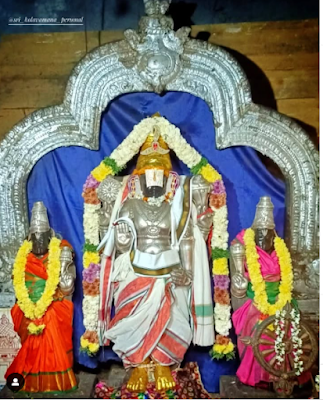
Lord Kolavamana Perumal (Photo Courtesy: The temple)
Since Lord Vishnu manifested in the Vamana form here, he came to be known as Kolavamana Perumal. After Kolavamana Perumal came here, Goddess Lakshmi, unable to stay alone in Vaikuntha without her Lord, came here too, and created the Lakshmi Theertham and prayed to Lord Kolavamana Perumal to be united with him. Answering her prayers, the Lord requested her to stay here and grant the wishes of their devotees as Komalavalli Thayar. Till this day, young men who are desirous of getting a good bride, or those boys whose wedding prayers are getting delayed, come here and worship Kolavamana Perumal and Komalavalli Thayar,and soon enough, just like how Goddess Lakshmi came looking for her partner, good matrimonial alliances come looking for these boys.
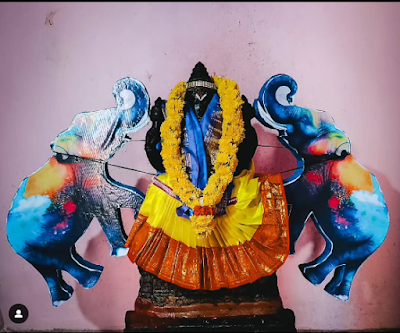
Komalavalli Thayar in Gajalakshmi Alankaram (Photo Courtesy: The Temple)
Varada Anjaneyar found in a seperate shrine opposite to Kolavamana Perumal is extremely popular among devotees who offer Kattamudhu to Varada Anjaneyar after their prayers have been answered. The temple has recently been consecrated. The rustic look and the multiple wall paintings are all gone, replaced with gary oil paints.
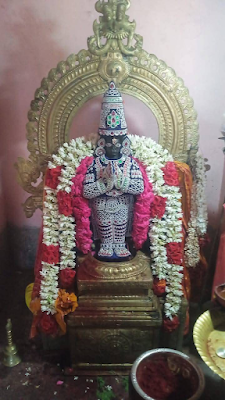
Sri Varada Anjaneyar
I have a habit of taking vastrams for the deities of any temple I have the opportunity to visit. Normally, the priests would either place the vastrams at the feet of the deity or around the shoulders and one really has to be satisfied with that. However, here, the priests so patiently adorned the vastrams to the Utsavar vigrahams while we were there which was a truly goosebumps moment for me.
Inscriptions:
There are a total of eight inscriptions that have been recorded here, out of which two are from the Kolavamana Perumal temple. Two others from the Navaneetheswara temple, describe the Sthalapuranam as mentioned above and also about all those who worshipped here to get the grace of Kola Vamana Perumal. Inscription No.103/1911, mentions this Kshetram as Gaya Saras and Deva Sannithyam. It further mentions that Ashwatha Vriksham (Peepal Tree), Ksheera Pushkarni (Milk Pond), Vata Vriksham (Banyan Tree), Surabhi, King Muchukunda, Sages Vishwamitra, Vashista, , Narada, Gauthama, Katyayana and Agasthya worshipped here.
Inscription 100/1911 mentions that in 1447, Lakkana Dandayaka, the Senapathi of the Vijayanagara King Mallikarjuna Raya (Deva Raya III) who called himself Dakshina Samudradhipati, found that Sirrayanallur village, that had been given as Thiruvidaiyattam (land given to a temple from which the tax revenue could be used directly by the temple for its operations) was far away from the temple and hence he replaced it with fertile lands that were irrigated by the Nallan Pillai Petral Eri in Sikkal of Gayamanicka Valanadu which was an Usavadi (sub-division) of Cholamandalam. Inscription 101/1911 states that a person named Ayar Pillai, a native of Mangalam converted this temple into a granite structure.
Festivals:
All Vaishnavaite festivals are celebrated here with pomp and glory. Specially Mohini Avatharam on the sixth day of Margazhi, Gajendra Moksham, Vaikunda Ekadesi, Vijaya Dasami, Hanumad Jayanthi, Puratasi Saturday and Gokulashtami. The temple has a lovely Instagram page where all the utsavams are comprehensively covered.
How to reach here:
Sikkal is around 4 kms from Nagapattinam town, enroute to Tiruvarur. The GPS location of this temple is 10.7566969,79.7964928.
Temple Timings:
6.30 am to 12 pm, 5 - 8.30 pm
Contact Details:
Shri Balaji Bhattar - 96556 97885
Acknowledgements:
I thank Mr Subash Chandran, Nagapattinam and the Kolavamana Perumal temple for allowing me to use their images for this article.







