


 In 1989, China’s regime followed Mao’s dictum, “power comes from the barrel of a gun,” shooting many hundreds of democracy proponents in Tiananmen Square. (Trump has called this a “strong, powerful government” quelling a “riot.”) Since then, even as China has modernized in many ways, its regime has become increasingly repressive, tolerating not the slightest chink in its absolute power. Its police state in Xinjiang is an Orwellian nightmare. Xi Jinping has made himself president-for-life. China bullies its neighbors, tightening its unlawful grip on a wide swath of the Pacific. It abuses world trade rules, its advance fueled by theft and dishonesty.*
So is China our enemy? Not exactly.
The Communist bloc, during the cold war, was our enemy. Its aim was world domination, ideologically, seeing the U.S. as a bete noir and wanting our failure or destruction. Putin’s Russia today, while non-ideological, has a similar outlook.
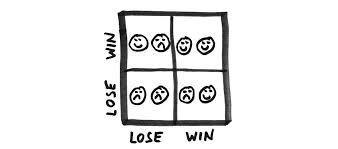
It’s not Trump’s mentality.
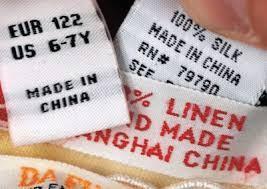
The win-win logic is a key concept of economics, called comparative advantage. We buy from China what China is better at producing; China buys from us what we make best. Both countries benefit — even if one buys more than the other.
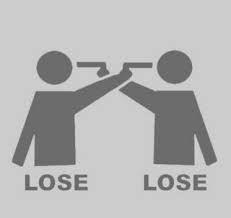
Nations are enemies when their interests clash, in a zero-sum sense. That’s not our situation with China. Again, we have a mutual interest in our bilateral trade. That doesn’t mean we don’t fight China on intellectual property theft, human rights, or territorial aggression.

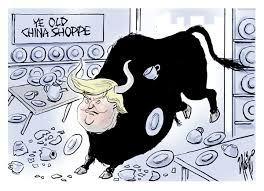
The tragic stupidity of Trump’s China stance is that it’s the opposite. He wants no fights with his “great friend” Xi over things like Xinjiang or silencing dissent. Nor is he even really confronting China over intellectual property theft, which is the trade fight we should be having. Instead, it’s the intercourse he wants to curtail.
“Intercourse” doesn’t even begin to cover it, as elucidated in a recent Thomas Friedman column (https://www.nytimes.com/2019/06/04/opinion/us-china-trade.html). Our two economies are totally intertwined. We have huge investments in each other. Both economies rely heavily on vast, interlinked supply chains, each supplying to the other things necessary for their productivity.

But he fears that’s happening; stumbling into a new cold-war-enemy relationship with China that’s totally unnecessary. “The erecting of an equivalent of the Berlin Wall down the middle of the global technology market,” dividing it into separate and mutually hostile spheres.
Instead we should be working to coax China into full partnership with the rules-based globalist economic order. Which is really in China’s own long-term best interests. In this, a united front with all our allies would help. But Trump has antagonized them, picking trade fights with them too. (Britain, for one, now sees its trade relationship with China as economically central.) So we’re on our own.
* Counterfeiting is a big industry — a major problem in my own business field, rare coins. Maybe bigger than we even know.
Advertisements






