


The iPhone 11 Pro is undoubtedly the king of Apple's iPhone lineup (at least until the iPhone 12 arrives) thanks to its three rear cameras, all-day battery life and high-resolution OLED screen. But it comes at a steep price, starting at $ 999 (£ 1,049, AU $ 1,749). With so many new iPhones including the $ 699 iPhone 11 and the $ 399 iPhone SEYou may be wondering which one to choose. I wanted to compare Apple's flagship model to the budget iPhone to see what a difference it made to $ 600.
If you want the top-of-the-line iPhone (and it fits your budget), you probably won't even consider the iPhone SE. But as I found out after using both the 11 Pro and SE for a few weeks, I didn't feel like I missed any of that when I switched to the cheaper iPhone.
For more of it
Subscribe to the mobile newsletter, receive notifications and see related articles on CNET.
Continue reading: How the $ 399 iPhone SE compares to the $ 699 iPhone 11
Angela Lang / CNET
While the iPhone SE looks like an older iPhone on the outside, don't be fooled. Teamed with the same A13 Bionic chip as the iPhone 11 and 11 Pro, it offers great performance and a very powerful camera for a starting price of $ 399. The battery won't last as long as the more expensive phone, but Apple made some wise compromises to keep the price low. Read our review of the Apple iPhone SE (2020).
Angela Lang / CNET
With a slim stainless steel case, excellent battery life and a high-resolution OLED display, the iPhone 11 Pro deserves the "Pro" label. It's the toughest iPhone you can buy, and it has three rear cameras that give you flexibility from ultrawide to telephoto. There's also the option of increasing the screen size from 5.8 inches to 6.5 if you choose the iPhone 11 Pro Max, and you also get a larger storage option of 512GB on the high end while the iPhone SE 256 GB reached. Read our Apple iPhone 11 Pro review.
The iPhone SE is the most compact, while the 11 Pro is extremely durable
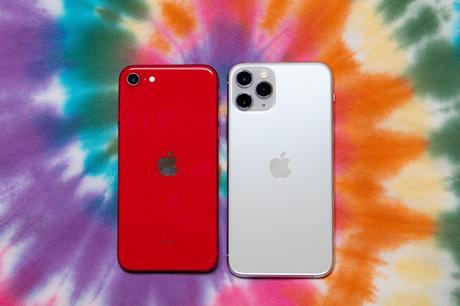
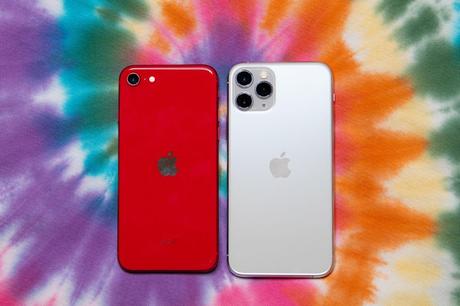
With a 4.7 inch screen, the iPhone SE has the same overall design as that iPhone 8. That means the home button is back! Or it never went away when upgrading from something like the iPhone 6 or 7. The iPhone 11 Pro has a 5.8-inch screen and has the newer iPhone design with no home button.
Lexy Savvides / CNET
The iPhone SE has an aluminum frame, while the iPhone 11 Pro is made of stainless steel. All Apple cell phones have special glass from Corning on the front and back. Apple claims the iPhone 11 Pro has the most durable glass of all. I've dropped the iPhone 11 Pro countless times (both in our formal drop test and if it has been used in the past six months) and it has not sustained any significant damage.
Even so, I recommend putting a case on your phone for safety, as not all drops are created equal. We haven't done a durability test on the iPhone SE yet, but we would expect it behave similarly to the iPhone 8 assuming it's the same design. (The iPhone 8 suffered a cracked screen when dropped five feet away.)
Both phones also offer water resistance, albeit to a slightly different degree: the iPhone SE has an IP67 rating, meaning it can reach a maximum depth of 1 meter for up to 30 minutes, while the iPhone 11 Pro has an IP68 rating or 4 meters at the same time Time. But in mine extreme water testI found the iPhone 11 Pro survived much deeper water than Apple claimsSo I wouldn't be surprised if the iPhone SE survived its rating too. Regardless, the water damage for either phone is not covered under warranty. So don't go crazy trying to test the limits of your phone (leave that to me!).
Winner: The 5.8-inch iPhone 11 Pro is perfect for me, although the iPhone SE is easier to use with one hand.
The iPhone 11 Pro has this gorgeous OLED display
The iPhone SE has an LCD display for liquid retina, while the 11 Pro has an OLED Super Retina XDR display. There's no question that the 11 Pro's screen looks great thanks to a contrast ratio of 2,000,000: 1 and HDR support. The OLED technology can generate deeper black levels than the LCD of the iPhone SE.
Even so, I wasn't disappointed when I switched to the iPhone SE. The colors look accurate and the screen is easy to read in bright outside light. In my eyes, watching a movie on the iPhone 11 Pro looked better because the screen was physically bigger.
Winner: It's tough to compete with the iPhone 11 Pro's OLED display.
Touch ID vs. Face ID: Home button or face recognition?
After using the new iPhone SE for several weeks, I count myself among the many people who prefer to use a fingerprint to unlock their phone. Face recognition is solid but has limitations, although it becomes more responsive over time. Touch ID just works better for me in many situations. Face ID struggles to recognize me the first thing in the morning after I rolled out of bed - I might look drastically different in the morning, but honestly I don't think I do. (It is also not compatible with face masks.) Switching to iPhone SE and unlocking my phone using my fingerprint always works.
On the iPhone SE, you're sacrificing screen real estate to accommodate the home button, and I've noticed the bezels on the SE a lot compared to the iPhone 11 Pro's nearly borderless screen (though there's a notch for TrueDepth's camera).
Winner: iPhone SE for seamless Touch ID.
The iPhone 11 Pro has three rear cameras, but do you need them?
The iPhone 11 Pro has three rear cameras: ultra wide, wide and 2x telephoto. The iPhone SE has a single wide rear camera. But as I noticed when looking at photos of the two side by side, the difference wasn't as dramatic as I expected.
The main cameras on both phones use Smart HDR to even out shadows and bring out details. The iPhone 11 Pro produced images with greater dynamic range in difficult lighting conditions, but some shots were difficult to distinguish in terms of color and overall processing. The iPhone 11 Pro features Apple's Deep Fusion processing, which can help you get sharper shots in medium-light conditions (think indoors). Read more about it how Deep Fusion works in Patrick Holland's great explainer.
You can see the difference Deep Fusion makes by looking at the same photo on the SE and 11 Pro at full magnification - see the photo of the orchid below.
Of course, thanks to its ultrawide and telephoto lenses, the iPhone 11 Pro offers more flexibility when composing your recordings. I love the ultra wide perspective, and it's the biggest thing I miss about using the iPhone SE.
This camera on the iPhone 11 Pro gives you more flexibility with selfies, e.g. For example, when creating Animoji and Memoji that mimic your facial expressions, and when filming in 4K.
The biggest difference between these two cameras is the night mode - the iPhone 11 Pro has it, the iPhone SE doesn't. Photos from the 11 Pro look much better in low light than photos taken with the SE, as the night mode illuminates the scene and provides a clearer, brighter shot. Stay tuned for my full camera comparison between these two phones, which will soon cover video recording and selfie cameras as well.
Winner: iPhone 11 Pro if you want different cameras and night mode.
The A13 bionic chip makes both iPhones incredibly fast
It's no secret that these phones use the same processor. Hence, I didn't see any significant differences in performance when using both of them side by side. I ran a few benchmarks on both phones and the results were tight and the 11 Pro came out on top for multicore performance on Geekbench.
In the real world, both apps loaded quickly and didn't have a noticeable lag while trimming a 4K video. In fact, the cheaper SE was a hair faster in my anecdotal test.
Apple doesn't disclose an official battery level for any of its phones, but we do know that the iPhone SE has a similar battery to the iPhone 8. The iPhone 11 Pro has a higher capacity battery than the cheaper phone. (Unofficial third-party crashes revealed that the 11 Pro has a 3,046 mAh battery and the 11 per max 3,969mAh.)
There is no question that battery life varies significantly with daily use. The 11 Pro easily got me through a day, sometimes up to a day and a half, of fairly heavy use, while the iPhone SE lasted a full day of lighter use. Whenever I watched videos or used the camera a lot, I reached for the iPhone SE charger to last a full day. Both phones also support wireless charging and fast charging, but only the iPhone 11 Pro comes with an 18-watt fast charger.
Winner: Overall performance feels like a tie, but the iPhone 11 Pro leads the way for battery.






