


However, even if the state dinner had taken place as planned, it would have been only the third of the Trump administration, behind the one organized for Australia in September 2019 and the other for France, in April 2018 .
Trump's two dinners are shy compared to many of his recent predecessors and are the least of any modern American president at that time.
At this precise moment in their presidency, Barack Obama had organized six state dinners, George W. Bush four and Bill Clinton 13. And while this may seem like a lot, comparatively, the trend of lavish and exaggerated business for chief executives. State aliens have declined over time since their peak under Jimmy Carter, signaling the decline of one of the White House's most extravagant traditions.
Diplomacy on the menu
The first state dinner is historically considered to be that organized in 1874 by Ulysses S. Grant for King Kalākaua of Hawaii. It included several dishes and cutlery in expensive silver and porcelain - the king would have had a great evening, as expected.
At first, state dinners were an opportunity for a president and a first lady to showcase their hosting skills more than anything else. Yet, as the United States has become a global power, the attractiveness of meeting with an American president has become crucial - both from the American perspective and in other parts of the world.
"The desire for state dinners really accelerated with the advent of the world wars," said Matthew Costello, historian for the White House Historical Association and vice-president of the David M. Rubenstein National Center for White House History.


"Franklin Roosevelt, in particular, realizes that they have a chance of obtaining information, directly from the horse's mouth, so to speak. In 1939, for example, Roosevelt invited King George VI the first time that a British monarch was coming to visit an American president, and he did so just as the Nazis began to advance. "
Roosevelt saw the effectiveness of using a state dinner as a political currency and began expanding his guest repertoire, hoping to capitalize on potential alliances or find out if could face a future enemy.
"Roosevelt is really the first to start using dinners more strategically, and it also uses them to recognize governments in exile," said Costello.
Thaw the Cold War
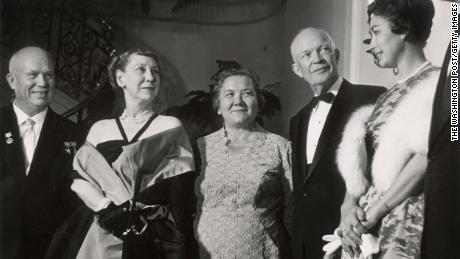
After Roosevelt, state dinners became a delicate dance of strategy during the Cold War. Costello said the official visits were an opportunity to bring Western allies together or to try to thaw more icy relations.
"In 1959, Dwight Eisenhower invited Nikita Khrushchev, marking the first state visit of a Soviet leader, not to mention the United States' biggest global competitor," he said.
Post-Eisenhower, John F. Kennedy, Lyndon Johnson, Richard Nixon, Gerald Ford and Jimmy Carter have all become supporters of state dinners that have given - or at least attempted - some sort of positive diplomatic outcome and tangible.
Johnson was the most prolific party thrower in the White House, ultimately hosting more state dinners than any president - a total of 54. He was already 26 and a half years in his presidency, corresponding to the term of office. Trump.
Johnson's first (and unofficial) state dinner, however, took place only a month after the assassination of John F. Kennedy. Unlike the dozen that Johnson would later house in the White House, he was not in Washington - he hosted him on his Texas ranch.
Johnson hosted a barbecue feast for West German Chancellor Ludwig Erhard, where they discussed the Berlin Wall and the imminent Soviet threat, at a dinner prepared by cooks wearing cowboy hats and grills of meat.
Although the cold weather forced the gathering of 300 people inside, Johnson's Texas hospitality relaxed the formality of the occasion, facilitating dialogue and familiarity between the two leaders. Once back in Washington, the Johnson Administration dinners would take place regularly, as often as once a month.
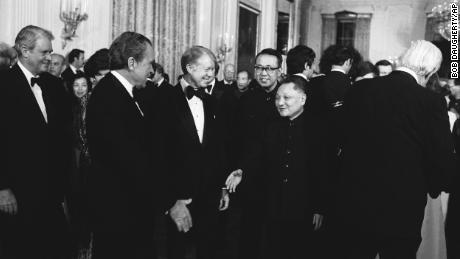
Carter, although pre-political a peanut farmer from Tiny Plains, Georgia, to the White House has proven to be a conscientious host. At the same time as Trump is today, Carter had already hosted 33 state dinners. However, Carter issued an important holiday directive: no strong alcohol. Pious Carter and First Lady Rosalynn Carter would only serve beer and wine, although this sometimes included a glass of champagne.
By the time Ronald Reagan, for whom entertainment came naturally, was in the White House, events centered on the telegenic relationship with the visiting head of state, but the menu, music, talent and celebrities (who can forget the Reagan State Dinner for Prince Charles and Princess Diana, when John Travolta spun Diana on the dance floor?) Also began to peak.
"The Reagan loved to host state dinners," said Costello, adding that they even hosted one in San Francisco in 1983 for Queen Elizabeth. "In the 1980s, global change was at a peak, and Reagan had won the admiration of several leaders."
At Reagan's state dinner for British Prime Minister Margaret Thatcher in 1981, Thatcher toasted the president as "the new leader, not only of the United States, but of everyone in the West."
Casual dinners
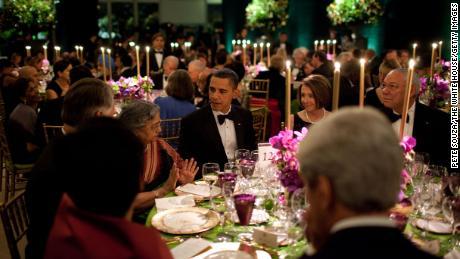
"At the end of the Cold War, you're really starting to see the change," said Costello of the reduction in the number of state dinners. "Where they were mainly during 20th century dinners to address geopolitical and global issues, they quickly developed into much more socially centered events."
Costello said one way to say it is the largest size of the Chinese presidential services, which increased from 100 to 150 people to 320, which was the size of Obama's official porcelain in 11 pieces. Dinners ballooned to welcome celebrity guest lists and Grammy winners as entertainment - to accommodate guests, tents were often set up on the south lawn.
"They have also become more inclined to embrace more neutral countries, and less to be a means for a president to measure someone in person," said Costello.

For Trump, the two have so far been with countries, France and Australia, including leaders with whom the President has had some political alignment, in particular Australian Scott Morrison. Since then, he has sometimes met publicly with French President Emmanuel Macron, but in the spring of 2018, the relationship was more rosy.
But the area in which Trump can choose leaders is meager, in part because of his America First philosophy, but also because of his unique style of global diplomacy. As for when the King and Queen of Spain could become the third state guests of Trump's term, a White House official said the president and first lady hoped to reschedule.






