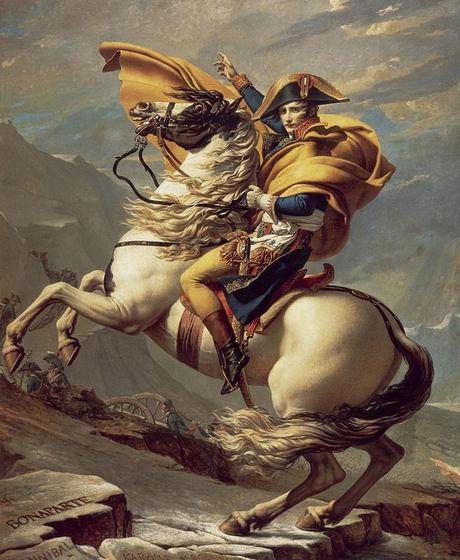
 Marengo (c.
1793–1831) was the famous war mount of Napoleon I of France. Named after the
Battle of Marengo, through which he carried his rider safely, Marengo had
been imported to France from Egypt in
1799 as a six-year-old. Marengo was wounded eight times in his
career, and carried the Emperor in the Battle of Austerlitz, Battle of
Jena-Auerstedt, Battle of Wagram, and Battle of Waterloo. He also was
frequently used in the 80-mile gallops from Valladolid to Burgos, which he
often completed in 5 hours. As one of 52 horses in Napoleon's personal stud,
Marengo fled with these horses when it was raided by Russians in 1812,
surviving the retreat from Moscow; however, the stallion was captured in 1815
at the Battle of Waterloo by William Henry Francis Petre, 11th Baron Petre.
Petre brought the horse
back to the United Kingdom and sold him on to Lieutenant-Colonel Angerstein of
the Grenadier Guards. Marengo stood at stud (unsuccessfully) at New Barnes,
near Ely, at the age of 27. He eventually died at the old age of 38, and his
skeleton (minus two hooves) was preserved and later passed to the Royal United
Services Institute and is now on display at the National Army Museum in
Chelsea, London. One of the remaining hooves was given to the officers of the
Brigade of Guards by John Julius Angerstein as a snuff box. The fourth hoof was
mounted as a silver inkwell and retained by the family; it is still owned by
the family but is now on loan to the Household Cavalry Museum. The Duke of
Wellington was asked to disinter his own horse, Copenhagen,
to be exhibited alongside Marengo, but refused to do so. Coincidentally, one of
Copenhagen's hooves was also later used as an ornament.
After capture by the
British armu, the stallion changed hands and was brought to a farmhouse in Somerset. When Marengo died in
1831, the family had his two front hooves mounted in silver and kept them as
keepsakes.One of those silver-plated front hooves went to the officers’ mess at
St. James’s Palace, where it still resides today. The other, though, was
lost.But recently a descendant of Marengo’s original British owners
re-discovered the hoof. It was in a plastic bag, The Times reports, “at the
back of a kitchen drawer in a Somerset farmhouse once one by the wealthy family
who bought Marengo.” It’s now on loan to the Household Cavalry Museum in
London, still separated from the horse’s skeleton but found at last.
So the famous horse of
Napoleon or rather its hooves are still making news ! – centuries later.
With regards – S.
Sampathkumar
Marengo (c.
1793–1831) was the famous war mount of Napoleon I of France. Named after the
Battle of Marengo, through which he carried his rider safely, Marengo had
been imported to France from Egypt in
1799 as a six-year-old. Marengo was wounded eight times in his
career, and carried the Emperor in the Battle of Austerlitz, Battle of
Jena-Auerstedt, Battle of Wagram, and Battle of Waterloo. He also was
frequently used in the 80-mile gallops from Valladolid to Burgos, which he
often completed in 5 hours. As one of 52 horses in Napoleon's personal stud,
Marengo fled with these horses when it was raided by Russians in 1812,
surviving the retreat from Moscow; however, the stallion was captured in 1815
at the Battle of Waterloo by William Henry Francis Petre, 11th Baron Petre.
Petre brought the horse
back to the United Kingdom and sold him on to Lieutenant-Colonel Angerstein of
the Grenadier Guards. Marengo stood at stud (unsuccessfully) at New Barnes,
near Ely, at the age of 27. He eventually died at the old age of 38, and his
skeleton (minus two hooves) was preserved and later passed to the Royal United
Services Institute and is now on display at the National Army Museum in
Chelsea, London. One of the remaining hooves was given to the officers of the
Brigade of Guards by John Julius Angerstein as a snuff box. The fourth hoof was
mounted as a silver inkwell and retained by the family; it is still owned by
the family but is now on loan to the Household Cavalry Museum. The Duke of
Wellington was asked to disinter his own horse, Copenhagen,
to be exhibited alongside Marengo, but refused to do so. Coincidentally, one of
Copenhagen's hooves was also later used as an ornament.
After capture by the
British armu, the stallion changed hands and was brought to a farmhouse in Somerset. When Marengo died in
1831, the family had his two front hooves mounted in silver and kept them as
keepsakes.One of those silver-plated front hooves went to the officers’ mess at
St. James’s Palace, where it still resides today. The other, though, was
lost.But recently a descendant of Marengo’s original British owners
re-discovered the hoof. It was in a plastic bag, The Times reports, “at the
back of a kitchen drawer in a Somerset farmhouse once one by the wealthy family
who bought Marengo.” It’s now on loan to the Household Cavalry Museum in
London, still separated from the horse’s skeleton but found at last.
So the famous horse of
Napoleon or rather its hooves are still making news ! – centuries later.
With regards – S.
Sampathkumar
5th May 2o17.