


The limits of one’s own horizons and experience always become exposed when seen through the eyes of an outsider. Since being in Jena for the last two weeks, I have not only read a shed load of books, but also seen a couple of films and listened to some interesting (challenging?) perspectives on life, the world and British political culture.

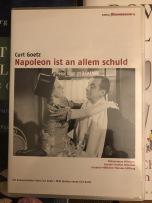
Das Haus in Montevideo, in black and white and cleverly scripted, actually presents the moral dilemmas involved in finding your strict morals challenged by pecuniary potential. Napoleon ist an allem Schuld sounds like farce, but mocks historical pretentiousness at the same time as depicting human generosity of spirit. You have to see them to get the stories, but they offer a German slant on morality from someone who left Germany in 1939 to avoid working for Hitler, but returned after the war to recover at least some elements of German theatrical culture from the ashes of destruction.
The other gift of these two weeks has been an introduction to theologians with whom I was unfamiliar. My friend has many books of German sermons. I dipped into Wolfhart Pannenberg, Eberhard Jüngel, Martin Niemöller and the poetry of Goethe, Schiller, Ingeborg Bachmann and, in a bookshop, Bertolt Brecht. All of these I knew. But, I had not heard of Manfred Josuttis until I dipped into his Petrus, die Kirche und die verdammte Macht, followed by several books of sermons. Now dead, he was a theologian who clearly knew how to preach in a way that gripped the attention and tackled both the biblical text and contemporary issues with rhetorical clarity.

Manfred Josuttis, in a sermon on Psalm 25:1-10 in Wirklichkeiten der Kirche, says: “Kein kollektivesGedächtnis kann uns davor bewahren, daß sich die Barbarei wiederholt. Schreckliche Bilder lösen nicht nur Entsetzen aus, sondern regen auch zur Nachahmung an.“ (p.80) [“No collective memory can preserve us from the repetition of barbarity. Shocking pictures don’t just horrify us, they also excite imitation.”]
Compare this with Marilynne Robinson in her book of essays What Are We Doing Here?: “It is not always easy to tell a slumbering conscience from one that is weighing consequences,” (p.4) or: “A society is moving toward dangerous ground when loyalty to the truth is seen as disloyalty to some supposedly higher interest. How many times has history taught us this?” (p.20)
We don’t always learn from history.
These questions were not merely academic to preachers and theologians such as Josuttis and von Rad and they shouldn’t be to us now as we cast an eye over developments across the world. We never foresee the future, even when we see the clouds gathering. But, the experience of those who found themselves exposed to existential challenge in relation to truth, integrity and politico-theological consistency is worth revisiting at a time when global norms are under pressure and change is in the air.
Advertisements






