Photo by Sam Azgor.
This post is part of a series on Biomarkers of Longevity & HealthBecause I have have several members in my extended family who are diabetic (both Type I and Type II), I tend to read more about diabetes for someone without a diagnosis.
I want to offer them support. I also want to understand the risks that my children and I might face because of the history of diabetes on my side of the family.
Most recently, I have been interested in learning more about the HbA1c test, also called the A1c test.
Many diabetics test their blood at home in an an effort to keep their blood sugars within a healthy range, typically identified as 80 to 120 milligrams per deciliter (mg/dL).
[Please see a licensed health care professional in order to maintain good health. This post is only for raising awareness and should not be a substitute for professional medical advice.]
This number from a provides only a snap shot of glucose levels at a very specific time.
The HbA1c test offers a window into the rate of glucose in the blood over several weeks. The test scores differ because they measure different things. An HbA1c score is in a percentage, and might be somewhere between 5% and 10%.
More on HbA1c results below, but know that lower numbers are ideal, but not numbers lower than 4%; that suggests problems with too frequent hypoglycemia.
Because HbA1c tests phenomena occurring over several weeks, it offers a fuller picture than home blood glucose monitoring.
I found over a dozen videos explaining HbA1c, and I like this one the best. For starters, it is not connected with a testing service, which might exaggerate the convenience and usefulness of the test.
This video also does a good job of explaining the life cycle of hemoglobin as 120 days but emphasizes that the average life of the blood's homoglobin must be averaged at 60 days since they are continually entering and exiting the blood system.
HbA1c measures the percentage of hemoglobin that have glucose attached to them. When this happens, the result is termed glycated hemoglobin. If a person has many instances over several weeks of hyperglycemia (high blood sugar levels), their percent of glycated hemoglobin will be higher.
I have seen some variation in ideal ranges.
The most consistent number I've seen is 6.5% as the threshold for diagnosing a person with diabetes. A person without a diagnosis of diabetes usually have test results between 4% and 6%.
The ideal test result may vary depending on the individual's age and condition.
Many sources emphasize that lowering a score by even 1% has great benefits, even if that improved number is still above 6.5%.
For example, if a person had been testing quarterly for five years at 8% HbA1c and finally maintained a result of 7% over a year of quarterly tests, that would be a triumph.
Here is a chart for an individual sharing HbA1c test results over several years. (Click on image to enlarge.)
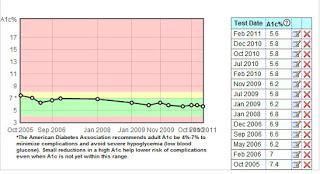
Photo by E.S. O'Connor. Click to enlarge or follow link.
And kudos to Erin for staying "in the green" for so many tests.
Related:
Biomarkers for Longevity and Health