


Risk/reward is a rating used to express how well a player is playing in a specific zone, or manpower situation. The number represents the difference between the number of unsuccessful plays a player makes subtracted from the number of successful plays a player makes per-minute of ice-time. The higher the number, the more a player helps, rather than hurts a team's ability to maintain or acquire puck-possession. Traditional plus/minus, as well as goals and assists are not included in the calculation.
Events used in this calculation can be found here.
 Even-strength risk/reward rating is a quantified expression of how well a player is performing at even-strength. Only those events that take place at even-strength are used in this calculation.
PK Subban has the top even-strength risk/reward rating among players with enough ice-time to create a reflective rating. Subban is among the leaders in all three zones, while his best-numbers are produced in the defensive-zone. His rating is also carried by the fact that he is involved in more events per-minute of ice-time than any other defensemen.
Lars Eller leads all forwards with an impressive even-strength risk/reward ratings. Eller is among the leaders in both the offensive and defensive-zones, and produces more events per-minute played than any other player; including Subban.
-----------------------------------------------------
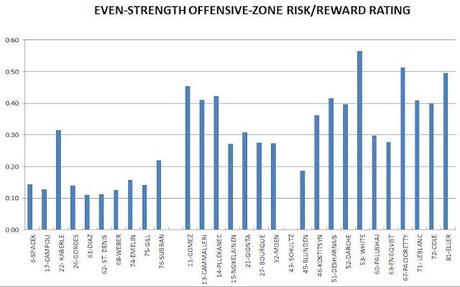
Even-strength offensive-zone risk/reward rating is a quantified expression of how well a player performs in the offensive-zone while playing at even-strength. Forwards normally have much higher offensive-zone risk/reward ratings than defensemen, as they engage in far more o-zone events than their defensive-teammates.
Although Ryan White has the top offensive-zone risk/reward rating, he has not played enough minutes to allow us to accept this as anything more than a measurement of his play over a short period of time. As such, it an not be used to determine his potential play over the course of an entire season.
Max Pacioretty has the top offensive-zone risk/reward rating on the Canadiens. His rating is helped by both his ability to win puck-battles, and recover loose-pucks. Other current players with o-zone ratings above 0.40 include, Scott Gomez, Tomas Plekanec, David Desharnais, Erik Cole, Louis Leblanc, and Lars Eller.
Thanks to his offensive-zone passing-percentage and ability to get even-strength shots through to the net, Tomas Kaberle has the top o-zone risk/reward rating among defensemen.
-----------------------------------------------
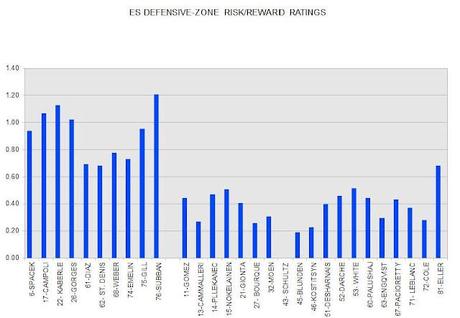
Even-strength defensive-zone risk/reward rating is a quantified expression of how well a player performs in the defensive-zone while playing at even-strength. Defensemen usually have much higher defensive-zone risk/reward ratings than forwards, as they engage in far more d-zone events than their offensive-teammates.
Subban has the highest defensive-zone risk/reward rating on the Canadiens. Subban's rating is the product of his ability to recover loose-pucks in the defensive-zone, and his 72% success-rate when attempting passes from the defensive-zone. Other players with d-zone ratings above 1.00 include Chris Campoli, Josh Gorges and Kaberle. Like Subban, Kaberle and Campoli have high ratings because of their ability to recover loose-pucks and complete d-zone passes, while Gorges' rating is the product of his high success-rate in d-zone puck-battles, and his willingness to block shots.
Lars Eller has by-far the top defensive-zone risk/reward among forwards. Eller completes a higher percentage of passes, wins a higher percentage of puck-battles, and recovers more loose-pucks in the defensive-zone than any other forward. Mathieu Darche, Petteri Nokelainen, and Plekanec have also produced solid d-zone ratings.






