


Last Updated on 31 March, 2026
This is your definitive playbook for surviving the punishing economy of Monster Lab Simulator, the hit creature collection and management game by Round 3 Studios. Playing as a mad scientist breeding adorable mutant Fulus is thrilling, but the brutal market prices and unforgiving evolution machines can easily bankrupt your entire laboratory. This comprehensive guide offers the precise mathematical baselines and elemental recipes you need to maximize your daily profits. By applying our foolproof timeline manipulation tactics and strict pricing rules, you will completely solve your financial woes and build an unstoppable monster empire.
 Did You Know? The game’s publisher, KikiGames, is known for other simulation titles. This has sparked a fun theory that the player character is actually an obsessed fan from the Table Battle Simulator universe who decided to make their tabletop monster battles real.
Table of Contents
- The Financial Foundation of Creature Crafting
- Navigating the Perils of Premium Materials
- Outsmarting the System for Ultimate Beasts
- The Master Alchemist’s Breeding Blueprint
- Conclusion
The Financial Foundation of Creature Crafting
Breaking Down the Initial Investments
Establishing a profitable enterprise requires absolute clarity regarding your base manufacturing expenses. You must monitor every single dollar you channel into eggs, essences, and orbs. Laboratory managers frequently fail because they assign arbitrary price tags to their inventory. To establish a baseline, you must calculate the exact production cost of a single one-star ( ) common Fulu.
The manufacturing sequence begins when you purchase an egg for exactly $40. You then need to acquire three individual essences to complete the foundational mixture. Since each essence demands a $20 investment, your total essence expenditure equals $60. Combining the $40 egg with the $60 essence bundle yields a base material cost of $100. The final step requires a standard orb, which adds $2 to your expenses. Therefore, creating a basic one-star common Fulu drains exactly $102 from your accounts. You must firmly refuse to sell any one-star common Fulu for less than this $102 threshold.
Scaling Up Your Operations
Your profit margins follow a strict mathematical progression as you enhance the quality of your creations. To synthesize a two-star (
 ) Fulu, the system requires you to merge three separate one-star creatures. You calculate this new baseline by multiplying the $100 base cost of a single entity by three, resulting in a $300 subtotal. Then, purchase the mandatory $2 orb, bringing your grand total to $302. You must always price your two-star variants at or above $302.
The investment multiplies again when you attempt to breed a three-star (

 ) specimen. The merging apparatus consumes three distinct two-star Fulus for this tier. You derive the financial baseline by multiplying the $300 two-star cost by three, which leaves you with a $900 subtotal. After adding the final $2 orb fee, you reach a definitive minimum price of $902. Selling a three-star Fulu below $902 guarantees a mathematical loss for your laboratory.

 Pro Tip: Always manually calculate your total material investment on a notepad before you finalize any listing on the marketplace to guarantee your profit margins stay positive.
Navigating the Perils of Premium Materials
The High Price of Upgrades
As your laboratory evolves, you will inevitably integrate exotic components into your daily operations. Amber represents one of the most significant upgrades, but it drastically alters the economic reality of your business. We owe a massive debt of gratitude to community researcher Façade for documenting exactly how this specific ingredient impacts our bottom line.
Integrating amber into your formulas triggers an immediate and violent spike in your production costs. You must completely abandon the standard pricing model the moment you utilize this premium material. The absolute minimum acceptable price for a one-star ( ) Fulu engineered with amber surges to $262. When you advance to a two-star (
 ) amber creation, the minimum price leaps to an astonishing $782. Finally, attempting to sell a three-star (

 ) amber Fulu requires you to demand at least $2342 just to recover your funds.
Avoiding Complete Bankruptcy
This severe price inflation creates a dangerous trap for inexperienced players. Because amber inflates the baseline cost to extreme levels, synthesizing a common Fulu with amber almost always results in a devastating financial deficit. The market value of a common outcome rarely covers the steep $262, $782, or $2342 entry fees. You must remain vigilant and review these specific amber thresholds constantly.

 Pro Tip: Strictly reserve your amber inventory for high-rarity breeding attempts, as utilizing this expensive material on common outcomes guarantees a massive financial loss.
Outsmarting the System for Ultimate Beasts
The Staggering Cost of Elite Breeding
Manufacturing a legendary creature demands an agonizing sacrifice of time, energy, and digital currency. The in-game mechanics require you to surrender 9 legendary eggs, 9 legendary baby Fulus, and 3 legendary juvenile Fulus just to activate the final merging sequence.
The most frustrating aspect of this process involves the game’s brutal probability engine. After you sacrifice your hard-earned legendary stockpile, the system only grants you a 60% probability of successfully acquiring a legendary adult Fulu. Even worse, the mathematical code retains a horrifying 1% chance of spitting out a completely common adult Fulu, which instantly vaporizes your entire elite investment.
The Timeline Manipulation Strategy
You can entirely circumvent this punishing probability system by executing a brilliant file-loading tactic pioneered by a fellow player named Etharian. This method ensures you never waste your legendary resources on a failed roll.
You begin this process by loading all your elite Fulus into the merging chamber. Immediately after locking the ingredients in place, you pause your progress and save your game. You then activate the machine and monitor the progress bar closely. A few seconds before the merging cycle concludes, you capture a second save state.
Once the machine finishes processing, you inspect the final product. If the game hands you anything other than a legendary adult Fulu, you immediately exit to the main menu. You then reload the second save file you created right before the timer expired. You repeat this sequence of loading and checking until the randomizer finally capitulates and awards you the legendary beast you deserve.

 Pro Tip: Keep a tertiary backup save file safely stored right before you place the ingredients into the machine, just in case you accidentally miss the critical timing window at the very end of the merging process.
The Master Alchemist’s Breeding Blueprint
Understanding Core Elements
Keeping track of your successful laboratory experiments often frustrates even the most meticulous scientists. Your memory will inevitably fail as you try to recall exactly which elemental combinations you have already tested. We have designed a streamlined, spoiler-free checklist detailing every known formula currently available in Monster Lab Simulator. We intentionally redacted the final creature names from this catalog. This strategic omission ensures you still experience the excitement of discovering the actual monsters yourself.
The laboratory relies on four fundamental elemental categories to function:
- W: Represents the Water element
- F: Represents the Fire element
- N: Represents the Nature element
- Nt: Represents the Neutral element
Aquatic Mixtures
Focus your research on harnessing aquatic energy by testing these specific formulas:
- WWN (Combine two parts Water with one part Nature)
- WWNt (Combine two parts Water with one part Neutral)
- WWF (Combine two parts Water with one part Fire)
- WWW (Combine three parts Water)
Blazing Mixtures
Turn up the laboratory thermostats and experiment with these intense thermal combinations:
- FFW (Combine two parts Fire with one part Water)
- FFNt (Combine two parts Fire with one part Neutral)
- FFN (Combine two parts Fire with one part Nature)
- FFF (Combine three parts Fire)
Earthly Mixtures
Cultivate organic growth by blending these dominant botanical recipes:
- NNW (Combine two parts Nature with one part Water)
- NNNt (Combine two parts Nature with one part Neutral)
- NNF (Combine two parts Nature with one part Fire)
- NNN (Combine three parts Nature)
Balanced Mixtures
Stabilize your output by relying on these highly neutral configurations:
- NtNtW (Combine two parts Neutral with one part Water)
- NtNtN (Combine two parts Neutral with one part Nature)
- NtNtF (Combine two parts Neutral with one part Fire)
- NtNtNt (Combine three parts Neutral)
Complex Multi-Element Mixtures
Push the boundaries of science by merging completely diverse elements:
- FWNt (Combine Fire, Water, and Neutral equally)
- FWN (Combine Fire, Water, and Nature equally)
- FNtN (Combine Fire, Neutral, and Nature equally)
- WNtN (Combine Water, Neutral, and Nature equally)
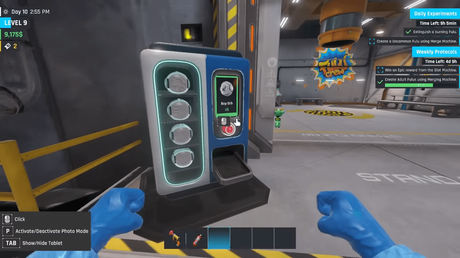
 Pro Tip: Physically check off each specific elemental combination from this list the exact moment your machine finishes processing it to prevent repeating identical experiments in the future.
Conclusion
Mastering the chaotic genetic experiments in Monster Lab Simulator requires ruthless financial discipline and highly organized documentation. You now possess the exact pricing formulas to ensure your Fulu sales always turn a profit, along with a complete checklist to uncover every elemental species. Our strategic file loading method solves the agonizing problem of losing your legendary investments to a terrible dice roll in the merging machine. Implement these rigid protocols into your daily gameplay, and you will construct a highly lucrative biological facility that completely dominates the combat arena.

 Fun Fact: Being a mad scientist gets messy quickly. As you level up and expand your facility, you can add an “Assistant Trash Robot” to your team to automate the cleanup process and keep the lab hygienic






