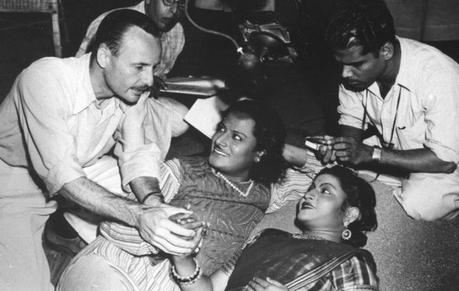
 Ellis Dungan on the sets of Ponmudi - pic credit : NYtimes.com
Back home
in Chennai aka Madraspattnam, there was this American - Ellis Roderick Dungan
made his mark in Tamil cinema, from 1936 to 1950. He was an alumnus of the
University of Southern California and moved to India in 1935. Dungan directed
the debut films of several popular Tamil film actors, including MG Ramachandran
in Sathi Leelavathi, T. S. Balaiya and
N. S. Krishnan. Ellis Dungan visited Madras in 1935 at the invitation of a
classmate from the University of Southern California, where Dungan had studied
filmmaking. Intending to stay six months, he spent almost 15 years in India,
revolutionizing the Tamil-language film industry in the process.
In Fantasia, story
takes a back seat to the emotional experience of music and the film is designed
as a magical night at the symphony. A full two years before the release of
Fantasia, Metro-Goldwyn-Mayer had produced an animated experiment called An
Optical Poem (1938) which similarly used colors and movement to visually
interpret a classical piece of music – in this case, Franz Liszt’s Second
Hungarian Rhapsody. An Optical Poem is not at all what you might expect from a
major Hollywood studio; it’s abstract, it’s experimental and it has no story
aside from a ballet of colorful geometric shapes. MGM’s introductory message
describes An Optical Poem as “a novel scientific experiment” intended to convey
mental images evoked by music.
An Optical Poem
(1938) was so different from most American-made cartoons
of its time is that the experimental short was conceived and directed by
animator and visual artist Oskar Fischinger.
Google today has honoured Oskar Fischinger, the German-American artist,
musician and filmmaker who created incredible works of animated art set to
music, with a commemorative Doodle on what would have been his 117th birthday.
Fischinger left
Nazi Germany for Hollywood in 1936 as Hitler cracked down on abstract art. His
impeccably-created stop-motion animations, synchronised to music, were a
painstaking endeavour that he would obsess over for months or years. Before
computer software, the animations were a labor of love, requiring its creators
to meticulously plan the arrangements and make sure they were in time with the
music.
Ellis Dungan on the sets of Ponmudi - pic credit : NYtimes.com
Back home
in Chennai aka Madraspattnam, there was this American - Ellis Roderick Dungan
made his mark in Tamil cinema, from 1936 to 1950. He was an alumnus of the
University of Southern California and moved to India in 1935. Dungan directed
the debut films of several popular Tamil film actors, including MG Ramachandran
in Sathi Leelavathi, T. S. Balaiya and
N. S. Krishnan. Ellis Dungan visited Madras in 1935 at the invitation of a
classmate from the University of Southern California, where Dungan had studied
filmmaking. Intending to stay six months, he spent almost 15 years in India,
revolutionizing the Tamil-language film industry in the process.
In Fantasia, story
takes a back seat to the emotional experience of music and the film is designed
as a magical night at the symphony. A full two years before the release of
Fantasia, Metro-Goldwyn-Mayer had produced an animated experiment called An
Optical Poem (1938) which similarly used colors and movement to visually
interpret a classical piece of music – in this case, Franz Liszt’s Second
Hungarian Rhapsody. An Optical Poem is not at all what you might expect from a
major Hollywood studio; it’s abstract, it’s experimental and it has no story
aside from a ballet of colorful geometric shapes. MGM’s introductory message
describes An Optical Poem as “a novel scientific experiment” intended to convey
mental images evoked by music.
An Optical Poem
(1938) was so different from most American-made cartoons
of its time is that the experimental short was conceived and directed by
animator and visual artist Oskar Fischinger.
Google today has honoured Oskar Fischinger, the German-American artist,
musician and filmmaker who created incredible works of animated art set to
music, with a commemorative Doodle on what would have been his 117th birthday.
Fischinger left
Nazi Germany for Hollywood in 1936 as Hitler cracked down on abstract art. His
impeccably-created stop-motion animations, synchronised to music, were a
painstaking endeavour that he would obsess over for months or years. Before
computer software, the animations were a labor of love, requiring its creators
to meticulously plan the arrangements and make sure they were in time with the
music.
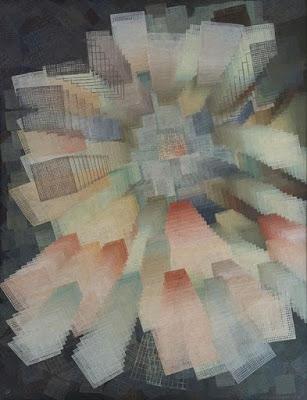 Fischinger died in 1967 but to this day many
of his works are in the Center for Visual Music in Los Angeles. Although mostly
known for his films, Fischinger was also a prolific painter, creating numerous
works that capture the dramatic movement and feeling of his films within a
single frame. Unsatisfied with traditional media, he also invented a
contraption, the Lumigraph, for generating fantastic chromatic displays with
hand movements — a sort of optical painting in motion and a precursor to the interactive
media and multi-touch games of today.
Even with the
advanced technology that now exists, emulating Fischinger's work is an
impossible task. His colours and motion were so carefully planned yet naturally
playful, his timing so precise yet human. So today's Doodle aims to pay homage
to him.
With regards – S.
Sampathkumar
Fischinger died in 1967 but to this day many
of his works are in the Center for Visual Music in Los Angeles. Although mostly
known for his films, Fischinger was also a prolific painter, creating numerous
works that capture the dramatic movement and feeling of his films within a
single frame. Unsatisfied with traditional media, he also invented a
contraption, the Lumigraph, for generating fantastic chromatic displays with
hand movements — a sort of optical painting in motion and a precursor to the interactive
media and multi-touch games of today.
Even with the
advanced technology that now exists, emulating Fischinger's work is an
impossible task. His colours and motion were so carefully planned yet naturally
playful, his timing so precise yet human. So today's Doodle aims to pay homage
to him.
With regards – S.
Sampathkumar
22nd June 2017