


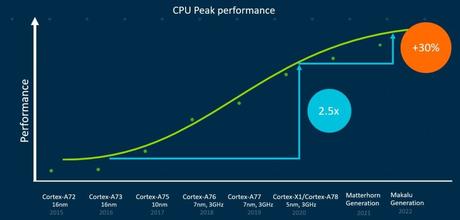
Arm announced that its future Arm Cortex-A processor cores will drop hardware support for 32-bit applications by 2022. The announcement was made by Paul Williamson, vice president and general manager of Arm, during the 'Arm DevSummit keynote.
Support for 32-bit applications hasn't contributed much to advancements in the processor arena. However, a 64-bit proprietary kernel is reported coming up with a performance improvement of about 30%.
The future of the arm
First, let's quickly talk about what Arm brings to your phone. Assuming you have an Android device powered by a Qualcomm processor, the cores for that processor are designed by Arm. Hearts are the real muscle behind your phone's capabilities.
Arm named Matterhorn and Makalu their 2021-22 " big " Cortex-A cores. The latter will be an exclusive 64-bit chip, and it also does not interfere with the future ArmV9 architecture. Simply put, 2021 mobile processors may ship with cores that support 32-bit, but no overall support. However, the output of the chip would be that it will be a 64-bit exclusive, thus getting some sweet performance improvements.
What does this mean for your phone?
So when the company says it becomes 64-bit exclusive, that means they stop supporting older 32-bit apps, which are less efficient. All in all, this is good news for future smartphones and other gadgets using its architecture. The best news is that last year Google made 64-bit app support on the Play Store mandatory, so you won't lose any apps.
It is reported that the switch is likely to provide a performance increase of up to 20% in some cases. Updates should also speed up with a single binary for developers. Until now, the company has provided legacy support for 32-bit applications.
The drop also allows Arm to get rid of the extra silicone in their designs. This directly means cooler chips in a more compact form factor. Take the example of Apple. Apple switched to 64-bit in 2017, and we're all aware of its superior performance on the landmarks.
It's about time Arm realized they should be upgrading to 64-bit exclusivity. App developers as well as companies like Google have switched to 64-bit in recent years. This is Arm's first major speech after Nvidia acquired Arm less than a month ago. We can expect AI-related announcements from both companies, following the acquisition.
The post Future Arm Chips will drop 32-bit support to gain performance first appeared on Fossbytes.






