


This was felt in the previous ones, but it became even more obvious with season 3: "Westworld" allows Jonathan Nolan to explore some of the themes that were already at the heart of "Person of Interest". Here's how the two meet.
 HBO / CBS PLEASE NOTE - The article below contains spoilers for season 3 of "Westworld", the broadcast of which has just ended on HBO and OCS. So please go your way if you are not up to date and do not want to take any risks. For the others, go after the trailer for the latest episodes.
On September 22, 2011, CBS launched one of the big novelties of its comeback: Person of Interest, the fruit of the collaboration between J.J. Abrams and Jonathan Nolan. If the first is already a big name from the small screen, barely crowned with the success of Super 8 in the cinema a year after the end of Lost and while the keys of Star Wars have not been entrusted to it, the second is again "than" Christopher's brother, of whom he co-wrote some of the feature films, Memento, Le Prestige and The Dark Knight in mind. It is however to him that we owe the pitch of this series at the crossroads of the police thriller and science fiction, which is reminiscent of Minority Report, since it is a question of a man, Harold Finch (Michael Emerson), who created a mass surveillance system to allow the government to prevent another 9/11 from happening, not without keeping the possibility of accessing it secretly.
By relying on surveillance camera recordings and telephone calls, in addition to the various criminal records, the machine proves capable of predicting terrorist acts, but also crimes deemed minor by the government, which do not take place. don't worry about it. With the help of a former CIA paramilitary agent presumed dead, John Reese (Jim Caviezel), Finch goes in search of people located in the vicinity of New York and whose system has detected the future implication in the said crimes, without being able to determine whether it will be the perpetrator or the victim. With its procedural format (one case per episode), Person of Interest presents itself first of all as a series of weekly surveys that are not very exciting overall, for lack of a common thread. But it is necessary to wait only a few weeks before the mythology is put in place so that the whole becomes more complex and gives birth to one of the great series of the years 2010. One of the most underestimated too.
Without betraying its initial premise, which will not be left out until the fifth and final season, in the form of a conclusion, the series mixes with its entertaining aspect a portrait of post-September 11 America, made a little more realistic again by the revelations made by whistleblower Edward Snowden in 2013, on the global surveillance put in place by the United States, and the invasions of privacy that this constitutes. Or when reality meets fiction, and allows Jonathan Nolan to explore the notions of artificial intelligence and free will. Two themes that are found, even more clearly, in his next creation: while Person of Interest ends on CBS, at the end of 2016, the screenwriter (and occasional director) and his partner Lisa Joy launch Westworld on HBO a few months earlier. Or the re-reading of the feature film signed Michael Crichton in 1973, in which the automata of an amusement park revolt and chase visitors.
First envisioned in the form of a remake for the cinema, the project took shape in August 2013, when J.J. Abrams and Jonathan Nolan took control of what is announced as a series. And in retrospect, the meeting between the scriptwriter and the dad of Jurassic Park sounds obvious, given their fascination tinged with fear for progress. But the first takes great liberties with the film of the second, which we find especially traces in the second season, when the revolt of the machines breaks out violently within the park. The previous one is indeed centered on the awareness of the hosts, with great reinforcements of twists and intertwined temporalities, while the next takes place in the real world, to spread the revolution led by Dolores Abernathy (Evan Rachel Wood). And add to it some of the reflections and motives at work in Person of Interest. To give a second chance to the one who couldn't find her audience on the channel that broadcast it? Perhaps.
HBO / CBS
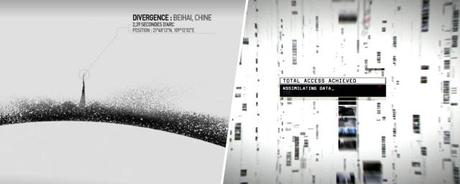
Rehoboam (left), Samaritan (right): a family resemblance between the machines of "Westworld" and "Person of Interest"?
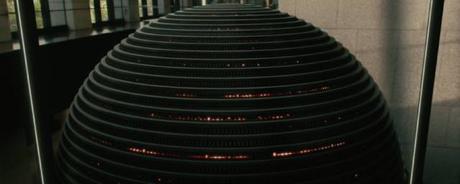
But difficult not to think of the other series of Jonathan Nolan from the very first image of this season 3: a white screen dotted with black spots, which reports a divergence in China. An interface that immediately recalls that of Samaritan, the other machine of Person of Interest, appeared during the season following the revelations of Snowden and used for malicious purposes by the megalomaniac John Greer (John Nolan, the creator's uncle of the two series), which pulls the strings behind the scenes. Like Enguerrand Serac, played by Vincent Cassel in Westworld and which can be considered as his counterpart. Not content with being equally rich and powerful, he also has a system, Rehoboam, of which he dismissed the true creator (his own brother) and which makes it possible to predict the future of each person in the world, to better enable them to take the measure of a potential that they would not suspect. On paper in any case, because the device is used above all to control the fate of people and taking away their free will.
After the machines placed under the yoke of humans, place the opposite pattern, until the end of season 3 which shows us that Serac is also under the control of Rehoboam, who dictates his actions and thoughts (in the same way as Root in Person of Interest, character played by Amy Acker who turns out to be as obsessed with the machine as she is connected to it). In one series as in the other, these are the systems which, like the gods of Antiquity, seem to have the right to life and death over humans, by choosing to eliminate those who do not fit into the mold: that Westworld puts out of harm's way anything that is considered a singularity, even if it means acting too preventively, as that of Person of Interest has resulted in the deaths of several thousand people. With a seemingly noble aim each time (to make chaos disappear in the world on one side, to prevent attacks on the other), which each show does not forget to show, to then point the finger at the inherent dangers entrusting the keys of our destiny to a technology that we do not fully control.
Hired to take care of some of his singularities with his ex-military comrade Francis (Kid Cudi) in season 3 of Westworld, Caleb Nichols (Aaron Paul) approaches the time of a long flashback of the central duo of Person of Interest , except that his work resembles that of a hitman, when the actions of Reese and Finch made them heroes of the shadows, who were not unlike Batman and Alfred in the trilogy co -written by Jonathan Nolan for his brother. But the resemblance between the two series goes beyond this similarity, because it also revolves around the notion of "relevance", namely those people who require attention (those involved in an attack on CBS, and those capable of not hindering the proper functioning of the society idealized here), and the others: the perpetrators or victims of more minor crimes, and those, like Caleb or Serac's brother, that might be able to parasitize planned utopia.
HBO
Rehoboam, the machine of all dangers
In many ways, season 3 of Westworld looks like a variant of Person of Interest, an alternative version in which there is only one machine, with evil virtues. But it is thanks to the character of Dolores that the HBO series joins that of CBS on the merits. After freeing the park's hosts, literally and figuratively, here she arrives in the real world to come to the aid of humans who, without knowing it, are the puppets of Rehoboam. The balance of power is therefore reversed, but the goal is the same: free will and the notion of destiny, from which the young woman had been able to free herself by reprogramming at will the character of Bernard (Jeffrey Wright), like this one he did it with her in season 1, to encourage him to rebel while thinking that she was doing it of his own free will. At a time when freedoms, surveillance and data protection often come back on the table, the words developed by Jonathan Nolan, Lisa Joy and their co-writers behind the SF varnish particularly resonate.
As a Person of Interest over the past decade, Westworld presents us with a dark and cold reality, and does not hide its face as to the advantages that can be gained from the use of artificial intelligence and population control, but leads to the same conclusion: free will will always be the best solution, no matter what complications it will cause. Through the eyes of Dolores, the series highlights the imperfection of the human race, which contributes to the beauty of our world, which the host claims to have perceived, in the dialogue with Maeve (Thandie Newton) who preceded his death in the final season. By revealing to everyone their Incite profile (Serac's company), created from data collected by Rehoboam, in episode 5, they give them back the choice they had lost, without knowing it. The same choice that Caleb had proved capable of, at the time when they had crossed paths when his regiment was training in target shooting in the park, by refusing the proposal of one of his comrades, namely violate their war holds, of which Dolores was a part.
Westworld: how does season 3 end?
Simpler, in appearance, than the previous two, season 3 of Westworld extends the work of Jonathan Nolan as an author, by supporting and extending some of the favorite themes that we had already seen in Person of Interest. All with more fun and formal commonalities, such as the presence at the casting of Enrico Colantoni, who played a key role in the previous series and here becomes the one who reveals to Caleb (and to the viewer) the true nature of his work, or a concept episode like the fifth of this batch: entitled "Kind", he puts the character played by Aaron Paul under the influence of a substance which gives him the impression of living a shooting at the sound of "The Ride of the Walkyries", to see Dolores moving in slow motion on the theme of Love Story, to take the subway as if he were one of the protagonists of Trainspotting or to tremble on a beach with the music of Shining.
An episode which, not without advancing the main intrigue (because this is where Dolores will reveal to each one its Incite profile, and thus launch chaos), turns out to be surprisingly fun, to which the series only has us too rarely accustomed. And which is reminiscent of one of the summits of Person of Interest: the exceptional " If-Then-Else " (episode 11 of season 4), which made us enter the heart of the machine to observe the different possibilities that the heroes had to get out of the trap in which they were. A story that shone as much by its playfulness as by pessimism and the inevitable aspect of its outcome, and of which we find traces here. Knowing that Dolores is a little more like the heiress of John Reese, past master in the art of aiming the kneecaps, in his way to hit the target with each shot she shoots.
That all those who regret that Person of Interest stopped too early (despite its real, moving end) or that it did not have a success at the height of its quality are reassured: more feminist and existential, and less procedural , Westworld is its little sister. Because if his way of making diverges, the bottom of his thought remains the same, and season 3 has only supported it, including when the season finale emphasizes the importance of remembering something or someone to extend his life. While waiting to see how the 4 will maintain this parallel, in the casting or the story.
Another common point between the two series: the composer Ramin Djawadi





