Found a vintage Vesta Dietrich sewing machine: discovering a piece of history | #LRCrafts - DIY Passion: if you can think it, you can make it
Recently, we had to empty the old house of my husband’s grandmother. As a job she used to sew for a shoemaking company in Italy, using her industrial Singer 31K15 machine both for work and her family until a few months before her passing. With that machine, she repaired shoes, created new ones and sewed for the family.
I went with the family to see if there was anything of granny’s we could keep as mementos. We took a mirror and a couple of vases, but I was particularly interested in her sewing machine. I knew about the Singer, having seen it many times in her living room. But I didn’t know there was another one.
Among her belongings, next to her bed, my husband showed me a table I had never noticed before. To my surprise, it held a vintage treadle sewing machine. It was in perfect condition, with pristine decals, two small drawers filled with accessories and attachments, and even the original manual. The treadle and main body bore the name Dietrich, while a Vesta badge was affixed just above the plate with the serial number. It wasn’t a Singer, so my usual serial number database was of no help.
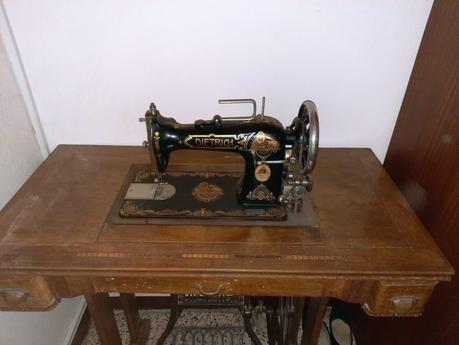
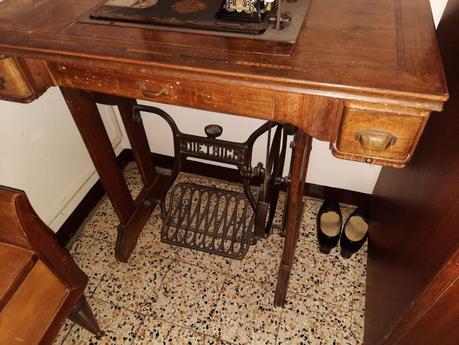
Since workers were scheduled to empty the house the next day and discard whatever was left, I took it upon myself to save this machine, along with the industrial Singer. I called my dad with his truck to help me find a place for the machines. He had room in his cellar and agreed we could figure out what to do with them later. Like me, he was determined to save these machines from the landfill.
Do not fear, the outcome is a happy one for both machines. Now, let me tell you the story of the Vesta Dietrich. Stay tuned to learn more about the industrial Singer as well.
Table of contents
Saving the sewing machines from the landfill
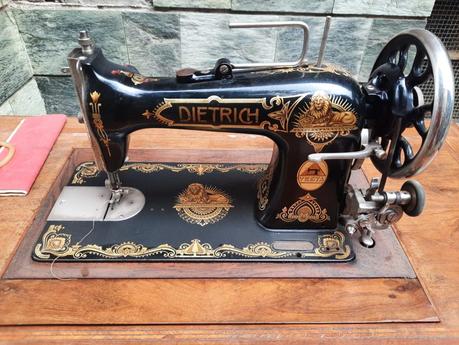
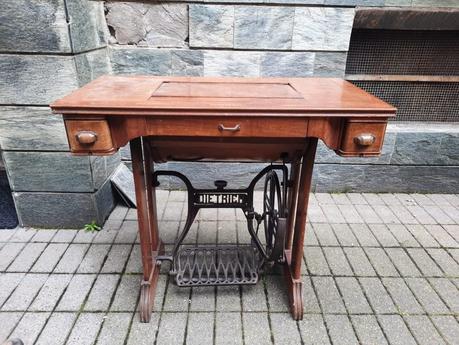
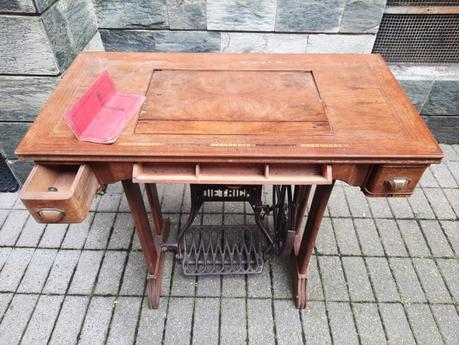
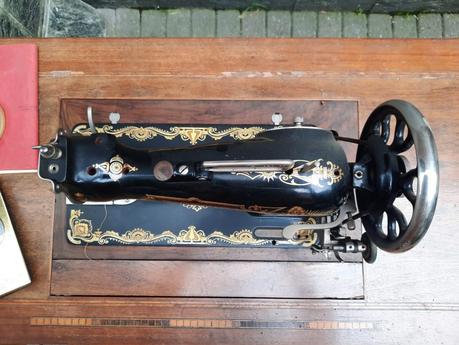
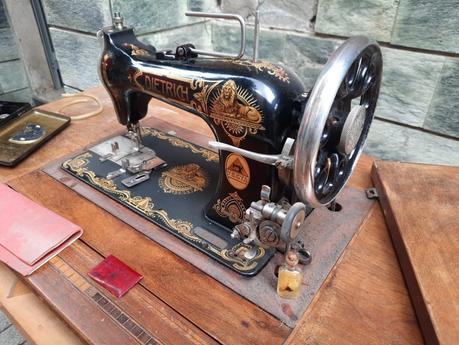
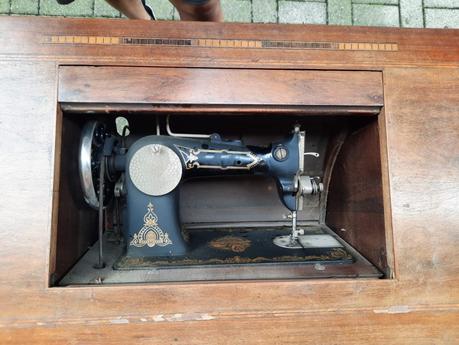
Well, after arriving at my parents’ house, my father and husband unloaded the machines, and we started inspecting them more closely. My husband suggested taking some photos in the sunshine to sell them online. As I started photographing the details of the Dietrich/Vesta, my father admired it more and more, saying it was in even better condition than the Singer 15K we had acquired a couple of months before for our countryside home.
I hadn’t even finished photographing the accessories when my father decided: that machine wouldn’t go to the cellar. Instead of taking it downstairs, he carried it up to his bedroom and placed it next to an antique chest of drawers he salvaged from his childhood home.
That’s how it quickly ended for the Dietrich/Vesta, and I am so happy about it! Now I have plenty of time to explore it, learn how to use it, and discover all the attachments and accessories.
Upon closer inspection, we found that the machine was a treasure trove of history.
It has what I learnt is a signature “crocodile” texture on the back plate, on the face plate and on the stop motion clamp screw. I wonder if this feature could help dating the machine…
In one drawer, there was the manual, printed in Pavia ( Italy) in 1935. Since Pavia was the headquarter city of Necchi, another sewing machine manufacturer with a long history, I wonder if that typography had also printed the manual for the vintage Necchi Supernova Julia my husband’s uncle owns… I’ll go check it out for sure.
The other drawer contained a box of attachments and more. We found various presser feet, a few spare parts like a needle plate, bobbin case, oil bottle, thread tension spring, and needles. There was even a group of German needles in their original envelope. Additionally, the drawer held the key to lock the table, plus some old keys of unknown purpose.
As an archaeologist, I wanted to find out more about the history of this machine, as I did for the Singer 15K.
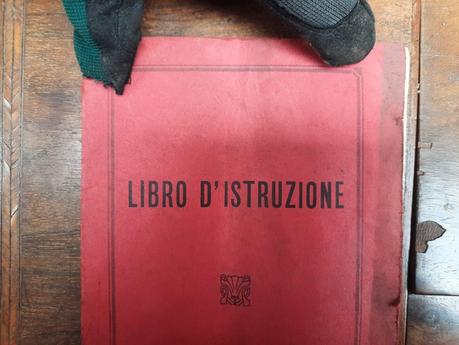
Cover of the 1935 manual of our Vesta Dietrich sewing machine
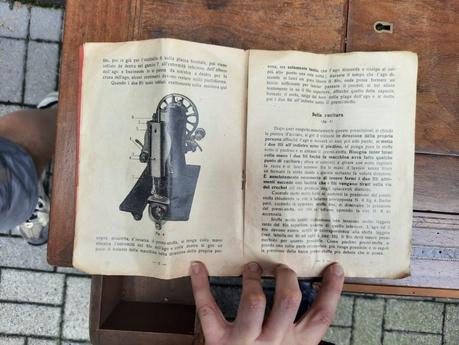
A page of the 1935 manual of our Vesta Dietrich sewing machine (in Italian)
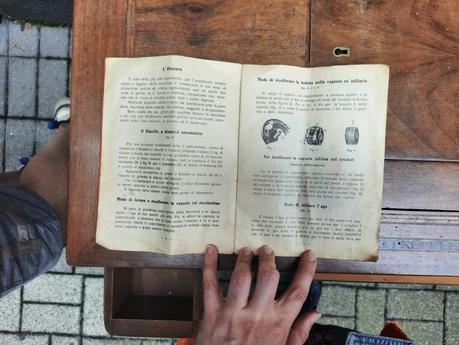
A page of the 1935 manual of our Vesta Dietrich sewing machine (in Italian)
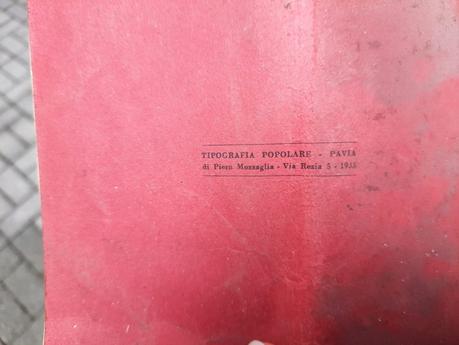
Back of the 1935 manual of our Vesta Dietrich sewing machine, with the year of printing (1935)
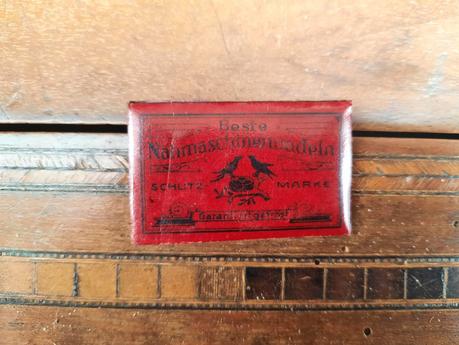
German needles in their original envelope
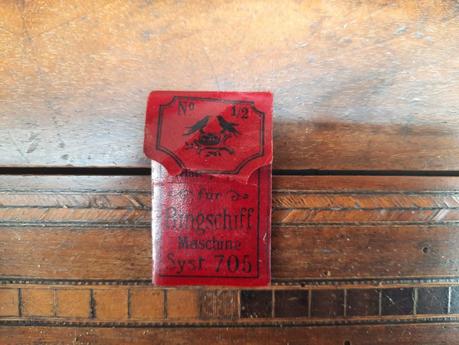
German needles in their original envelope
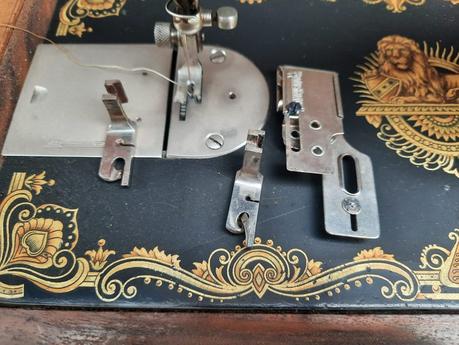
The presser feet that came with the Vesta Dietrich sewing machine
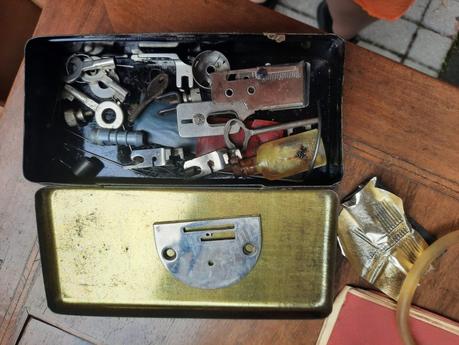
The box of attachments and accessories we found in the drawer of our vintage Vesta Dietrich sewing machine
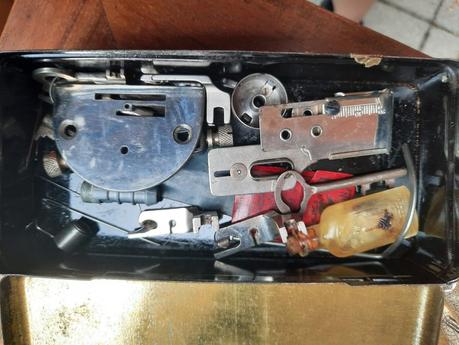
The box of attachments and accessories we found in the drawer of our vintage Vesta Dietrich sewing machine
The history of Dietrich & Co. and the Vesta brand
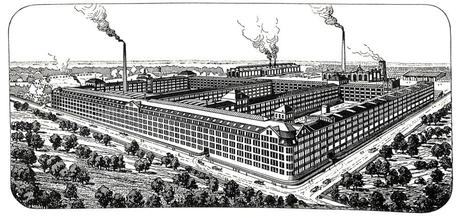 L. O. Dietrich sewing machine factory in Altenburg (Germany), 1913Photo by Wikimedia Commons
The history of Dietrich & Co. is a fascinating journey that begins in the 19th century with three visionary locksmiths who decided to embark on a venture that would leave a significant mark in the sewing machine industry. In July 1871, Leopold Oskar Dietrich, Hermann Köhler, and Gustav Winselmann founded a workshop in Altenburg in Thuringia (Germany), about 40 kilometres (25 miles) south of Leipzig, for the production of sewing machines under the name Dietrich & Co.
The three founders, having worked together at the renowned Clemens Müller Sewing Machine Factory in Dresden, utilized their combined expertise and skills to develop their first sewing machine model, the Allemannia, in January 1871. By the end of that year, they had produced approximately 300 machines. For the first 20 years their machines were basically copies of Singer models, with a big S on their badges.
In 1873 Dietrich parted ways with his partners to start his own sewing machine trade. Despite this separation, Dietrich continued to make significant strides in the industry. By 1874, he was manufacturing his own sewing machines, and in 1875 the company relocated to Wilhelmstrasse to accommodate its growing operations.
As production increased, Dietrich & Co. moved again in 1880/81 to a new factory on Ziegelstrasse. This facility enabled them to scale up their operations significantly, reaching an annual production of about 12000 sewing machines. The company’s commitment to innovation and quality soon established them as a major player in the sewing machine market.
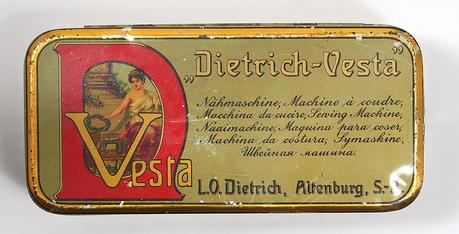 Tin box of Dietrich-Vesta sewing machine attachments from The NetherlandsPhoto from Wikimedia Commons - tincollectors.nl
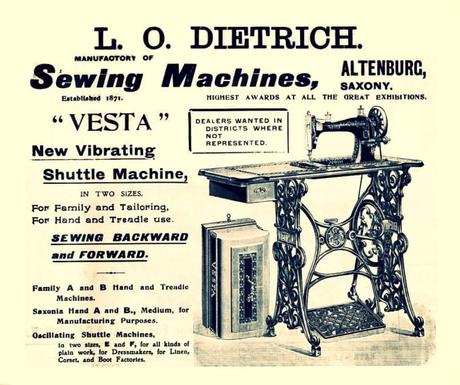 1898 advertisement of the new Vesta vibrating shuttle sewing machine by L. O. Dietrich
A pivotal moment in the company’s history came in 1895 with the introduction of the Vesta trademark. The name, derived from the Roman goddess of fire and the hearth, symbolized the strength and reliability of their machines. This rebranding marked the beginning of a new era for Dietrich & Co., as the Vesta name became synonymous with quality and durability.
In November 1896, the company registered its first gold logo badge, which did not mention Singer as before, distinguishing their brand identity further. By this time, Dietrich & Co. had established their own foundry in 1889, allowing them to produce essential components like shuttles, cabinets, and tools in-house, reducing their dependency on external suppliers.
The early 20th century was a period of expansion and diversification for Dietrich & Co. In 1904, after the death of Leopold Oskar Dietrich, the company continued to flourish under the new management of his son. They introduced knitting machines in 1906, further broadening their product range. The factory underwent several expansions, including significant additions in 1908 and 1912/13, to keep up with increasing demand.
By 1920, the Vesta name had fully replaced the Dietrich name on their sewing machines. The company’s production figures were impressive, with about 1.5 million machines produced by 1925 and a workforce of around 1400 employees. The annual output had risen to approximately 150000 machines by 1927, showcasing the company’s substantial growth.
The economic downturn of the 1930s posed significant challenges for the company, leading to a decline in sales. In response, Dietrich & Co. diversified into defense contracts and began manufacturing MG 15 machine guns by 1935. This shift in production priorities reflected the broader economic and political landscape of the time.
During World War II, the company’s focus shifted entirely to war munitions, and sewing machine production was halted. The post-war period brought further changes when the factory was dismantled by the Russians as part of war reparations.
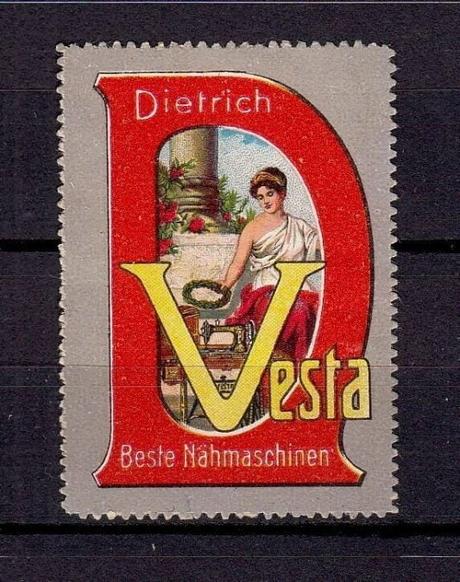 A Vesta Dietrich advertising stamp
In 1948, the remnants of the Dietrich and Köhler companies merged to form VEB Naehmaschinenwerke Altenburg under the Textima Co-operative. This merger marked the beginning of a new chapter for the company in the German Democratic Republic (East Germany).
Despite the challenges and changes, the legacy of Dietrich & Co. lived on through the quality and durability of their Vesta machines. The company’s ability to adapt and innovate throughout its history is a testament to its enduring impact on the sewing machine industry.
The symbolic meaning of the Vesta trademark
Rooted in ancient mythology, the Vesta trademark holds a significant symbolic meaning.
The name “Vesta” itself is deeply embedded in ancient mythology. For the ancient Romans, Vesta, known as Hestia to the Greeks, was the goddess of hearth, home and family. She was revered as the guardian of the sacred fire that burned at the center of every home and city. The Vestal Virgins, her priestesses, tended to her flame with utmost dedication, ensuring it never extinguished. This eternal flame symbolized continuity, purity, and the enduring stability of the home and community.
Drawing inspiration from this rich symbolism, L.O. Dietrich named their line of sewing machines “Vesta”: a thoughtful choice that connected the qualities of the goddess with the product’s intended role in households. Just as Vesta’s flame represented the heart of the home, the Vesta sewing machines were designed to become central to household life, aiding in the creation and repair of clothing and textiles that families relied upon.
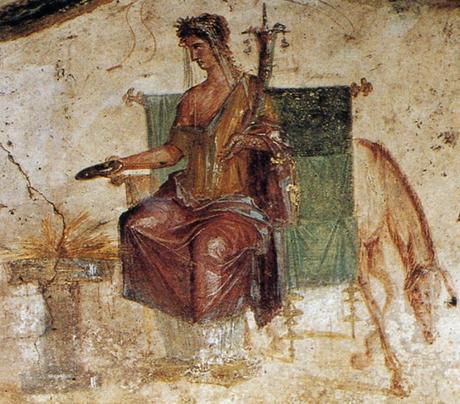 Rare depiction of Vesta in human form, as the central figure from the Lararium of a bakery at Pompeii, 1st centuryImage from Wikimedia Commons
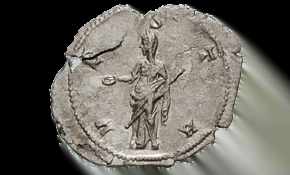 The goddess Vesta standing left, holding patera in right hand, transverse sceptre in left. Face of an Antoninianus coin.Image from Wikimedia Commons
Ing. R. Stärk, who had worked for the L.O. Dietrich company in Altenburg for years, was interviewed in the 1980s about the symbolic meaning of Vesta by Otto Landgraf for his book “Oldtimer-sewing Machine“. He was known in the sewing machine industry as a specialist and experienced person, and also as a man with a good humanistic education.
This story of Vesta fits into our context in many ways. Just as the Vestal Virgins guarded the sacred fire, the company L.O. Dietrich, later Vesta, safeguarded the quality of their sewing machines. The high quality and reputation of the Vesta sewing machines are still respected today, and this is symbolized by the Vesta brand.
The evolution of the Dietrich and Vesta emblems
The Vesta emblem on the sewing machines evolved over time, but it always retained its core symbolic elements.
One of the earliest trademarks used by L.O. Dietrich was an oval shield inscribed with the initials “L.O.D.” This badge was not just a mark of the company’s founder, Leopold Oskar Dietrich, but also a testament to the brand’s promise of quality. The inscription “Beste Deutsche Näh-maschine” (“Best German Singer Sewing Machine”) highlighted their competitive edge and high standards.
The Vesta triangular emblem with upward-facing letters represented a commitment to excellence and continual improvement. This shape symbolized a striving towards greater perfection, much like the upward aspirations of human endeavors.
Around this triangle, laurel wreaths were added. Traditionally, laurel wreaths symbolize victory, honor, and achievement. In the context of the Vesta trademark, they represented the praise and recognition the brand received for its superior quality. The dark red color of the wreaths further emphasized a bold, enduring commitment to excellence, contrasting with the softer symbolism of the Vestal Virgins’ fire.
The basic triangle and circle logo with the wreath underneath was introduced in 1932. “Vesta” was added in 1933, and “L.O. Dietrich-Altenburg” was curved around the logo in 1934. There is some uncertainty about whether a version with “L.O. Dietrich Altenburg” blocked underneath dates slightly later, but it was certainly used before 1937.
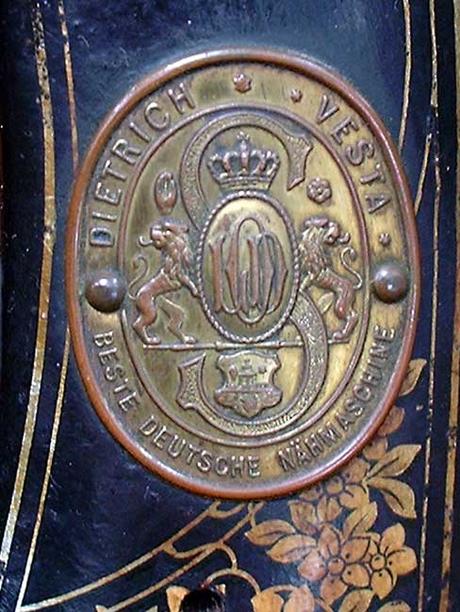
This logo uses the old style L.O.D. ‘S’ logo and also mentions Vesta. The name Vesta was first used by the company in 1895.
Image from Needlebar Wiki (now offline)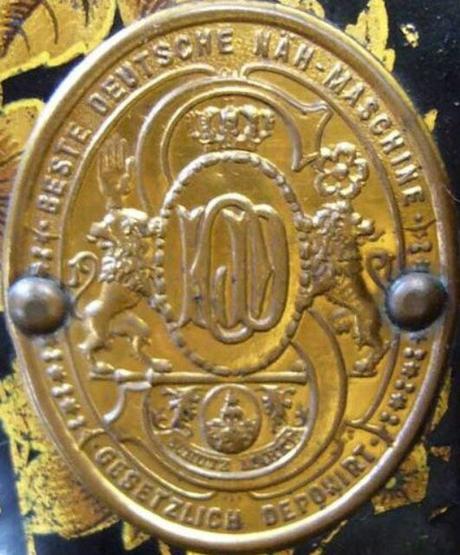
One of the earliest trademarks used by L.O. Dietrich was an oval shield inscribed with the initials “L.O.D.”. The inscription “Beste Deutsche Näh-maschine” (“Best German Singer Sewing Machine”) highlighted their competitive edge and high standards. The gold logo badge was registered in November 1896 and was the first Dietrich badge not to mention Singer.
Emblem from the sewing machine base frame “L. O. Dietrich – Vesta” around 1900
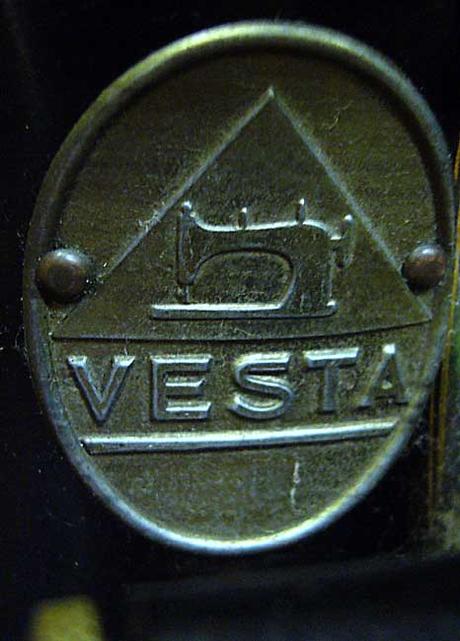
Mid-1920s Vesta sewing machines logo, without wreath
Image from Needlebar Wiki (now offline)Vesta sewing machine triangle and circle badge, 1930s. The basic triangle and circle logo with wreath underneath was introduced in 1932. “Vesta” was added in 1933 and L.O. Dietrich-Altenburg curved around the logo in 1934. It is unsure whether this version, with L.O. Dietrich Altenberg blocked underneath, dated slightly later, but it was before 1937.
Image from Needlebar Wiki (now offline)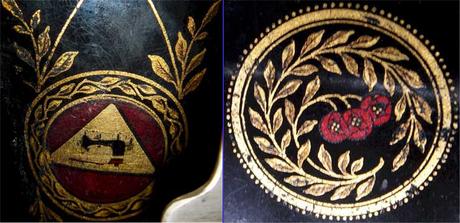
Little Vesta sewing machines logo around 1930
Image from Needlebar Wiki (now offline)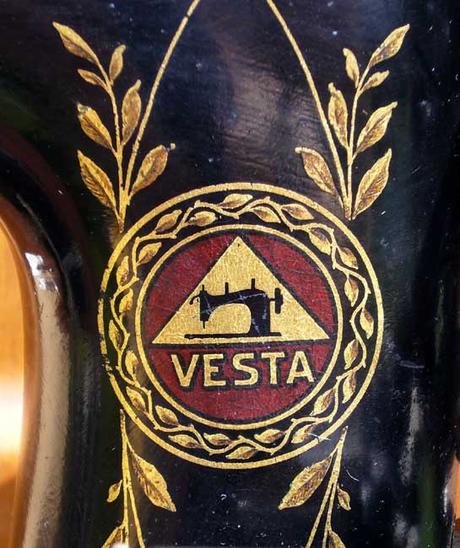
Vesta logo around 1930s on a vesta B model
Image from Needlebar Wiki (now offline)Identifying our Dietrich Vesta sewing machine: the issue of dating
Researching the history of the Dietrich company was fascinating. I learned a lot about a firm I had never heard of before. This deep dive was paramount to try and find a date for our Vesta Dietrich sewing machine.
As I said, the machine has a serial number 1E562570, where the letter “E” is smaller than the numbers. With no available database, I had to dive deeper and make polite guesses based on various clues and historical details.
The machine features both the Dietrich and Vesta names. Given the Vesta badge, it indicates production after 1895 when the Vesta brand was first used. The name “Dietrich” was replaced by “Vesta” around 1920, suggesting that machines bearing both names could likely date to before this transition. I looked for photos of other machines from the same manufacturer but I never found the two names on the same machine body. The most common machines bear just the Vesta name and badge.
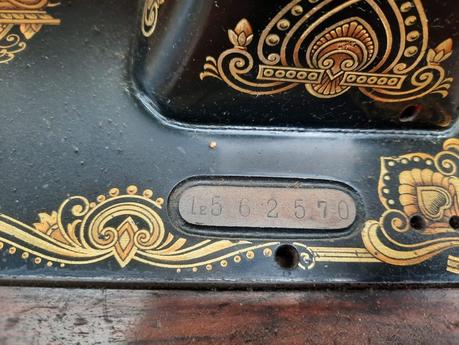 My Vesta Dietrich serial number, with an odd miniature letter "E"
I reached out to SingerSewingInfo, one of the most reliable websites on vintage sewing machines, focused on Singer, but with info on other manufacturers.
They told me that, usually, the name on the main body of this kind of machines was usually the model name. This is consistent with the other Vesta-badged machines I saw around. I’d love to know more about a Vesta machine, Dietrich model. Was is some commemoration model for L. O. Dietrich or some descendant?
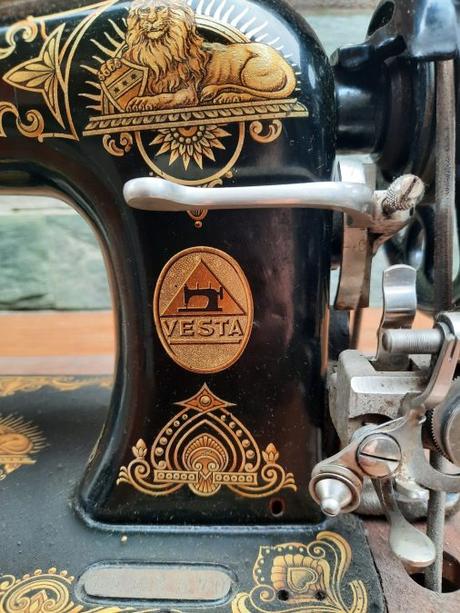 My Vesta Dietrich sewing machine badge
Since the machine came with a manual printed in 1935, I could have a clue that it was built before 1935. I suppose they manufactured the machine first, then translated and printed the manual. The same kind lady at SingerSewingInfo, though, correctly pointed out that manuals often get lost or damaged, so sewists replace them much later with copies of whatever date they can find. So they can be older or newer than the machine. Not such a strong clue, then.
Refining further, I found out that, according to Fiddlebase, a machine with serial number 1516561 is dated around 1925. This could provide another benchmark, suggesting my machine was likely made after this date. However, due to the tiny letter “E” in the serial number and uncertainty about Vesta machines dating, this clue has limitations.
Going on considering serial numbers, I found more:
- Serial No. 1487439: Made in the early 1930s.
- Serial No. 1619431: Dated to 1932.
- Serial No. 1632485: Dated around 1933.
- Serial No. 1991349: Dated to the late 1930s
If there’s a pattern in serial numbering and the tiny letter “E” can be ignored, my machine’s serial number 1E562570 fits within this range, likely placing it in the early 1930s, just before the one made in 1932. All this if we consider the information I found reliable, but I have no clues about it. Also, the company could have allotted the serial numbers in order, as Singer did, but then skipped some in the final production, or used smaller previously unused numbers in later machines and so on.
Those are just clues and I have nothing more to cling to. If anyone has further information I could benefit from, please tell me in the comments below.
Conclusion (for now) and future plans
The journey of saving two sewing machines from the landfill and uncovering the history and dating of our Dietrich/Vesta sewing machine has been both enlightening and rewarding. From the initial discovery amidst my husband’s grandmother’s belongings to the detailed research into the company’s storied past, I’ve gained a deeper appreciation for the craftsmanship and innovation that defined Dietrich & Co.
By piecing together clues, I’ve arrived at an educated guess that our machine likely dates to the early 1930s. However, there is still more to uncover. How did Granny acquire this machine? Was it a family heirloom? What are all the attachments for? How can I operate it and maintain it in its pristine condition?
If anyone has further information or insights that could help refine the dating of our Dietrich/Vesta machine or discover more about its operation and accessories, I would greatly appreciate your input. Please share your knowledge in the comments below. Together, we can continue to honor and preserve the legacy of these incredible machines.
And don’t forget about the industrial Singer 31K15: the next step will be to uncover its history. From the family clues, I suspect it will be an interesting one!
Resources
- Fiddlebase on Vesta Sewing Machines
- Needlebar on Vesta brand
- SewMuse on Dietrich Sewing Machines
- Needlebar Wiki on L.O. Dietrich
- Sewing is Cool on Vesta Sewing Machines
- Alex Askaroff on Vesta sewing machines
by Rici86.