"This is a big story, and you're part of it."
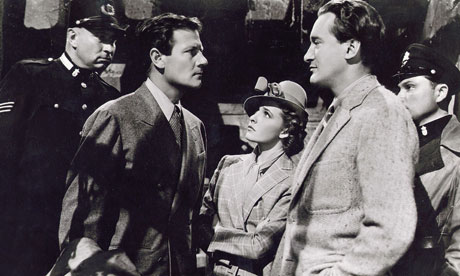
Alfred Hitchcock earned two Best Picture nominations in 1940, a feat unmatched until Francis Ford Coppola's The Godfather Part II and The Conversation thirty-four years later. His antifascist thriller Foreign Correspondent was more topical, yet aged far better than Rebecca's lurid Gothicism.It's August 1939 and the New York Globe sends reporter Johnny Jones (Joel McCrea) to cover simmering tensions in Europe. Under the alias "Huntley Haverstock," Jones falls for Carol Fisher (Laraine Day), daughter of a British peace activist (Herbert Marshall). Traveling to Holland, Jones witnesses the assassination of Dutch diplomat Van Meer (Albert Basserman). Afterwards, Jones/Haverstock uncovers a multinational fascist conspiracy to drag Europe into war.
Foreign Correspondent was among several antifascist dramas in prewar Hollywood, many directed by European émigrés. Hitchcock blends the message onto a lighthearted chase. Charles Bennett and Joan Harrison's script has time for humor, whether it's in Jones ducking an unctuous Lativan (Edward Conrad) or journalist ffoliet (George Sanders) bantering about his name while dodging assassin's bullets. This playfulness gives way to impassioned speechmaking, with Jones extolling America as the world's last hope.
Hitchcock contrasts this high-mindedness with prewar foolishness. Americans ignore the coming conflict while Britons wish it away. Peacemakers are ineffectual fools or active Nazis; no points for guessing Fisher's playing for the wrong team. Despite Jones' disdain for "well-meaning amateurs," it's a cabal of journalists who unravel the conspiracy. Embracing his "new" identity as Haverstock, Jones becomes an unlikely hero. Based on globetrotting journalist Vincent Sheehan, he transforms into Edward R. Murrow, broadcasting from Blitzed-out London.
Like most Hitchcock films, the plot hinges on a thin contrivance. Why stage an assassination of Van Meer then kidnap the real man? Any objection fades before the bravura set pieces. Jones stalks an assassin through a field of windmills (beautiful matte work by William Cameron Menzies) in a brilliantly intense sequence. Later, he's hustled about London by a friendly "detective" (Edmund Gwenn) who's been sent to kill him. The film ends with an epic, mixing miniature work and a studio tank. It's a marvel of Hollywood legerdemain that holds up well.
Joel McCrea makes a good straight man transforming from dilettante to passionate interventionist. The British players are equally effective: Laraine Day's tough-minded activist, George Sanders' snide journalist. But Herbert Marshall's beautifully complex, tragic villain steals the show: Hitchcock grants him sympathy rarely accorded to wartime Nazis. Edmund Gwenn is an hysterically chummy assassin. Stock villain Eduardo Cianelli plays another dastard.
Foreign Correspondent is as blunt as Confessions of a Nazi Spy or Man Hunt. Those films show German refugees slowly alerting Hollywood to the Nazi threat. Hitchcock followed their lead; an Englishman working in America, he stood by his homeland and urged Americans to do the same. The films seem strident today, but if you can't be strident about Hitler...