


The Bronco is officially back. After 24 years, Ford relaunched the 2021 Bronco in a quick revelation streamed Monday night on ABC, ESPN and National Geographic, each short film showing a different family member: the 2-door Bronco, the 4-door Bronco and Bronco Sport.
The Bronco 2021 - Ford's flagship series of 4 × 4 vehicles - is a brand that relies heavily on nostalgia, personalization, functional design and technology such as the automaker's next generation infotainment system and a digital tracking functionality that allows owners to plan, record and share their experiences through an app.
This is not the 1966 Ford Bronco, the first year the sturdy two-door off-roader entered the market to compete with the Jeep CJ-5. However, the DNA of that historical model is present in this modern version of Bronco 2 and in a new four-door version. The third model, the Bronco Sport, is a more comfortable spin-off designed to be capable of off-roading and to function as a daily driver on the streets and highways of the city.
Production of the new Bronco series will begin in early 2021 with the first models arriving in dealerships next spring. All three Bronco models will be built at the Michigan assembly plant in Wayne, Michigan. Ford has also opened reservations, where potential customers can earn $ 100 to keep their seat for the Bronco two- and four-door models.
Ford has not released all the details on the three models, such as prices for Bronco Sport and Bronco 4. (The Bronco 2 base model starts at $ 29,995, including the destination and delivery of $ 1,495).
There is still a lot here. Let's unpack it, starting with the bases of two-door Bronco two-door and Bronco four-door vehicles. So we will explore some important topics including nostalgia, design, personalization and technology.
Bronco 2 and Bronco 4
Both models have a steel frame and an independent front suspension, with the aim of improving control. At the rear, the solid axle features coil springs with five positioning links to provide road control and strength. The vehicles are equipped with two possible engines - a 2.7-liter V6 or a 2.3-liter four-cylinder - and are available with a 7-speed manual transmission and a 10-speed automatic transmission. The 2.7-liter EcoBoost V6 engine is designed to produce 310 horsepower and 400 lb.-ft. of torque, while the 2.3-liter four-cylinder engine has a torque of 310 lb.-ft. with an expected power of 270 horses.

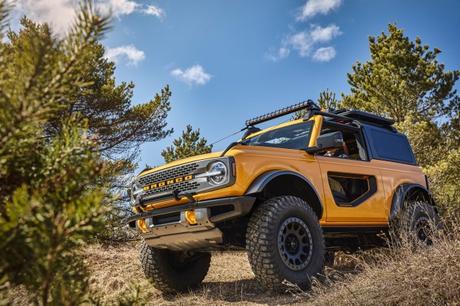
Ford gave the Bronco a 11.6-inch ground clearance, a 29-degree breakout angle and a 37.2-degree starting angle. It also has water forging capabilities of up to 33.5 inches. For safety, Ford designers have added more protection and weight, including modular steel bumpers with integrated winch support. Some of the high-end versions of the Bronco have steel screens to protect critical hardware, including the engine, transmission, transfer box and fuel tank.
Oh, and how could I forget. Ford provides 35-inch off-road tires for every trim level on Bronco 2 and Bronco 4.
Bronco Sport
In the meantime, the Bronco Sport is a slightly different animal that wants to be the one that goes everywhere and does everything the family truck driver does. Sport offers many of the same off-road capabilities in a smaller package.
While it may not have the same degree of customization as Bronco 2 and Bronco 4, there are many ways to configure Sport. It is available in five pieces, including the base model, Big Bend, Outer Banks, Badlands and First Edition, as well as four bundles of accessories available. Ford offers over 100 factory-supported standalone accessories for carrying a wide range of equipment including kayaks, skis and camping gear.
Bronco Sport has two EcoBoost engines to choose from, depending on the coating. There is a 2.0 liter engine that produces 245 horsepower and 275 lb.-ft. of torque or a 1.5-liter engine with 181 hp and 190 lb.-ft. of couple. Both engines are combined with an 8-speed automatic transmission. Some finishes of the Bronco Sport also have steering wheel controls mounted on the steering wheel.
Digging deeper into the Bronco family of vehicles some themes emerge, particularly with Bronco 2 and Bronco 4. The vehicles are meant to remind us of the original as they advance into the future. They are designed to be robust and establish a modern, human-centered functional design, while embracing technology in some key areas.
Nostalgia
While technologists may give nostalgia a little nostalgia, its power cannot be denied. As ProWellTech's Matt Burns noted last week, Ford will use the old Bronco to sell the new Bronco, just as Nintendo uses past games to sell new games.
Bronco 2 2021 is clearly new, especially when you look inside. But looking at the outside it is difficult to lose inspiration from the original.
Bronco 2 and Bronco 4 have square proportions, short protrusions and a wide position, all aspects that make these vehicles prepared for off-road use. They also referred to the original design. From the side, you will notice distinct edges and flared fenders, again a nod to the first Bronco.
Customization
That's where the Bronco 2021 series really shines. Ford has come up with countless ways to customize Bronco 2 or Bronco 4.
The automaker offers seven different versions of Bronco 2 and Bronco 4 with combinations of colors and matching finishes. There are also 11 different paint choices and four content packs. The options start with the basic version with no frills and end with the Wildtrak and Badlands versions to venture into the most extreme off-road vehicles. Big Bend, Black Diamond and Outer Banks sit in the middle. And of course, there is a first limited production edition that will be offered at launch.
The automaker also has more than 200 factory accessories.
Bronco 2 and Bronco 4 are designed to be configured in multiple ways. For example, Bronco 2 models are equipped with a standard three-section roofing system. There's also a premium painted modular top with four
sections that add a removable panel above the rear seats and the cargo area. The Bronco 4 has four removable roof sections, all Ford promises that can be removed by a person by unlocking the latches from the inside.
The models are also available on soft or hard disk, or they can be optional with both. Even large open wheel wells have a modular design with a quick release attachment for customization.
Technology
Much of the technological attention is paid to the all-wheel drive system and is at the heart of the so-called soil management system. Bronco 2 and Bronco 4 have up to seven modes selectable by the driver for off-road driving, including Normal, Eco, Sport, Slippery and Sand, with Baja, Mud / Ruts and Rock Crawl.
Ford offers two different 4 × 4 systems on all Bronco models, a basic configuration and an advanced system. The basic system uses a two-speed electronic transfer case with on-the-fly change. The advanced option
the system has a two-speed electromechanical transfer case that adds an automatic mode for engagement on demand that allows the driver to select between 2H and 4H (two high and four high).
There is another technology in the vehicle, such as the next generation Ford Sync 4 infotainment system and digital maps. The infotainment system is equipped with a multifunction color LCD instrument panel. Moving down, the driver can interact with the transmission gearbox / selector and the GOAT mode controller (off-road mode) in the center console. The grip handles are actually integrated into the modular instrument panel and the center console for those ST moments.
The designers also included attachment points integrated into the dashboard to mount virtually any desired device, including cameras, navigation units, phones or other devices.
Design
Another great piece of Bronco 2 and Bronco 4 is attention to functional design. After all, this is meant to be an off-road vehicle. And it should work as such.
For example, the trail sights on the front fenders can also be used as tie clips and can handle longer objects such as canoes. These lookout points are positioned so that a user can tie up a boat or other equipment without scratching the paint or lights. But they can also be removed or replaced with other tools, Bronco chief designer Paul Wraith underlined in a briefing before the revelation.
"You can swap them or bolt extra lights or go pro," said Wraith. "And, especially if you're shorter, you can simply use them to tell you where the corners of the truck are, which shows that innovation doesn't always need a microchip."
The interior was also designed with an owner hungry for accessories.






