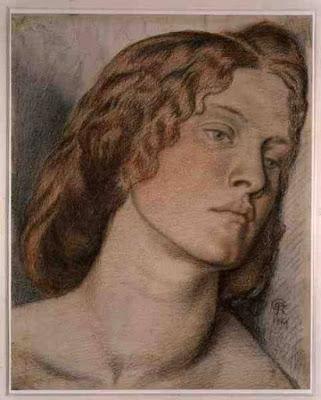
Study for Fair Rosamund (1861) D G Rossetti
When considering what posts I wanted to write this week, I knew I wanted to do a piece on how Fanny was portrayed in her lifetime. To be honest I didn't think any of Rossetti's biographers would bother with her, or any of the models, because you don't think of that sort of salacious biography being the Victorian's style. Having made a list of what biographies came out between 1882 and around 1910 I was delighted to find they were all available to download from Archive.org (links included) (God bless the internet) and so the Fanny hunt began...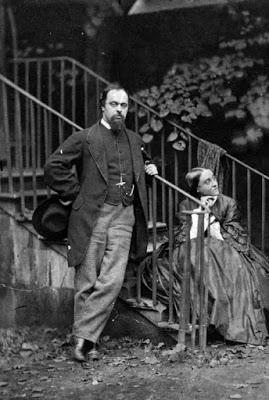
Dante Gabriel Rossetti and Christina Rossetti (1863) Lewis Carroll
Rossetti was bearly cold in the ground before the biographies arrived. For such an intensely private man, the myth of Rossetti was an enormous pull for people and maybe fueled by his enigmatic persona, the books about him, his art, poems and life, came in a steady flow. They fall into roughly three groups: those that pretty much ignore or aren't that interested in Rossetti's love life and therefore Fanny, those that hate her and surprisingly those that love her. Let's take them in that order...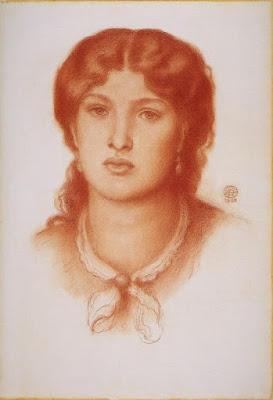
Fanny Cornforth (1868) D G Rossetti
In the neutral ground we have John Bonar Gregory. His chronology of Rossetti published in 1900 mentions that Fanny was the model for Bocca Baciata and that Fanny Schott is the first model for Lady Lilith, begun in 1863, but doesn't connect that it is the same person. He makes the point to mention that Rossetti met Alexa Wilding in 1865, which he obviously finds significant. As a rule of thumb I find if they mention Alexa but not Fanny then something is amiss. Mr Gregory escapes my utter ire as he glosses over both fairly evenly. He, like many others, mentions the final trip to Cumbria in 1881 that Rossetti took with Thomas Hall Caine (more on him later, hiss boo) and Fanny, but completely misses Fanny out of the details. His sins are of omission rather than malice, so he doesn't go on my list...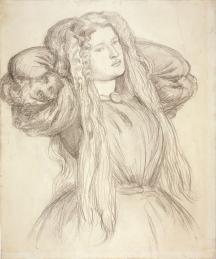
Fanny Cornforth (1860s) D G Rossetti
The same can be said for Joseph Knight in his 1887 Life of Dante Gabriel Rossetti. There is no Fanny or Alexa in the index, although he makes a comparatively big fuss about Elizabeth Siddal and the romance with Rossetti. Again,when it comes to the trip to Cumbria in 1881 there was no Fanny on that trip as far as Knight is concerned.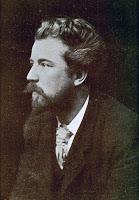
William Sharp
Oh, William Sharp, you naughty boy! In his 1882 Dante Gabriel Rossetti: A Record and Study Mr Sharp gives a handy guide in the back to who owns all of Rossetti's works. Only it's not all the works, its all the works except the ones Fanny owns (which I merrily cross-checked against her Rossetti Gallery catalog from 1883). Even then he says that at least two pictures that are hers, including the oil portrait of Swinburne from 1860, belong to other people or are left with mysterious dots in the comment box. He does list certain pictures to be of 'F.C.' and 'Mrs S-' , both of which are Fanny, but most interesting is that he lists one of the chalk 1874 portraits of Fanny as belonging to William Michael Rossetti, a very interesting mistake to make (no. 6 in the 1883 Rossetti Gallery catalogue).Finally in our neutral category is Ernest Radford's Dante Gabriel Rossetti of 1905 and again his sin is omission. Both Elizabeth and Jane Morris appear, and unusually Radford enthusiastically claims that the later Dante's Dream with Jane as the model is a better version than the original watercolour. He mentions the loveliness of Alexa Wilding but doesn't actually name her, and finally there is no mention at all of Fanny. It's a brief book but has lots of illustrations so I'll let him off.
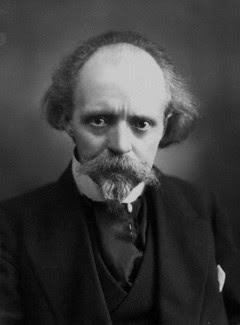
Thomas Hall Caine
The Gollum to Rossetti's One Ring
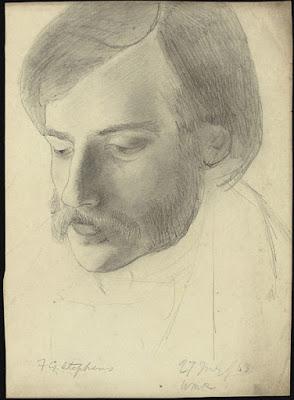
Frederick George Stephens (1853) W M Rossetti
Moving on to the big guns when it comes to Fanny-denying, I am disappointed to say that hot Fred Stephens earns my ire for his Dante Gabriel Rossetti from the 1890s. I expected more from him, not actually being involved in any of the ugly wrangling with Fanny at the end of Rossetti's life, but his trouble is that he cuts Fanny out of the story rather crudely, whilst making himself look like an idiot. Firstly, he lists Alexa in the index but not Fanny. I thought it was a mistake as he talks about Bocca Baciata in quite glowing terms - 'the bust of a young woman whose face, saturated with passion as it is, battles description and justifies its title of Bocca Baciata, or lips that have been kissed.' Well, that's all quite lovely and he correctly goes on to explain how the model for the original Lady Lilith and The Blue Bower are the same as Bocca Baciata. Well done Fred! You can tell he knows what he's talking about! He then says that model is Ruth Herbert. Idiot.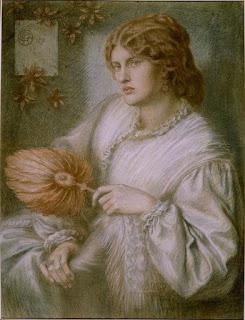
Woman with a Fan (1870) D G Rossetti
It's not so much the fact he leaves Fanny out of the narrative, because heaven knows he wouldn't be the first to do that, it is just that a man who was present at the time, who knew exactly what Fanny meant to Rossetti's work, could be so petty as to exclude her and misidentify the works. He finishes the section where Fanny should be by saying that Ruth Herbert was followed by Jane Morris in Rossetti's work, completing his new chronology. The only thing he says about a picture featuring Fanny without misidentifying the work is his comments about A Lady with a Fan from 1870. Grouping the model for that picture with all other Rossetti models of similar works he say that their 'nobelest function is to live and be beautiful.' On A Lady with a Fan specifically he says the hands are too big. Thanks for that.Another rule I learnt while reading these biographies was that if the author thanks Thomas Hall Caine in their acknowledgements I knew what to expect. This is definitely the case with Esther Wood's 1894 Dante Gabriel and The Pre-Raphaelite Movement. Wood mentions many models in her text including Alexa Wilding, Marie Stillman and Ruth Herbert but no mention of Fanny Cornforth. The description of the trip to Cumbria comes straight out of Hall Caine, with the agonized painter/poet pacing the room and refusing to go out with only his valiant young companion to keep him company. A slightly different account than Rossetti himself gave to his friends and family in his letters home where he rolled down hills while Fanny laughed and they had a jolly good time. As further proof of how dubious Wood's sources are she writes how Rossetti and Morris shared Kelmscott together, no doubt in jolly peace and certainly no love-triangle. Hmmm.....
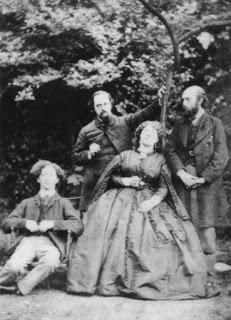
From the left: Algernon Swinburne, DGR, Fanny, and William Michael Rossetti
We come to William Michael Rossetti, who is somewhat of a contradiction. Whilst he undoubtedly knew Fanny, as witnessed in the photograph above, it can't be said that he liked her. In fact the longer he knew her, the more reasons she gave him to want to expunge her from his brother's memory, but he gave her mixed reviews in his biographical works. In the Rossetti Papers of 1903 all mention of Fanny is removed, even though he talks about Alexa, calling her 'one of [Rossetti's] most valued sitters'. He lists the paintings Fanny sat for but never mentions her by name and when he talks about the seances held for his brother in the 1860s he misses out the one held with Fanny in February 1866. All this would be understandable, as Fanny had been a thorn in William Michael's side, from the IOU she presented, the Rossetti Gallery she set up and his refusal to allow her any part in Rossetti's death or funeral. However, in Dante Gabriel Rossetti: his family letters with a memoir , William Michael speaks of "Mrs H-" (Mrs Hughes), denying Bell Scott's nut story and calling her 'a pre-eminently fine woman, with regular and sweet features and a mass of the most lovely blonde hair...' Mind you, WMR then goes on to say that she has no charm of breeding, education or intellect, so it's not all good news. I find his omissions both understandable and conversely deplorable as he managed to talk about her fairly in one biography, why cut her so obviously out of another? I get the sense that William Michael struggled to understand his brother's private life and found it inconvenient that he had to engage with it in order to speak of his work. He is an example of someone far too close to a subject, I suspect...
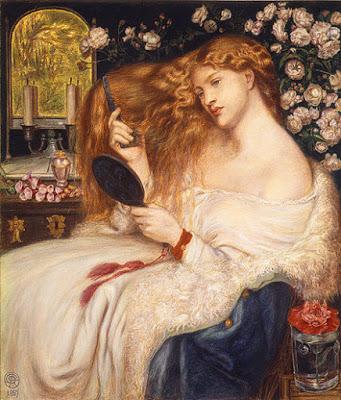
Lady Lilith (1867 watercolour) D G Rossetti
Hans Wolfgang Singer in his 1906 Dante Gabriel Rossetti calls Fanny the personification of womanly charm (as opposed to 'womanly dignity' which he thinks is Jane Morris). Singer is one of a number of biographers to criticize Rossetti for the over-painting of Lady Lilith (which I'll talk about tomorrow) stating that Fanny's version of Lady Lilith is 'truly dazzling' but her beauty could never be employed for 'ulterior motives'. In the end Singer concludes that Fanny is too spiritual for such a role, unlike Alexa Wilding. You don't hear that everyday...
One of my favorite early biographies has to be Henry Currie Marillier's Dante Gabriel Rossetti, not least because I bought a knackered edition of this many years ago when I was writing Stunner. Marillier uses William Michael's pleasant description Fanny and comments on her appearance in 'sensuous' pictures calling her 'a favorite model, who sat to Rossetti until almost the end of his life'. Unusually, he lists Fanny as Mrs Schott as well as Fanny Cornforth, aware that they are the same woman and includes the pictures of her in the catalog.
Arthur Benson, looking dapper...
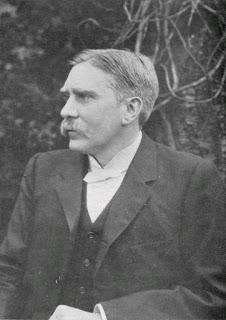
Similarly, Arthur Benson's 1904 Rossetti from the 'English Men of Letters' Series manages to combine an acknowledgement to Hall Caine with a positive review of Fanny's place in Rossetti's work, a rare feat indeed. I enjoyed Benson mainly because he does struggle with the personal life at times, claiming that Elizabeth Siddal died of consumption from thinking too much (with a side brief reference to a miscalculated dose of medicine). Jane Morris is only mentioned within the general talk of the Morris family rather than anything further. Benson holds that Found and 'Jenny' are Rossetti's finest works because they shows his potential and splits his female figures into two types, in which Fanny represents the early, untroubled sweet natural beauties. For Benson, Fanny is a positive, sunny influence which is true of many of the biographers who don't get their feet too muddy with all the druggy, sexy business that took up the latter part of Rossetti's life.
An Introduction: Miss Cornforth 'Oh very pleased to meet Mr Ruskin, I'm sure"
Max Beerbohm