


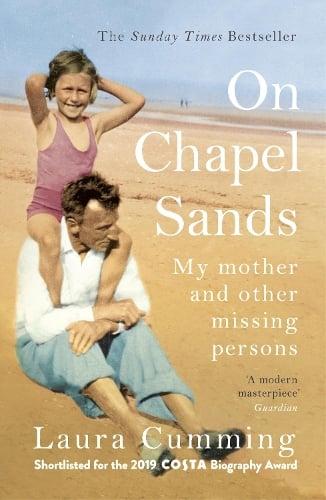
On Chapel Sands is essentially a book about subtext in life and art. The two go hand in hand; if we know to look beyond the surface of an image, it’s because life teaches us this lesson from our earliest days. Navigating adult storms of emotion – terrifying to small children whose sense of survival depends on their parents’ good will and who must assimilate unwritten family rules governing the transactions of love – requires us to become miniature art critics, reading the energy of a gesture, the twitch of an eyebrow, the message in a direct or averted gaze. Laura Cumming, herself an art critic, applies all her tools of analysis and interpretation to the family history at one remove, as it’s the story of her mother’s origins that she seeks to illuminate, via an act of intense willed imagining and a trove of archive material that is nearly a century old.
The book opens with an incident that will eventually prove to be misleading: the kidnap in 1929 of her three-year-old mother from the Chapel Sands beach in Lincolnshire. Betty lives with her (unusually elderly) parents, Veda and George, in a small village, and the subsequent days are fraught with anxiety. But Betty turns up safe and sound and not very far away; in the next village along, in fact. As is the case with most crimes, this event marks the end of a story that has been hidden from general view, though its presence is readable all around young Betty, if she only knew how to decipher it. It’s legible in the authoritarianism of her father, who keeps her more or less prisoner in their small house for the rest of her childhood; it crops up unexpectedly on the bus to school when a woman she doesn’t know tells her that her grandmother wants to see her; it’s written in the name Grace, which was hers until the age of three, and it’s woven into the very atmosphere of her upbringing in which love is never mentioned, causing a deep-rooted insecurity to form at the very basis of her identity.
Her mother, Laura Cumming writes, ‘has only modest hopes of other people’s affections. She is the woman who always asks all the questions of egotists who never offer any in return, who writes back to every letter by return of post, who cannot let gratitude be delayed by a moment, who never wants anyone to be left out.’ She is a mother who loves with a ferocious passion. ‘”You are my most precious possession,”‘ she tells Laura, who reads this as love’s lasso, capture as well as captivation. ‘”I never belonged to anyone until I belonged to you.”‘ The story of Betty’s young life belongs to both of them, however, ‘She and I used to make up stories to fill those empty years,’ Cumming writes, referring to the years before her mother’s memory kicks in. And for Laura’s twenty-first birthday, her mother ‘gave me the gift I most wanted: the tale of her early life. This memoir is short, ending with her teenage years, but its writing carries so much of her grace, her truthful eloquence and witness, her artist’s way of looking at the world.’ It’s a very incomplete story, however, as at this point in the lives of mother and daughter, the kidnap is still unknown, and of course, in the absence of knowledge about the kidnap, a huge chunk of her mother’s history is obscured.
Laura Cumming sets to work uncovering it, reading family photographs and sifting through her hoard of old family objects: among them a barometer, a recipe book, a saucer of Willow pattern china from the old parlour. She adds to this meagre collection some great works of art that feel full of resonance to her – Eric Ravilious’s alphabet, Degas’ portrait of an unhappy family, Turner’s seascapes, Pieter Breughel the Elder’s Landscape with the Fall of Icarus, a key image that speaks to Cumming of how a traumatic event might fail to take up the true measure of its space, and thus be overlooked by all around. I won’t tell you anything about the family history that she uncovers, mostly because there isn’t really enough of it to warrant the length of the book in the first place. This is one of the many reasons why, for me, the opening incident of the kidnap is misleading. It sets the tone for a book that sounds like it will be more thrilling, more incident-heavy, than it is. The pleasure of this book is wholly in the beauty of its writing, in particular the exquisite readings of the art. When it comes to the family memorabilia, Cumming tries to scour it, too, for the same depths of meaning as the masterpieces, picking apart every word of every sentence she’s told, every line of every image, risking some wild speculation and – worse – some repetitive speculation in her urge to get beyond and below the surface. In fact, the answers to their questions arrive by chance, mostly, and not by acts of deductive reasoning. What I felt I was left with was Laura Cumming trying, oh so very desperately, to give her mother something commensurate to the love she herself had been given.
In fact, I became more interested in what Laura Cumming was doing than in the ostensible subject of the book. When I finished it, I felt the way I did after reading Naomi Klein’s Doppelganger: I was longing to know what Naomi Wolf made of it. With On Chapel Sands, the urge was to hear Elizabeth Cumming’s response. It must be so odd to be the main subject of a book someone has written about you, offered up to you whether you want it or not. It’s clear that Elizabeth Cumming has less courage in her convictions than her daughter, often choosing to step away from a line of inquiry into her past, doubtless feeling the heft of all that repressed emotion buckling the edges of her peripheral vision. But Laura has conviction for both of them. She is so very present in this book, the tour guide to the mysteries of the past, the brilliant art critic bringing works to new levels of life, the detective with the observational nuance of Sherlock Holmes, whipping conclusions out of thin air. It’s only by the very end that she reveals a less grandiose identity, as the protector of her wounded mother. She describes how she would look at the photos of her mother taken by George ‘as if the roles were reversed: how can I reach you, dear child to whom I feel so maternal, how can I protect you from what is coming next…?’ The history she uncovers ‘is all as remote as a fairy tale for my mother, but not for me. I reach back for my forebears, longing to make them love her.’ And when I reached this point in the book, I thought, aha, she is a rescuing child. Of course she is. It is hard for a child to grow up watching their beloved mother think herself to be worthless. It is hard to bear the burden of love that it seems necessary to give her, to top her back up to the level of any other carefree mother. It’s one of the great paradoxes of being alive that the more whole we are, the less we weigh.
From a love letter to a mother, then, to a love letter to mother earth. Can there be a reader in the world who hasn’t heard of Orbital? The premise is simple – a day spent on a six-man spaceship orbiting the earth, its crew conducting routine scientific investigations while watching the globe spin past sixteen times – sixteen dawns and sixteen sunsets – such is the mind-bending nature of space travel. There is no plot, other than their spiralling trajectory. The novella is an exploration and an elaboration of the extraordinary perspective this gives to the astronauts: life, but not as we know it. The speed of travel that warps the usual sense of time passing – ‘The mind is in a dayless freak zone, surfing the earth’s hurtling horizon. Day is here, and they see night come upon them like the shadow of a cloud racing over a wheat field. Forty-five minutes later here comes day again, stampeding across the Pacific…’ – is, I think, what prevents Orbital from having a conventional plot: ‘When the planet is galloping through space and you gallop after it through light and dark with your time-drunk brain, nothing can end. There could be no end, there can be only circles.’ And so, reader and astronaut alike are held at a divine distance from the earth and forced to watch, motionless, the unimaginably fast unfurling of life on the planet. We watch it spin as it has done for billions of years and as it will (fingers crossed) for (far fewer) billion in the future. What, then, is the point? What can we learn from this? There may be no plot as such, but that doesn’t mean this novella is eschewing the whole of meaning creation; it couldn’t even if it wanted to. I spent much of this book – a slow read despite its brief page count – asking myself, what is the story here? What story (without end) are we being told?
The aimlessness of the plot allows space for the most grandiose of ambitions. Everything rises up into the viewing orbit of Orbital, from the overwhelming beauty of the earth (and the descriptions are really extraordinary, breathtakingly amazing), to the meaning of humanity’s most outrageous achievements, from the scientific history of the planet, to the teamwork of the crew and curated moments from their lives on earth, from the strangeness of existing in zero gravity to the existential strangeness of existing at all. One of the women astronauts ‘finds she often struggles for things to tell people at home, because the small things are too mundane and the rest is too astounding and there seems to be nothing in between.’ Reading, I am struck by how hard it is to remember anything about the six crew members, although I’m often held in their heads, witnessing their thoughts. But even the most profound thought is chased away by the next rotation, by the next orbit and the thoughts that it, in turn, will give birth to. Noteworthy events in the crews’ lives – Chie’s mother has recently died, Anton finds a lump in his neck – that would gave traction in an earthbound novel and force some kind of reckoning, are elided here by the gliding swoop of the spaceship. We orbit the characters in the same way that we orbit the earth, going around and around in a world where there are no endings.
The role model for this, the great pattern-setter, is the earth itself. As the space shuttle performs its circumlocutions, the astronauts watch ‘its thick embroidered urban tapestries’ by night but ‘it’s the daytime earth they come to love. It’s the humanless simplicity of land and sea. […] You’ll see no countries, just a rolling indivisible globe which knows no possibility of separation, let alone war. […] Before long, for all of them, a desire takes hold. It’s the desire – no the need (fuelled by fervour) – protect this huge yet tiny earth. This thing of such miraculous and bizarre loveliness.’ And protection is required from humans and their cutthroat politics, their ruthless wants:
Every swirling neon or red algal bloom in the polluted, warming, overfished Atlantic is crafted in large part by the hand of politics and human choices. Every retreating or retreated or disintegrating glacier, every granite shoulder of every mountain laid newly bare by snow that has never before melted, every scorched and blazing forest or bush, every shrinking ice sheet, every burning oil spill …. The hand of politics is so visible from their vantage point that they don’t know how they could have missed it at first.’
Is Orbital, then, a novel that demands we finally pay attention to global warming and the attendant destruction of our beautiful, natural habitat? Why yes, it is. But… for me it’s also a novel that explains why we will continue NOT to do so. Because the orbits continue past this point in the narrative and the moment of stark recognition is overwritten by new views of the earth, new spectacular descriptions, new awe-inspiring images of endless, iconic, eternal gorgeousness. Because the story of the earth – of the entirety of the globe – takes place at this vast distance from it, the petty squirrellings of human beings remain mostly invisible. They do not gain traction and cohere into a story. There are no reckonings and no consequences in a journey of endless repetition. Even the typhoon, which we watch forming and whose predatory course we anxiously track, hits land when the astronauts are all asleep, failing to witness it. We are given a brief earth’s-eye view of the destruction, but the orbit carries on, and the few named characters we have cared about are humanely saved by a miracle – the church they take shelter in is somehow strong enough to withstand the tidal surge. Nature retreats exhausted to nurse its energies for another day and from space the blip simply disappears. We humans are so fragile compared to the earth, so temporary, a mere speck of dust in the brilliance of the sun, we shine a moment and are gone. In this distant perspective, how hard it is to believe that we might do any damage to the monolithic planet on which we live. How hard it is, in the relentless spinning of the globe, to believe that any one day might make a fatal contribution to our ongoing safety.
Samantha Harvey’s novella is a thing of great beauty and, I think, great honesty, but not a weapon of political power. Revolution is too tied to its meaning of orbit to be able to embrace the radical difference of change. But I don’t know of any other book that could have described the problem we face so well.







