How To Get To The Top of The Eiffel Tower.
The Eiffel Tower is a press-created lattice tower on the Champ de Mars in Paris, France. The Eiffel Tower carries the last name of the engineer Gustave Eiffel, whose company designed and built the tower. Built from 1887 to 1889 as the entrance to the 1889 World’s Fair, it was initially criticized by some of France’s leading artists and intellectuals for its design but has become a global cultural icon of France and one of its most recognizable structures in the world. To date, the Eiffel Tower is the most visited paid monument in the world. More than 250 million people have visited the tower since its completion in 1889. The tower is 324 meters tall, roughly the same height as an 81-story building, and is the tallest building in Paris. The design of the Eiffel Tower is attributed to Maurice Koechlin and Émile Nouguiert, two senior engineers working for the Compagnie des Etablissements Eiffel.
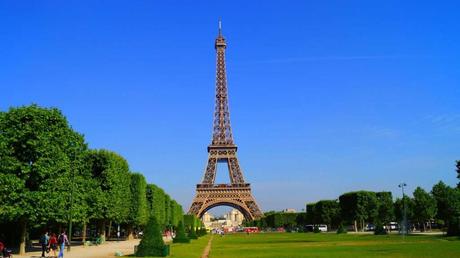 Eiffel Tower, Paris, France. Find the Cheapest Hotels and Flights Over There.
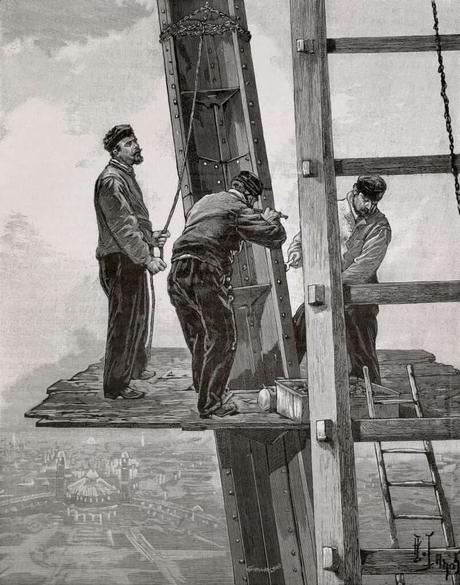
In May 1884, while working at home, Maurice Koechlin made a sketch of their idea, which he described as “great nylon consisting of four trusses, diverging at the base and meeting at the top, connected at regular intervals by metal trusses, Eiffel showed little enthusiasm at first, but he agreed to continue his studies, and the two engineers then asked Stephen Sauvestre, the company’s head of architecture, to help with the design. added decorative arches at the base of the tower, a glass pavilion on the first level, and other ornaments. After some discussion of the precise design and location of the tower, a treaty was signed on January 8, 1887. The big most important work was completed at the end of March 1889. Currently, the base of the Eiffel Tower is only accessible through security checkpoints and entry is free. All four pillars have passenger elevators and atriums on the first and second floors. A separate passenger elevator takes you from the second floor of the Eiffel.
From the tower to the top floor, there are over 300 steps to climb from the ground floor to the first floor and from the first floor to the second floor. It is recommended to purchase tickets online in advance to access the 1st and 2nd floors by stairs or elevator. The best way to avoid hours of waiting is to buy tickets online in advance. Beware of fraudulent websites and always buy your tickets from the official Eiffel Tower website. The ticket price (adult) is €25.50 for the lift to the top floor. Lift to 2nd floor €16.30, stairs to 2nd floor €10.20 (2020 prices) As you can see here, there are two entrances for those who bought tickets. The entrance on the left is for priority access tickets only. The pillars have the main lift and that’s what we’ll see, but first let’s take a look at the park surrounding the recently renovated Eiffel Tower. There are many such parks and green spaces around the Eiffel Tower. To the southeast is the Champ de Mars Park.
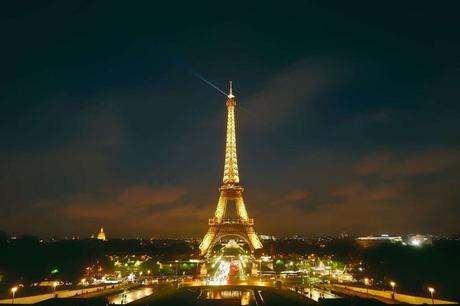
In recent years, the green space around the Eiffel Tower has been redesigned and extensively renovated. This is the entrance to the passenger lift. Equipping the tower with an adequate and safe passenger lift was an important point of attention. It was expected that some visitors would go to the 1st or 2nd floor but apparently, the elevator was to be the primary means of ascent. The installation of elevators on the 1st and 2nd floors was more difficult due to the impossibility of a direct route. The Eiffel Tower is a non-constant inclined orbit. The slope varies from 54° at the base to 80° on the second floor.
It was necessary to create a system for tilting the cabin when raising and lowering it. Here you expect a cabin on the first floor. Notice the huge yellow tank that moves up and down depending on the position of the cabin. These act as counterweights for the cabin. These are containers originally used for the hydraulic pumps that power the machine. Now retired and only serving as a counterbalance, one is also fully retired and unused. The lifting platform is different for each floor. Today, the station is on the ground floor of the pillar, as it was when the tower was built. It has been modernized with a glass door but is in its original condition throughout. On the other hand, the infirmary on the ground floor underwent various modifications. At the moment they are very modern, entirely in glass, almost no metal, with rounded shapes.
The passenger elevator (cabin) in which we are about to climb requires very regular maintenance. They are regularly maintained and regularly replaced. A single system with more than 100 round trips per day. The height of the elevator from here to the second floor is 128m. This is its ground floor, but that’s not all. Go directly to the second floor. The ground floor is the most modern of its three floors. Renovated in 2011, it has benefited from the arrival of new structures and impressive monuments to adapt to what is currently happening. Since 2011, the guardrail has been made of outward-sloping glass panels, approximately 2m50 in size. As the center panels are in the foreground of the glass shelves, leaning against the glass is interesting. It gives the impression of flying.
The second floor consists of an upper level and a lower level. The lower level is a bit more interesting than the other, but still not the best view of the Eiffel Tower. Visitors can access the platform from these galleries. The upper level, as seen here, is more of a large platform. On this platform, you can enjoy breathtaking views. You have to tread carefully so you don’t get hurt when you hit the massive metal beams. The ancient tower structure that physically connects this platform gives a truly authentic feel to the place. The large yellow twist of the lifting mechanism, as seen here, is still in operation today. The northwest side offers a great view of the Palais de Chaillot and the financial district (in the distance)
The second level was completed on August 21, 1888. Once completed, the French newspaper Le Figaro had an office and printing house here. Also, on the second floor is Le Jules Verne, a gourmet restaurant with its own lift. This restaurant has one star in the Michelin Red Guide. From 2007 to 2017 it was managed by the multi-starred chef Alain Ducasse. As of May 2019, it is led by three-star chef Frédéric Anton. The southwest view offers a breathtaking view of the Champs de Mars. There were many notorious stunts starting on the second floor.
On October 27, 1991, Thierry Devaux, accompanied by high mountain guide Hervé Calvayrac, performed a series of acrobatic maneuvers by bungee jumping from the second floor of the tower. Facing the Champ de Mars, Devaux used an electric winch between the figures to return to the second floor. Upon the arrival of firefighters, he stopped after jumping six times. This floor can get crowded in places. Make sure you visit the Eiffel Tower during the off-season. Expect wait times of more than two hours from mid-July to the end of August and less than 30 minutes during weekdays in January and February. Early March and again from November to mid-December. Or, if you visit the Eiffel Tower in high season, we recommend buying skip-the-line tickets.
Unfortunately, the time-saving skip-the-line access does not apply to the second-floor elevators that lead to the top, or the elevators used to descend from the tower. The second level houses two floors. We now go to the other floor, which is bigger than this one. The floors are connected by these authentic stairs. The higher you go up the tower, the more wind you will feel. When it was built, many were shocked by the bold shape of the tower. Eiffel was accused of trying to create something artistic without considering the principles of technique. However, Eiffel and his team – expert bridge builders – understood the importance of wind forces and knew that if they were to build the tallest structure in the world, they had to be sure they could withstand it.
Eiffel used graphical methods to determine the strength of the tower and empirical evidence to account for the effects of wind, rather than a mathematical formula. Close examination of the tower reveals an essentially exponential shape. All parts of the tower are oversized to ensure maximum resistance to wind forces. The Eiffel Tower sways up to 9 centimeters (3.5 inches) in the wind. However, wind could be a big deal without the extensive maintenance work. Tower maintenance includes applying fresh paint every seven years to prevent rusting. The tower has been completely repainted at least 19 times since its construction.
Approximately 25 crew members fearlessly climb the tower with approximately 35 miles of climbing rope over 18 months during the last painting, which began in 2009. It takes approximately 66 tons of lead-free paint to cover every crack, beam, nut, and bolt. At moment (2019) until 2025 the Eiffel Tower is undergoing the largest renovation in history to enhance the experience. The Eiffel Tower is undergoing a complete makeover from head to toe to be ready for major events such as the World Expo (2025) and the Olympic Games. During this time, the entire Eiffel Tower remains accessible. The extensive second-floor renovation was completed in early April 2019. The climb from the second to the top floor is approximately 150 meters. We now walk towards the passenger lift that takes us to the top floor. The entrance for the correct queues for the top floor is a bit difficult to find. Just follow these ‘Summit’ signs. The waiting time for the second-floor passenger elevator is usually between 5 and 20 minutes. There are four elevators (two on each side) with dual entrances. Get the 150m ride on the passenger lift.
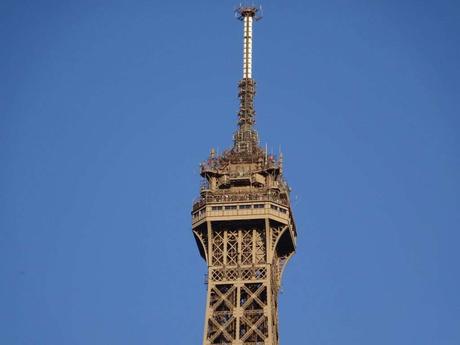
The top floor is at an elevation of 906 feet (276 m) and is the highest floor accessible to the public. From above, there is little more than the technical installations dedicated to radio and television broadcasting. The top floor is 2 floors, there is a closed room and above, a gallery around the monument and some curiosities. The walls of this floor have large windows offering a panoramic view of Paris and its surroundings.
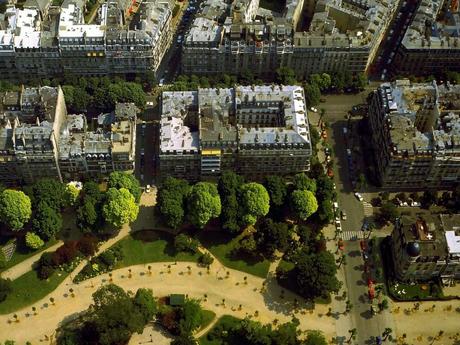
There are stairs to the upper floor in two places in this room. The upper level is the highest public area of the Eiffel Tower. There are four tunnels that go around. They are protected by a normal railing but above all by a dense large-mesh net that climbs over it. Get a great view by peeking through the net. As seen here, the gallery is not very wide, about one and a half meters. The air is fresh and the wind can be very strong, so pay close attention to your gear. The northwest view is probably the most amazing view from the top floor. Watching the shadow of the tower itself vanish into the Seine. From the top floor, the view on a clear day is up to around 85km, but in theory, we should be able to see points at 126.5km.
On a clear day like this, you can see the entire Paris region. On the top floor, there are two interesting things, the champagne bar, and Gustave Eiffel’s office. The champagne bar is quite unique but very expensive. Eiffel’s office is a room he has set aside at the top of the tower to welcome visitors.
If you ever decide to travel to Thailand, use our traveling resources such as hotels and flights at affordable prices. If you have questions, contact us immediately.