The rapid advancement of AI and autonomous agents tech has led to experts calling for a cautious approach, especially urging a stop to developing “fully autonomous AI agents”. [4] The latest research paper claims it may be too late before we halt autonomous AI agents.
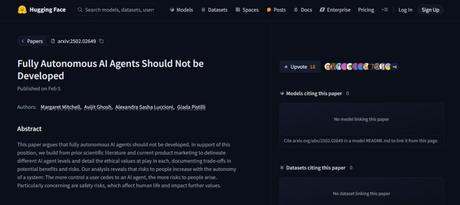 Autonomous AI Agents Should Not Be Developed By Huggingface
These systems can independently write and execute code without predefined constraints and can be a danger to humanity in the long run. [5] Here’s why:
- Increased Risks: The more autonomy our custom-built AI agent has, the greater the risks to individuals, especially concerning safety. This includes potential loss of life, privacy breaches, and security vulnerabilities. We have already seen AI giving unsafe responses to users, including life-threatening responses.
- Hijacking: Malicious actors could exploit fully autonomous agents to steal confidential data or launch large-scale automated attacks that may expose a business or entity’s personal or confidential data. In a recent event, hackers gained access to Azure OpenAI to create harmful content. [1]
- Loss of Control: Complete freedom in code creation and execution means these agents could override human control. A level of human intervention is required to keep the output. Researchers claim that AI’s uncontrolled use may go out of control in a few years.
- Misplaced Trust: Over-reliance on unsafe systems can compound these dangers. A business can harm its image and safety if content without human supervision is published on its website. This may lead to brand image destruction just to save some bucks.
- Ethical Concerns: Autonomous weapons systems, a controversial application of AI, raise serious questions about accountability and moral responsibility. Illegal piracy websites are a huge concern for creative industries. With AI in place, it will become easy for anyone to replicate these projects. This may lead to unethical use of AI.
- Inherent Risks: AI agents can produce incorrect information that appears correct. With increased autonomy, inaccuracies may create outcomes that are unaligned with your business goals. Bugs in your code may go public for months before someone points out or abuses the system.
The research paper proposes a leveled scale of AI agents, emphasizing that risks escalate with each level of autonomy. Defining autonomy levels can reduce the risk significantly.
While AI agents offer potential benefits like increased efficiency and assistance, the dangers of fully autonomous systems outweigh the advantages because the risks are huge compared to the advantages. A recent OpenAI hack claimed loss of $20 million by purloined private info from millions of OpenAI accounts. [3]
The authors advocate for “semi-autonomous systems” that retain some level of human control. They stress the need for clear distinctions between levels of AI agent autonomy, clear disclaimers of AI use, strict frameworks for maintaining human oversight, and methods to verify that AI agents stay within intended operating parameters.
This group of researchers concluded that while AI agents hold promise, giving full control to machines could lead to catastrophic consequences that may be irreplaceable.
References:
- https://indianexpress.com/article/technology/tech-news-technology/hackers-azure-openai-harmful-content-microsoft-9776908
- https://indianexpress.com/article/technology/tech-news-technology/hackers-azure-openai-harmful-content-microsoft-9776908/
- https://decrypt.co/305056/openai-hack-investigating-claims-20-million-stolen
- https://huggingface.co/papers/2502.02649
- Mitchell, M., Ghosh, A., Luccioni, A.S., & Pistilli, G. (2025). Fully Autonomous AI Agents Should Not be Developed. arXiv:2502.02649v2 [cs.AI].