 The
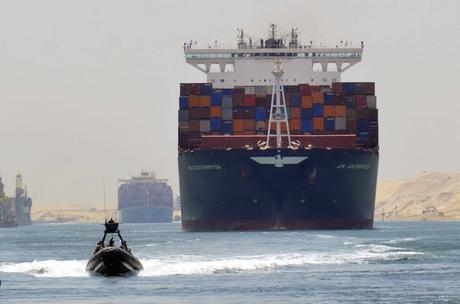
Suez Canal Authority (SCA) has announced the opening of the New Suez Canal on
6th August 2015 by Egyptian President Abdel Fattah El-Sisi. It opens a major expansion of the Suez Canal,
which deepens the main waterway and provides ships with a 35km (22 mile)
channel parallel to it. At the inauguration ceremony in the
town of Ismailia, the president appeared in military uniform and sunglasses
aboard the El-Mahrousa–(the yacht that was the first vessel to pass through the
canal when it was built in 1869) as helicopters and fighter jets flew by.
With this
expansion, Egypt's government hopes the revenues will revive the economy - but
analysts have questioned the projections.They point out that the volume of
world trade has not been growing at the pace needed to deliver the sums Egypt
hopes to collect.Egyptians commenting to the international press and on Twitter
appear divided over the project, with many asking if the $8.2bn (£5.3bn) spent
on the expansion could have been better deployed on improving infrastructure
and public services.Ahmed Kamaly, an economist with the American University in
Cairo, told Reuters news agency that the Egyptian projections were
"wishful thinking".
The 72 km of new
channel and by passes could have 97 ships a day by 2023. Security was tightened
for the inauguration ceremony amid fears of attack by militants allied to
Islamic State.The original canal currently handles 7% of global sea-borne
trade. The waterway connects the Mediterranean to the Red Sea, providing the
shortest sea link between Asia and Europe.
The expansion reportedly cost $8.5
Some
marine biologists, however, aren’t applauding the expansion. They note the
Egyptian government pushed ahead with the project despite the lack of a thorough
environmental risk assessment, writes - http://news.sciencemag.org. The increased ship
traffic and 35 kilometers of new, deeper channels could make it easier for
invasive species to move between the two water bodies, a group of 18 scientists
warned last year in the journal Biological Invasions.Already, researchers
estimate that some half of the 700 nonindigenous organisms found in the
Mediterranean Sea got there via the canal. Some have created extensive
problems. Less desirable goldband goatfish have replaced economically valuable
native red mullet, for example, while invasive jellyfish have clogged water
intake pipes.
“I am not aware of
any marine biologist who thinks opening the canal without implementing
[measures to prevent the spread of invasive species] is a good idea,” Yoni
Belmaker, an ecologist at Tel Aviv University in Israel, tells ScienceInsider.
For example, scientists say engineers could have created one kind of barrier by
creating areas with very salty water, which is inhospitable to many species.
One clear plus for
the debt-strapped Egyptian government is that the project is domestically
financed: thousands of Egyptians last year snapped up nearly $9 billion in
special investment certificates paying 12% interest. The downside for punters
is that they are in local currency, in a country where inflation is currently
running at over 10%. But there may be another long-term plus. Egypt’s
government plans to turn the whole canal zone into a giant logistical,
ship-servicing and manufacturing hub. If that ambition comes true, Egypt will
stand hugely benefitted.
With regards – S.
Sampathkumar
The
Suez Canal Authority (SCA) has announced the opening of the New Suez Canal on
6th August 2015 by Egyptian President Abdel Fattah El-Sisi. It opens a major expansion of the Suez Canal,
which deepens the main waterway and provides ships with a 35km (22 mile)
channel parallel to it. At the inauguration ceremony in the
town of Ismailia, the president appeared in military uniform and sunglasses
aboard the El-Mahrousa–(the yacht that was the first vessel to pass through the
canal when it was built in 1869) as helicopters and fighter jets flew by.
With this
expansion, Egypt's government hopes the revenues will revive the economy - but
analysts have questioned the projections.They point out that the volume of
world trade has not been growing at the pace needed to deliver the sums Egypt
hopes to collect.Egyptians commenting to the international press and on Twitter
appear divided over the project, with many asking if the $8.2bn (£5.3bn) spent
on the expansion could have been better deployed on improving infrastructure
and public services.Ahmed Kamaly, an economist with the American University in
Cairo, told Reuters news agency that the Egyptian projections were
"wishful thinking".
The 72 km of new
channel and by passes could have 97 ships a day by 2023. Security was tightened
for the inauguration ceremony amid fears of attack by militants allied to
Islamic State.The original canal currently handles 7% of global sea-borne
trade. The waterway connects the Mediterranean to the Red Sea, providing the
shortest sea link between Asia and Europe.
The expansion reportedly cost $8.5
Some
marine biologists, however, aren’t applauding the expansion. They note the
Egyptian government pushed ahead with the project despite the lack of a thorough
environmental risk assessment, writes - http://news.sciencemag.org. The increased ship
traffic and 35 kilometers of new, deeper channels could make it easier for
invasive species to move between the two water bodies, a group of 18 scientists
warned last year in the journal Biological Invasions.Already, researchers
estimate that some half of the 700 nonindigenous organisms found in the
Mediterranean Sea got there via the canal. Some have created extensive
problems. Less desirable goldband goatfish have replaced economically valuable
native red mullet, for example, while invasive jellyfish have clogged water
intake pipes.
“I am not aware of
any marine biologist who thinks opening the canal without implementing
[measures to prevent the spread of invasive species] is a good idea,” Yoni
Belmaker, an ecologist at Tel Aviv University in Israel, tells ScienceInsider.
For example, scientists say engineers could have created one kind of barrier by
creating areas with very salty water, which is inhospitable to many species.
One clear plus for
the debt-strapped Egyptian government is that the project is domestically
financed: thousands of Egyptians last year snapped up nearly $9 billion in
special investment certificates paying 12% interest. The downside for punters
is that they are in local currency, in a country where inflation is currently
running at over 10%. But there may be another long-term plus. Egypt’s
government plans to turn the whole canal zone into a giant logistical,
ship-servicing and manufacturing hub. If that ambition comes true, Egypt will
stand hugely benefitted.
With regards – S.
Sampathkumar
14th Aug 2015.