Has it been a while since you’ve seen some real people on your screen (or maybe real life)? Me too.
428 ~Fuusasareta Shibuya de~ is a sound novel by Spike Chunsoft and the most well-known thing about it in the English community is that it managed to score a rating of 40/40 from Famitsu back when video game magazine review scores weren’t the target of ridicule. Also it is the prequel of the Type-Moon anime, Canaan, but don’t expect it to be anything like that.
The term “sound novel” was coined by Chunsoft, and is used to refer to their line of text-heavy adventure games defined by their suspenseful plots, text on full screen, and focus on having realistic sounds rather than color character CGs. Their most recent notable example is 428, which uses stills from live-action footage to accompany their text. The end result with 428 is a sound novel that ends up as a more dynamic experience than the average visual novel thanks to its huge number of stills featuring live-action actors.
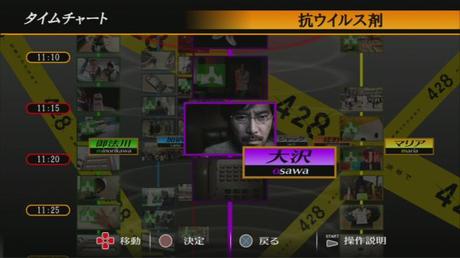
You can jump back and forth or sideways in the timeline
As indicated by its title, 428 takes place in Shibuya, Japan, and is centered around a kidnapping case involving a pair of twin sisters. The game features 5 protagonists, and a key gameplay element is switching between the protagonists to make choices that indirectly help the others avoid bad endings. Placing an emphasis on the concept of small actions stringing together to trigger important events, many of the choices the player has to make may seem trivial to the character making the choice, but will affect life and death situations for other protagonists.
With 5 protagonists and 85 bad endings (many of which end in death, but some end with the protagonist in question wasting time or running off to get married to his girlfriend in the countryside), the game ends up being quite long and full of content. There are also many unlockable side stories littered throughout the script, available by pressing certain strings of button commands at specific screens of text after beating the main story. There’s also a final hidden message obtained through turning off the console at a certain point in the game (the cue for which appears if you read the third character from each row of text down vertically), in an attempt to bring back some retro game flavor.
Is this game the godtier end-all-be-all of visual novels? I highly doubt it, and certainly wouldn’t hold it above most of my favorite eroge. Heck, I found the Zero Escape series and the two Dangan Ronpa games from the same company to be superior in writing, atmosphere, and pacing. But I do admit that 428 was a fun ride with good characters, and has the advantage of appealing to a more general audience. Rather than drawing from the cliches used in otaku-targeted media, 428 draws more from Japanese dramas, which is fitting for its use of live-action actors.

Speaking of which, there was also another adventure game by Level-5 that also employs a similar 5-protagonist system with the ability to jump between them. This one is called Time Travelers, but instead of being done in the format of a sound/visual novel, it’s a much more cinematic experience that uses 3D models and plays out like video game cutscenes for the whole game. The story is some time travel thing that uses very basic elements seen in the genre, and while it isn’t bad per se, the execution is subpar and the characters are hardly likable or memorable. The emphasis on the “novel” aspect of 428 is what gave its characters depth and absorbed the player into its world.
Time Travelers was also clearly developed for a younger audience, due to its juvenile character writing, the game actually telling the player when they made a “good” choice, and its shoehorned quick-time events for those whose fingers are just aching to move. It was enjoyable enough for the duration of the playthrough (which clocks in at around 10-15 hours, whereas 428 is double that), but doesn’t leave a lasting impression on the player.