


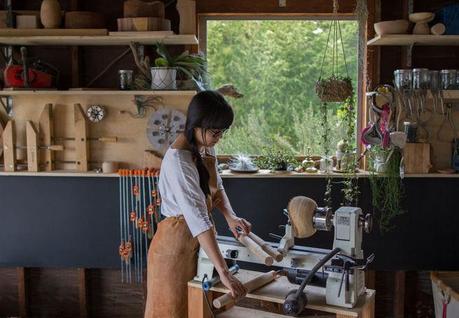
Wood sculptor Silvia Song's studio is located in her former garage in Berkeley, California.
Woodworking requires a steady hand, strong instincts, and a meticulous attention to detail. Berkeley-based designer Silvia Song is one such person who possesses these characteristics. Originally trained as an architect, Song began her craft as a way to explore form making. She first used clay, but after an allergic reaction forced her to stop experimenting with it, she traded a potter's wheel for a lathe.
"I think we are naturally drawn to earthy materials, like clay, wood, and stone," Song says. Modern designers have had a long affair with wood, each coaxing out different characteristics. George Nakashima turned imperfections like burls and knots into highly prized furniture items. J.B. Blunk used chainsaws to form his wooden sculptures. Jens Quistgaard defined midcentury tableware with his sculptural teak pieces for Dansk.
Slideshow
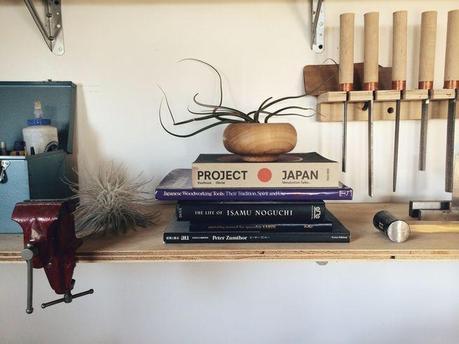
Song's inspirations include Dieter Rams, Isamu Noguchi, Buckminster Fuller, and Peter Zumthor ("The use of materials in each of his buildings is ethereal," she says). Books about the icons rest on her studio's shelves, along with an armada of chisels, clamps, and hammers.
"Wood is constantly in flux, even after it has been felled," Song says. "It is a breathing material—it expands and contracts, depending on its environment."Song's repertoire includes minimalist bowls, cutting boards, drip-coffee cones, and platters. She produces everything herself, by hand, without any assistants in her studio. " I work with wood because it primordial to me," she says. "It feels like an intuitive process to study wood. I need to understand, and work with it, and allow it to become what it wants to be."
For a bowl, she typically starts with a block of wood, inspects it for cracks and knots, trims it down to size on a bandsaw or chainsaw, and then cuts it into a round blank that gets mounted onto a lathe—a tool which rotates an object on an axis. She shapes exterior of the bowl, sands the exterior, then mounts it onto a chuck to turn the inside using a bowl gouge. After mounting the bowl onto a cole jaw to remove the tenon (a stump of the wood that's used to mount the bowl to the chuck) and giving it a final sanding, Song then applies oil and wax to the finished piece. She typically uses sugar maple and claro walnut, two woods that are readily available. "Sugar maple is quite dense and the grains are very consistent whereas walnut is much more porous," she describes. Slideshow
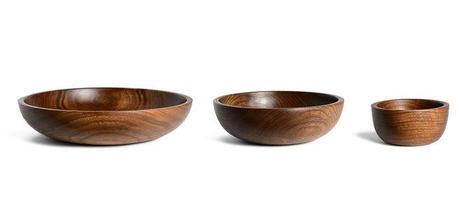
Song's walnut nesting bowls are available from Kaufman Mercantile.
2014 was a big year for Song, who exhibited at Heath Ceramics; collaborated with natural dyer Kristine Vejar on a series of indigo-dipped bowls for March, a high-end purveyor of kitchenware; and is now selling her work through the international e-commerce site Kaufmann Mercantile. We're eager to see what's in store for her next.







