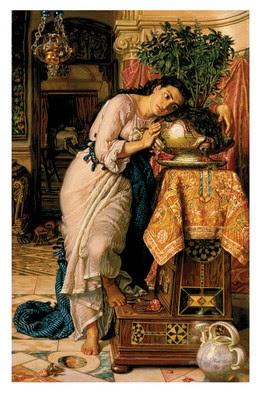
Isabella and the Pot of Basil (1867) William Holman Hunt
On Tuesday 17th June, this painting will go under the hammer at Christies to raise money for the art gallery that currently owns it. The sale of it has caused an outcry within the Pre-Raphaelite community and a shiver down the spine of museum curators. What on earth happened?The sale was announced last year, or rather Delaware Art Museum announced that in order to raise $30 million it would have to sell up to 4 works of art. The situation that led to this quiet announcement had happened over the preceding years when the museum decided to have building works done in 2005. The deadline to pay for the expansion works has come and the fund-raising has failed. In order to pay the $20 million in building works and increase their reserve to $37 million, the works are being sold. The Artistic Director at the time of the decision to sell was Danielle Rice, who has spoken of the struggle not to sell paintings in order to pay for things: 'Every...museum board always thinks 'we can always sell art'.' She threatened to leave if they took that option and has since found a position elsewhere.

Milking Time Winslow Homer
Since Isabella was announced as up for sale, two more works have been taken off the walls, Milking Time, possibly one of the most popular works in the collection (and the lead image of the museum's 2012 advertising campaign), and a mobile by Alexander Calder. The proposed fourth work has not been hinted at yet and the latter two still have yet to be confirmed. Calls are still being made for Isabella to be removed from the sale on Tuesday, even though it is on the cover of the catalog.
Mrs Walker considers how many kidneys she'd have to sell to afford any of it...
So, here is my opinion: I don't like it one little bit, but not for the reason that most people are upset. Yes, it's terrible that a work of art is being sold because of a miscalculation, in fact it seems downright stupid. To spend the money before having it in your pocket is ridiculous. To sell paintings to pay for an expansion makes absolutely no sense whatsoever. To have one of the outstanding Pre-Raphaelite collections in your country and sell the only painting you have by one of the founding brothers is a level of gob-smacking incompetence that beggar's belief. But that's not my biggest problem. My problem is that Delaware are pushing a dangerous precedence. It says to the world 'Art is an asset and assets can be disposed of.' To anyone in the museum business in the UK this will all sound chillingly familiar...
Triumph of Love (1871) Edward Burne-Jones
In 2008, one of my favorite galleries sold this beautiful painting by Edward Burne-Jones. It came off the wall and presumably after the sale went into a private collection, along with this gem...
Jasmine (1880) Albert Moore
It was a moment that split the museum world and resulted in the Museum Association changing its guidelines on disposal. Before this point the only reason to dispose was to acquire something else. The idea that you could dispose 'for the greater good' (to quote Hot Fuzz) was unthinkable and got you threatened with the removal of your accredited state. Then the Watts Gallery near Guildford decided the only way to safeguard the future of its collection was to sell two works that were not by Watts. Their historic building was terrifying and needed urgent care to stop it damaging the works of art. I'd been to the Watts before this point and as much as I loved it, the building made me cry (and I've worked in some rickety museum buildings in my time). By disposing of two works that had no bearing on the collection, in order to not only save everything but to make it the fabulous monument to one of the 19th century's finest talents, the Watts Gallery took a bold step. They found support, nervous but genuine, and the Museums Association, after condemning and threatening, changed the rules to support their sensible decision. The Watts Gallery today is amazing and a pleasure to visit.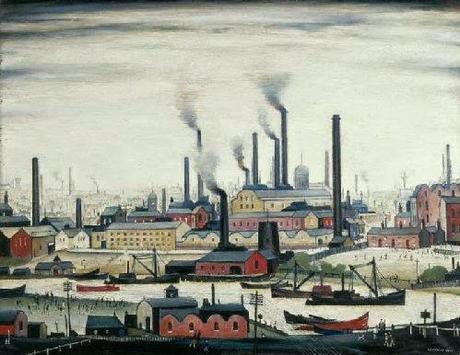
A Riverbank (1947) L S Lowry
The flip side of this is that in 2006, Bury Metropolitan Borough Council sold LS Lowry's A Riverbank at auction for £1.4 to fill a gap in their finances. The painting had been given to Bury Art Gallery by the artist as a gift to his home town. The money was not destined to be put back into the art gallery, it was used to keep services open, save jobs and basically used like any money obtained by the Council through the disposal of an asset. Bury had resigned from the Museum Association before they had a chance to expel them. They lost their accredited status making them ineligible for grant aid or assistance (or at least making it very, very difficult to apply for it).The problem with any gallery selling a painting is that it tells the world that the pictures in an art gallery are assets, like land, computers, buildings, and in one way, of course they are right. As the Watts Gallery proved, many collections of any age have picked up pieces along the way that make no sense in that gallery and the money they could raise could give all the other pieces a new lease of life. The work done at the Watts is an astonishing transformation and the Moore and the Burne-Jones are not missed in the story the gallery tells us. However, the other end of the line is Bury's Council taking a picture from the walls to sell for bin collections to go ahead for another year or for old people to have meals delivered. No-one wants to be in the council meeting where you have to argue that a painting is more important than providing free school meals to under-privileged kids but you can only sell a painting once. As Mr Walker tells me, you could sell every single painting in the country and it would support our social security budget for about half an hour. Then what will you do?
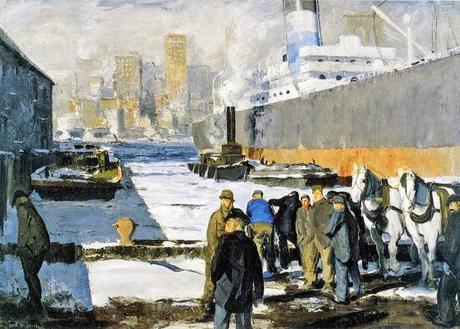
Men of the Docks (1912) George Bellows
An interesting middle-ground seems to have been found in the actions of Randolph College, Lynchburg, Virginia whose gallery, the Maier Museum of Art sold Men of the Docks to the National Gallery in London for $25.5 million. There was an outcry on one side of the ocean and a welcome party on the other, but the work of art remained in public hands. If the main issue that many seem to have with the Delaware sale is that it will end up in private hands, surely this is an acceptable alternative? Possibly not to the museum visitor in Virginia.Recently the De Morgan collection has found itself without a home again but they have not sold any of the collection in order to ensure a permanence residence. However, at present, you cannot visit the collection. When a similar situation occurred with the lovely Folk Art Museum in New York who could no longer afford to stay in their building, they moved somewhere smaller and more affordable, not selling anything to do so.
So, what is the worse case scenario for the sale of the Holman Hunt on Tuesday? If it does end up in private hands, which seems to be the case most likely and most feared, it might disappear into someone's house and never be seen in public again. That would be terrible, but that's not the worst thing that would happen. If the work entered the collection of someone like Lord Lloyd Webber, then you could ask to borrow it for exhibitions, you could ask to be allowed to see it privately. There is no guarantee that either of these requests would be successful but the work would be cared for, would still exist and the sale would benefit Delaware and their expansion.
Far worse would be that the picture doesn't sell. This is known in the auction trade as a 'bought in' and ironically happened to this painting in 1871. Then what? It would be better that the picture sold for $30 million to a private collection than everything from Delaware be sold, which is a possibility if they can't repay the loan.
Better that they sell the picture and learn a lesson, but I think that might be a bit of a stretch. As it is, I think the smell of this sale (and any subsequent) will follow the museum around for quite a while.