


If you’re tired of juggling multiple loans and credit cards, you’ve probably wondered which debt payoff method actually works. It’s easy to feel overwhelmed when you’re facing several payments each month, a situation many find themselves in, with total household debt in the U.S. reaching $18.39 trillion in the second quarter of 2025. The good news is that getting out of debt is less about complex math and more about having a clear, simple plan you can stick with.
Two of the most effective strategies are the debt snowball and the debt avalanche. They’re both powerful ways to get control of your finances, but they work in completely different ways. One is designed to keep you motivated with quick wins, while the other is built to save you the most money possible.
The best method isn’t the one that looks perfect on paper—it’s the one that fits your personality. Let’s break down how each one works so you can decide which is the right fit for you.
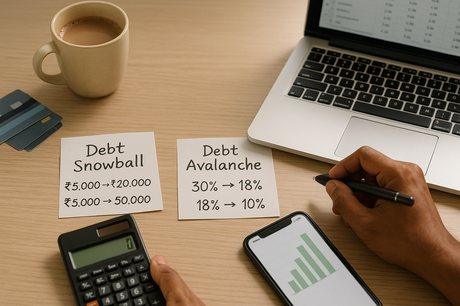
How the Debt Snowball Method Keeps You Motivated
The debt snowball method is all about psychology. The idea is simple: you pay off your debts from the smallest balance to the largest, no matter what the interest rates are. This method, popularized by financial expert Dave Ramsey, is designed to create behavior change through motivation.
Most people who give up on a debt plan do so because they don’t see results soon enough. That’s where the snowball method shines—it’s designed to give you a quick, motivating win right at the start. Paying off that first small debt feels great and builds the confidence you need to keep going.
Here’s how it works in real life:
- List your debts from smallest to largest. Don’t worry about the interest rates for now; just focus on the balance.
- Make minimum payments on everything except for the smallest debt.
- Throw every extra rupee you can at that smallest debt until it’s gone.
- Roll that payment over. Once the smallest debt is paid off, take the entire amount you were paying on it (the minimum plus the extra) and add it to the minimum payment of the next-smallest debt. This creates a “snowball” of money that gets bigger as it rolls from one debt to the next.
Let’s look at an example.
Imagine Priya has three debts and an extra ₹6,500 a month to put toward them:
- Medical Bill: ₹12,000 balance (₹1,500 minimum payment)
- Credit Card: ₹28,000 balance (₹2,000 minimum payment)
- Personal Loan: ₹96,000 balance (₹5,000 minimum payment)
With the snowball method, she’d start with the medical bill. She would pay her usual ₹1,500 minimum plus her extra ₹6,500, for a total of ₹8,000 a month. In just two months, that first debt is gone. That’s a huge motivational boost.
Next, she takes that ₹8,000 and “snowballs” it onto her credit card payment. Now she’s paying ₹10,000 a month on the card, and it’s paid off in about three months. Finally, she rolls that massive payment onto the personal loan, paying ₹15,000 a month until it’s cleared.
Using this method, Priya is debt-free in about 12 months, and she got her first win just two months in.
Why the Debt Avalanche Method Saves You More Money
If the snowball method is about emotion, the debt avalanche is all about math. With this strategy, you focus on paying off the debt with the highest interest rate (APR) first, regardless of the balance.
The logic is simple: high-interest debt costs you the most money over time. By tackling it first, you cut down on the total interest you’ll pay, which often means you get out of debt faster and for less money. This is the most efficient path to debt freedom from a purely financial perspective. This method is perfect for people who are driven by efficiency and long-term savings.
Here’s how the avalanche method works:
- List your debts from the highest interest rate to the lowest.
- Make minimum payments on all your debts except for the one with the highest APR.
- Put all your extra money toward that high-interest debt until it’s paid off.
- Roll the payment over to the debt with the next-highest interest rate, and repeat until you’re debt-free.
Let’s see how this works for Priya.
Here are her debts again, but this time ordered by interest rate:
- Credit Card: ₹28,000 balance at 22% APR (₹2,000 minimum)
- Personal Loan: ₹96,000 balance at 14% APR (₹5,000 minimum)
- Medical Bill: ₹12,000 balance at 0% APR (₹1,500 minimum)
With the avalanche method, Priya targets the credit card first. She pays the ₹2,000 minimum plus her extra ₹6,500, for a total of ₹8,500 a month. It takes about four months to clear it.
It’s a slower start than the snowball, but here’s where it pays off. By eliminating that 22% APR debt first, she saves a significant amount in interest. After the card is paid off, she rolls that ₹8,500 over to the personal loan, paying ₹13,500 a month.
With this method, Priya becomes debt-free in about 13 months and saves roughly ₹1,500 in interest compared to the snowball method.
So, Which One Works Best for You?
The truth is, “faster” depends on what keeps you going. The avalanche method is mathematically faster and cheaper, but only if you stick with it. The snowball method often feels faster because you see progress right away, which makes it easier to stay committed. In fact, multiple studies have found that consumers are often more likely to stick with the snowball method.
Here’s a simple way to think about it:
Debt Snowball Debt Avalanche
Focus Smallest balance first Highest interest rate first
Best For People who need quick wins to stay motivated. People who are disciplined and focused on saving money.
Advantage Builds momentum and confidence. Saves the most money on interest.
Downside You might pay more in total interest. It can feel slow and discouraging at first.
The Hybrid Approach: You Don’t Have to Pick Just One
You can also combine the two methods to get the best of both worlds. For example, you could start with the snowball method to knock out one or two small debts for a quick motivational boost. Once you’ve built some momentum, you can switch to the avalanche method to save money on your larger, high-interest debts.6 This gives you an early win while still being financially smart in the long run.
The Key Is Just to Start
Whether you choose the snowball for its motivation or the avalanche for its math, the most important thing is to pick a plan and start. Both methods work because they give you a clear, focused path to follow. They turn an overwhelming mess of bills into a simple, one-step-at-a-time process.
Don’t get stuck in “analysis paralysis.” Pick the method that feels right for you, make a plan, and take that first step. Every payment you make is progress, and progress is what will get you to the finish line.






