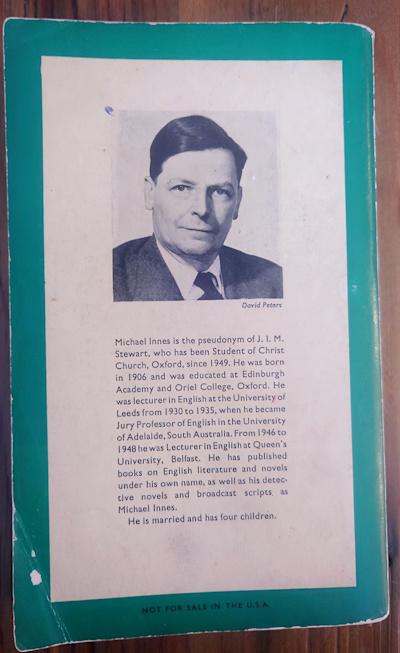
Book Review by Val H: This review is free of spoilers. All quotations from the novel are taken from the green Penguin edition of 1958.
Oh, I read a lot of Michael Innes novels as a teenager. He was recommended by my English teacher, I think, and I remember tidying a row of bright yellow Gollancz hardbacks when I worked in my local library. I’m pretty sure I found them difficult, and that I thought this was my fault. Now, much older, I’m not so sure I was to blame.
Michael Innes was the penname of the academic J I M Stewart (1906-1994). He was born and grew up in Edinburgh, graduated from Oriel College, Oxford and taught in Leeds, Belfast and Adelaide before returning to Oxford and a professorship. His list of publications, as Stewart and Innes, is long: studies of Joyce, Conrad, Hardy and more; over 20 novels and short story collections in his own name; and, as Innes, about 50 crime novels and collections of short stories. Most of his crime fiction features John Appleby, who rises in the novels from police inspector to Commissioner of the Metropolitan Police. Titles such as Hamlet, Revenge! (1937), There Came Both Mist and Snow (1940), From London Far (1946) and The Journeying Boy (1949) often appear in discussions of 20th century crime fiction. Stewart – Innes, rather – was good at titles. They’re mostly quotations, of course, and you can look them up after you finish this.
Death at the President’s Lodging (a prosaic title) is Stewart’s first book, Innes’ first novel, Appleby’s first appearance. Gollancz described it on the dust jacket as the ‘best “first” Detective Story that has ever come our way’. Reviewers generally liked it too:
Look out for Mr. Innes! Unless I am mistaken, he Is a safe tip for Double First in the Final Schools of Detective Fiction. (Yorkshire Post – 23 September 1936, p.6)
It is a splendid piece of writing, and those who are seeking something more exacting in the way of murders should not miss it. The author has a very delicate sense of humour, and he also has an uncanny gift of being able to portray the reaction of murder to more sensitive beings. (Evening News London – 6 October 1936, p. 2)
Like many a new novelist, Innes chose what he knew, setting the crime in a university college, St Anthony’s. (He explored forms of the Establishment, in which he was of course a respected resident, throughout his writing career.) St. Anthony’s is neither Oxford nor Cambridge, but a combination of the two, appropriately located near Bletchley, halfway along what was known as the ‘Varsity Line’ between the two cities. It’s a very convincing creation: chapels, libraries, sets and halls built around gardens, courts and quadrangles, all leading in and out of each other. In the tradition of the day, a helpful plan is provided.
Dusk was falling and the trim college orchard seemed to hold all the mystery of a forest. Only close to him on the right, breaking the illusion, was the gray line of hall and library, stone upon buttressed stone, fading, far above, into the darkness of stained-glass windows. Directly in front, in uncertain silhouette against a lustreless eastern sky, loomed the boldly arabesqued gables of the Caroline chapel. An exhalation neither wholly mist nor wholly fog was beginning to glide over the immemorial turf, to curl round the trees, to dissolve in insubstantial pageantry the fading lines of archway and wall. And echoing over the college and the city, muted as if in requiem for what lay within, was the age-old melody of vesper bells. (pp. 18-9)
Until the murder of the college president, Dr Josiah Umpleby (Innes is as good at names as he is at titles), the outside world is kept outside. The dons peer at their books and manuscripts and do a little teaching, but their main occupation is squabbling, often malevolent. The students are hardly there. A few thrust themselves (tiresomely, I think) into the investigation but the majority stay in their rooms, the library or, risking the wrath of the Proctor, Dr Gott, local pubs. The college servants – more splendid names like Slotwiner, the President’s butler, and Tantripp, the head porter – do their work, closely observing their, er, betters. This, you might notice, is a community without women, although there may be an occasional wife in a far suburb and, just glimpsed, ‘a female student, […] in that zealous pursuit of early morning instruction proper to her kind’ (p. 84). It is obvious from the start that the chief suspects must be the senior academics resident in the college. Into this closed world – the plot relies heavily on keys – come Inspector Dodd of the local police and Inspector Appleby, bizarrely delivered by Scotland Yard in a ‘great yellow Bentley … the Yard’s most resplendent vehicle’ (p. 9). Only a clever chap from the Met has a hope of solving this locked room mystery, the authorities feel.
Remember my saying at the beginning that I found Michael Innes difficult when I first read him? It turns out I still do.
Appleby’s investigation is in some ways like a ‘police procedural’. The President is found dead in his study, clues around him and motives a-plenty. Who did what where and when is painstakingly uncovered. But Appleby is hardly the typical copper. Statements are gathered, and alibis checked, by Dodd and his officers. Appleby observes, asks the odd, elliptical question and ruminates as he roams the college at night or broods in his room or the pub. This is a very cerebral investigation. The suspects lay false trails, wittingly and unwittingly, and the students scatter confusion. The solution, when it comes, is complex, presented in layers scrupulously lifted away until the last one is revealed as the truth. The detective story as archaeological dig or bibliographical enquiry.
The denouement, in classic form, with suspects gathered before Appleby, reveals everyone running backwards and forwards across the ground, barely missing one another in their eagerness to disguise their actions or motives. Think muddy field with hundreds of boot prints. Now I can appreciate that this is funny. It’s a farce, with every character in an academic gown. There’s even a car chase of sorts, involving the students in a De Dion-Bouton. I imagine Innes in his study, chuckling as he worked it all out, the college plan with each suspect’s actions in different coloured inks, crossing and criss-crossing the scene. Murder plots in Golden Age fiction are usually improbable, even ludicrous, but we suspend our disbelief for the pleasure of the puzzle. Here, however, I’m unwilling to do that. It’s all too complicated, and as I frankly can’t remember which suspect is which, I get frustrated.
Yes, that’s the thing. The suspects are indistinguishable. They all have a story to tell, as first one and then another does something to obscure the truth. Is their lack of definition deliberate, to add to the confusion? Perhaps, but it is irritating. Even when the guilty one is unmasked, I’m not sure I can work out which one he is, why he does murder or how. It’s not that Innes can’t ‘do’ character. Dodd the streetwise copper, Umpleby the brilliant but devious victim, Slotwiner and Tantripp who make the academic life possible. These all convince within the context of the novel. But Pownall, Titlow, Haveland and the rest? If I can’t keep the suspects separate in my mind, why should I care which one is the murderer, and why? Another reviewer, who thought nevertheless that this was ‘one of the best detective novels’, noted:
There is, however, some straining of probabilities. […] The reader, when he has finished with this book, may also feel that there has been a little too much of the round game of ‘passing the corpse’. (The Scotsman, 1 October 1936, p. 13)
The prose doesn’t help, reminding me of the passages I was made to translate in Latin at university.
And Appleby, with that effect of intuitive awareness that experience and training bring, knew that [he] knew that he had made a mistake. […]And in doing so he has landed himself in simply psychological impossibility. He might simply to have put up the story that he was scared by what had happened and acted out of mere indefinite, massive sense of danger. He has made a mistake which no talk about inference and induction can cover – and he knows it. (p. 104)
He could prove he didn’t do it here and now. He couldn’t prove he didn’t do it there and in twenty minutes’ time – were some indication left that he was guilty. (p. 188)
We are clerks, medieval clerks leading this mental life that is natural and healthy only to men serving a transcendental idea. But have we that now? And what then does all this thinking, poring, analysing, arguing become – what but so much agony of pent-up and thwarted action? The ceaseless driving of natural physiological energy into narrow channels of mentation and intellection… (p. 80)
As if this weren’t enough, the prose is larded with literary allusions. The Oxbridge college of 1936 could presumably cope with an anecdote about Kant quoted in De Quincey’s Murder considered as one of the Fine Arts presented as a clue (pp. 82-3) but almost a hundred years later I can’t. I could Google it, I suppose.
I suspect that Innes got carried away with his own cleverness in Death at the President’s Lodging. It is after all a first novel. (I’m re-reading Hamlet, Revenge! (1937) to test my theory.) There have been comparisons with Dorothy L Sayers’ Gaudy Night, pubIished a year earlier, in 1935. Both have the elite Oxbridge setting. Both have literary allusions on every other page. Both consider the academic life, upset by violence and set right by an outsider. Well, I can see the comparison, but Gaudy Night, with its debate about the role of women and its emotional weight, has worn much better.