


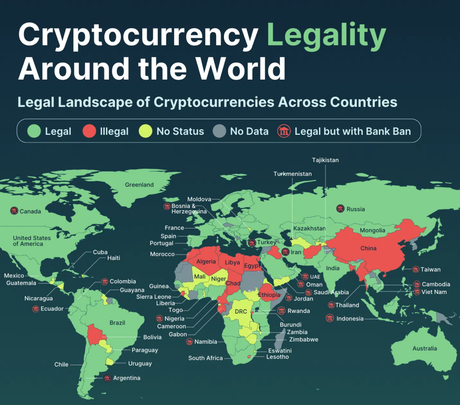
The global landscape of cryptocurrencies is experiencing a sweeping wave of legalization, as an increasing number of nations embrace this decentralized form of digital currency. With over half of the world’s countries, totaling 119 states and 4 UK overseas territories, already having legalized cryptocurrencies, this accounts for more than 60% of countries globally.
The European region leads in adoption, with 39 out of 41 countries legalizing cryptocurrencies, while North Macedonia and Moldova remain exceptions. In the Americas, 24 countries have embraced digital assets, except for Bolivia, which has taken a stance against cryptocurrencies. Asia, a significant player in adoption, shows similar approval percentages as the Americas, while Africa has the smallest percentage of global legalization.
Exploring the legislation and regulation surrounding cryptocurrencies is crucial, as only 62 out of the 119 countries with legalization have comprehensive legislation in place.
Global Adoption of Cryptocurrencies
More and more countries around the world are starting to use cryptocurrencies like Bitcoin for buying and selling things. Out of all the countries, over 60% have made it legal to use these digital currencies. Europe is in the lead, where 39 out of 41 countries have said it’s okay to use them. Only North Macedonia and Moldova haven’t yet.
In the Americas, 24 countries, which is about 77% of them, allow cryptocurrencies. Bolivia is the only country there that says no to them. Asia is also big on cryptocurrencies, with nearly 78% of countries giving them the green light. Africa is a bit behind, with only about 39% of countries allowing them.
Even though lots of countries let people use cryptocurrencies, only 62 of the 119 countries that say it’s legal have made full rules about it. This means that in about half of these places, there aren’t strong laws to guide how cryptocurrencies should be used. This is important because having clear laws can help protect people who use cryptocurrencies and make sure everything is fair and safe.
Legalization Trends in Different Regions
Cryptocurrency laws vary worldwide, with different regions having different stances. In Europe, the majority of countries, specifically 39 out of 41, have embraced cryptocurrencies and consider them legal.
The only exceptions are North Macedonia and Moldova, which have not yet given their approval. Moving to the Americas, approximately 77% of the countries, or 24 out of 31, have deemed cryptocurrencies acceptable.
However, Bolivia stands as the only country in opposition, while others such as Guatemala and Haiti have yet to reach a decision. In Asia, the majority, nearly 78%, of countries have legalized cryptocurrencies. Africa, on the other hand, exhibits a more cautious approach with less than 39% of countries permitting their use.
It is crucial to acknowledge that even in regions where cryptocurrencies are deemed legal, the regulatory framework may be weak or unclear. This lack of clarity poses a challenge for individuals seeking to utilize digital currencies securely.
Challenges and Concerns in Cryptocurrency Legislation
Regulating cryptocurrencies is a tough task for countries around the world. The main problem is that there isn’t one set of rules that all countries follow. Even though more than half of the countries allow cryptocurrencies, they still need clear laws to protect consumers, prevent crimes like money laundering, and stop unfair trading practices.
Because cryptocurrencies operate independently of governments, it’s hard for countries to apply rules and make sure everyone follows them. The fact that people can buy and sell things without revealing who they are also worries governments, as it could lead to illegal activities. On top of this, technology is always changing, and new kinds of digital money are being created, which makes it even harder to keep up with regulations.
Countries have to work through these issues to create laws that make sure cryptocurrencies are used safely and responsibly.






