


Taxi companies Addison Lee and Uber have announced new security measures as the government tries to ease restrictions on the coronavirus and people return to work.
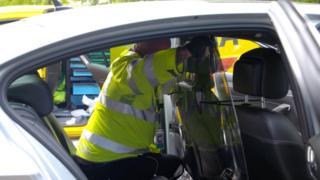
Addison Lee adapts to perspex partition screens between drivers and passengers on its 4,000 vehicles next week.
And Uber is paying the AA to install partitions in 400 cars in Newcastle, Sunderland and Durham as part of an initial pilot.
Both companies are also distributing free protective equipment to drivers.
The plans follow demands for improved protections for drivers and passengers.
"We know that there is significant demand from drivers, passengers, companies and the general public to do more to make transport cleaner and safer when returning to work, including requests to introduce partition screens in private rental vehicles, "said Addison CEO Lee Liam Griffin.
"That's why we decided to start installing safety screens between the driver and passenger seats."
Uber, an arriving taxi company, said its pilot in the North East of England was instrumental in the airline's understanding of how to transport passengers on trips as safely as possible.
Uber is first experimenting with the partition screens in areas where it has been able to obtain authorization from the regulator or city council to ensure that the screens are securely installed.
Transport for London (TfL) updated its guide for taxi companies and private hire vehicles on Wednesday.
The regulator advises companies to keep drivers and passengers socially, with passengers seated in the rear seats of cars. He advised drivers to bring a bottle of hand sanitizer gel containing at least 60% alcohol into their vehicle.
However, when it comes to the use of personal protective equipment (PPE) such as face masks, gloves or partitions, TfL said it was waiting to receive news from the London Strategic Coordination Group (SCG) on the recommendations before to impose additional coronavirus prevention and control measures for taxis and private rental vehicles.
"Lethal combination"
The BBC understands that several taxi companies in the UK are asking the government for clarification on the health and safety precautions to be taken once they are blocked and would prefer regulation rather than advice.
In Wales, taxi drivers have told the BBC to feel anxious about every passenger they take and are still waiting for approval from their local councils before they can make changes to their vehicles, such as installing a screen.
"Two months after a public health emergency that saw private rental drivers suffer from one of the highest professional mortality rates, but TfL and the Department of Transportation (DfT) are still not taking responsibility for introduce the necessary security checks, "James Farrar, president of the United Private Hire Drivers union, told the BBC.
"Poor regulatory standards and incorrect job classification have become a lethal combination for desperately exploited drivers."
Likewise, the union is concerned that Uber is not providing partition screens to its drivers in other parts of the UK, such as London, which has the largest concentration of Uber drivers in the country.
Farrar wants to see Uber commit to limit reservations to no more than two passengers per vehicle and to make the use of masks mandatory for both drivers and passengers.
For now, there is no evidence available to show that partitions in taxis will reduce the risk of coronavirus transmission.
But there is some evidence that the use of cloth face coatings can help reduce the transmission of coronavirus infection where it is not possible for people to maintain a distance of 2 m.
Distribute masks
Many companies have already started distributing PPE to their drivers after hearing the concerns of both drivers and passengers.
To date, Uber has distributed over one million disposable masks and 95,000 cleaning sprays to drivers. And in the coming weeks it will distribute another two million masks.
Unilever is partnering with Uber to distribute free hygiene kits that include antibacterial spray and hand sanitizer to drivers across the UK.
"In addition to working with Unilever to provide drivers with free sanitization products, Uber distributes millions of masks and reimburses drivers directly if they choose to procure PPE themselves," an Uber spokesman told the BBC.






