


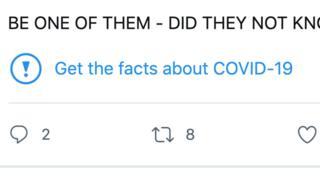
Twitter has started tagging tweets that spread misinformation about Covid-19, including some from Mark Steele, who posts posts about the links between 5G and coronavirus.
But the tweets of other 5G conspiracy theorists, like David Icke, remain unchallenged.
MEPs asked Google, Twitter and Facebook to return to Parliament to answer their content questions.
Only Facebook's global policy officer, Monica Bickert, has agreed to participate.
Digital, Culture, Media and Sport (DCMS) select committee chairman Julian Knight said MPs were "very disappointed" by the test standard provided by the three companies on coronavirus disinformation during their last meeting.
"The inability of Twitter, Facebook and Google to provide adequate written answers to our pending questions has left me no alternative but to call them back to Parliament," he said in a statement.
He specifically requested the participation of Google's Ronan Harris, UK and Ireland CEO and Dara Nasr, Twitter UK CEO.
The commission asks for clarity on a number of issues including:
- how Facebook manages the spread of false narratives on WhatsApp
- how Twitter manages influencers and celebrities in spreading misinformation like 5G conspiracy theories
- he fears that YouTube has allowed creators to effectively monetize the spread of disinformation through Super Chat revenue
In an interview with the BBC, Facebook founder Mark Zuckerberg said that the social network removed a post from Brazilian President Jair Bolsonaro stating that there is a cure for coronavirus, as well as the contents of groups that support the 5G network launch have been the cause of the spread of the virus. He also removed posts from conspiracy theorist David Icke, which Twitter didn't do.
Twitter recently introduced a tweet labeling system that could potentially cause harm and promised that world leaders like President Trump would not be above the rules.
But its application appears patchy, with some 5G conspiracy theorists having no doubts.
He sent a document to the DCMS committee outlining what he is doing to combat disinformation. He says, "Our goal with Covid-19's malicious disinformation is to quickly identify and remove the tweets that pose the greatest risk of causing harm."
Google did not respond to a BBC request for comment.
Analysis
Di Marianna Spring, journalist specializing in disinformation and social media
The first peak of viral disinformation seems to have passed, but it is difficult to determine whether this is due to the decisions made by social media platforms.
The spread of wrong information online has evolved during the pandemic and so social media policies have also tried to keep up.
In the past, elections or terrorist attacks have resulted in some localized changes to policies on fighting disinformation. But the unprecedented threat of the pandemic, which has hit people in countries around the world in a matter of weeks, has left social media sites with little choice but to tighten regulations faster than ever.
It took several weeks for the platforms - operating with remote and small labor force - to be on top of that initial avalanche of evil medical suggestions and speculations.
However, adopting stricter policies, especially when it comes to conspiracies that could cause harm, appears to have been somewhat effective. Mainly because false claims linking 5G to coronavirus or vaccinations have dominated the misleading online conversation in the past few weeks.
But it's hard to say if the slowdown in this "infodemic" is due to social media sites changing their policies - or just a case of timing. When the messages tell you that the tanks will roll your way and they never seem to start becoming skeptical. So you could stop forwarding on those evil WhatsApps, even if WhatsApp didn't make it a little more difficult.
Furthermore, it is debated whether the removal of conspiracies is always effective. It often leads to cries of censorship or establishment cover-up. However, in some way, it prevents the spread.






