


From concerts to dramas and quizzes, live entertainment moved online during the blockade - and creative minds are inventing new ideas to give us back some of the human connection we've lost.
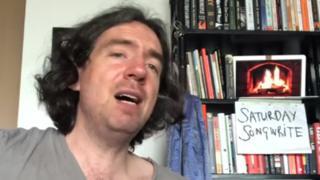
Every Saturday for the past two months, Snow Patrol singer Gary Lightbody he sat down and wrote a song.
Well, he wrote a song with 5,000 fans on Instagram.
He asks them for agreements, produces melodies and puts them to the vote. So he asks for ideas for the lyrics before returning an hour later with a finished song. "Some are really good," he says.
Lightbody also performs online solo concerts from home, but he also wanted to do something more collaborative.
"You can say anything in this. It's therapeutic and cathartic for me," he explains.
"In a" concert ", I talk a little, but you can't really read the comments because you're playing songs. But with this, it seems like you're busy with everyone."
Fans also voted for set lists at his regular online concerts. "I could just choose a bunch of songs that I want to play, which I did a week and it didn't really work," says Lightbody. "He seemed a little disconnected.
"I miss playing live, yes. But it will take a long time, so that's what we have."
With the common thrill of getting together in the same room that is currently out of the question, Lightbody is among the artists who have come up with interesting ways to bring people together.
When his Saturday Songwrite sessions generated 10 or 12 decent tracks, he will release an album for charity, although he hasn't yet opted for a charity. "It might be better to put this to the vote too."
Few musicians they do not have made online shows, which can have an intimate charm (but they can also be quite boring, beyond the voyeuristic football of having a busybody in their homes).
Lightbody recommends fellow singer from Northern Ireland roe, which could teach the big names something or two about audio and video quality.
Some artists engage their fans - accepting requests or asking questions and answers or tutorials like Duran Duran star John Taylor with his bass lessons and Oti Mabuse with his dance lessons.
The listening parties were also a great success. Frontman of Charlatans Tim Burgess has cut a sideline as the host of #timstwitterlisteningparty. Fans and musicians listen together in real time, tweeting thoughts and memories.
"There is power in listening and knowing that others do it the same way you do," Burgess told The Sunday Times.
In the United States, Swizz Beatz is Timbaland - who staged a song-by-song producer clash in 2018 - now perform a regular face-to-face lock-down, inviting several stars to confront Verzuz's weekly battles on Instagram.
Erykah Badu is Jill Scott The recent battle has been more than love, and has attracted 700,000 live viewers.
The New York Times called Verzuz "perhaps the most powerful quarantined entertainment franchise."
In addition to music, the blockade could prove to be a point of no return for activities such as quizzes, choirs and exercises, yoga and cooking lessons, which have found new leases of life online (despite the inevitable loss of the human touch).
In theater, as in music, it is difficult to replicate the live experience on the screen. But some use technology to create a new kind of show.
Although the monologues were filmed in bulk and the pre-recorded shows were put online, they often fail to capture the excitement of being in an audience. Furthermore, the magical and fantastic narration of the theater does not translate well on the screen.
"What doesn't work is watching the streaming of computer shows," playwright Simon Stephens told BBC Radio 4's Front Row last week. "Every time I look at those I feel more alone than I felt before.
"What's interesting is when writers, directors, actors and designers start thinking: what are Zoom's dramatic potentials?"
In the past few weeks, creative types have explored just that.
David Morrissey, Jenna Coleman is Denise Gough starred in A Separate Peace, a comedy about an act of Sir Tom Stoppard on Zoom.
"I am fascinated by the format, which is a completely new way of staging a show in which paradoxically you stay at home and live theater comes to you," said Sir Tom.
The show tried to replicate something of the live experience, with members of the audience buying a ticket in advance and showing up at an allotted time - the performance wasn't deliberately put online for later viewing.
He had a team of professionals, including videos, lights, costume designers and sound designers, and the actors (all at home, of course) entered and left their neighborhoods on the screen as if they were on stage. "The cast said they were so nervous, like 'I really felt like I was behind the scenes'," says the producer Matt Humphrey.
"The future of live theater"
"We want to show others that this can be done and to trust other people that live theater still has a place during the blockade." And he believes that such Zoom-style shows will still have a place when the quarantine facilities go up.
The Guardian's five-star review stated, "If this is the future of live theater for so long, then it works triumphantly."
Another triumph of the Zoom theater completely involved the audience from their sofas.
In a playful version of The Tempest from Northern Ireland-based Big Telly and the Creation Theater in Oxford, viewers were invited to help out doing things like creating storm sound effects and pretending to be a flock of birds. The most enthusiastic were highlighted on the screen to be seen by the rest of the audience.
Another show, Operation Elsewhere, was originally "an immersive theatrical game" played in the real world. When the world was blocked, it was quickly reworked for Zoom, even with a lot of audience participation.
"People turn off all the lights and go under the covers because we need to cover the darkness," Big Telly art director Zoe Seaton He explains. "There was a point where a character says, 'If you have the war paint, do it now', and you see people rushing to the kitchen and getting ketchup and things like that."
Virtual backgrounds and green screens can create settings and effects that would be difficult and expensive in real life. "I'm really enjoying it because it looks like a new trick box, a new way of telling stories," says Seaton.
People tuned in from all over the world and used the shows to have a shared evening "out" with separate family members.
"The joy of seeing your nephew in Canada do something in the same show you are part of was simply fantastic," says Seaton. "We are interested in going further.
"We work mainly in the rural communities of Ireland, as well as in Belfast and Derry, and suddenly our audience is in Brooklyn, and you think, oh God!"
The key invited the audience to bring the shows to life, adds Seaton. "They had that sense of community that the theater has, where you are all on the same journey.
"This is their main success. I think that's what people are missing from the block: that sense of community."
Follow us on Facebook or on Twitter @BBCNewsEnts. If you have a suggestion by email [email protected] .






