


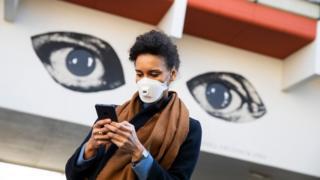
Countries around the world are developing Covid-19 smartphone apps to limit the spread of coronavirus and ease blocking restrictions.
It is hoped that the information they collect can be used to warn people if they present a risk of spreading the infection and need to be isolated. But, in recent weeks, a division has emerged between two different types of apps: the so-called centralized and decentralized versions.
Both types use Bluetooth signals to record when smartphone owners are close to each other - so if someone develops Covid-19 symptoms, an alert can be sent to other users who may have infected.
Based on the centralized model, the anonymous data collected is uploaded to a remote server where correspondences are made with other contacts, in the event that a person begins to develop the symptoms of Covid-19.
This is the method that the United Kingdom is pursuing.
By contrast, the decentralized model gives users more control over their information by keeping it on the phone. It is there that meetings are held with people who may have contracted the virus. This is the model promoted by Google, Apple and an international consortium.
Both sides have their fans.
Proponents of the centralized model say it can provide authorities with more information on the spread of the virus and app performance. Proponents of the decentralized approach claim that it offers users a higher level of privacy, protecting them from hackers or the state itself by revealing their social contacts.
Centralized v decentralized apps
In truth, both are not proven at this stage. South Korea, considered one of the most successful countries in tackling Covid-19, has done so without a contact tracking app. However, he used other surveillance methods that would be considered invasive by many.
In the beginning, the centralized approach was seen as pioneering. Singapore's TraceTogether was widely regarded as the one to be emulated. But this changed after the app emerged, it was only used by about 20% of the local population, and there has been a resurgence of Covid-19 cases.
Part of the problem is that TraceTogether isn't working properly in the background on the iPhone due to the way Apple restricts the use of Bluetooth. The company has promised to give up on these curbs, but only if the apps align with its decentralized system. Singapore has since reported that it will do so accordingly.
"We are working with Apple and Google to make the app more effective, especially for iOS users," said a spokesman for the BBC.
Australia, another early adopter of the centralized approach, launched its CovidSafe app based on TraceTogether and faced similar problems as a result. It also said it wanted to adopt the Apple-Google framework, citing a "big change in Bluetooth connectivity performance." And on Wednesday, Colombia also confirmed that it was considering a ride after turning off the contact tracking feature in CoronApp.
"[We need to] minimize the risk of generating unnecessary alarms, "said Presidential Advisor Victor Munoz.
'Apple doesn't help'
Others, however, are still advancing with the centralized approach. The French digital minister has said he plans to launch his StopCovid app by June 2 and is attempting to push Apple into a turnaround.
"Apple could have helped us make the application work even better on the iPhone," digital minister Cédric O said Tuesday. "They wished they didn't. I regret it."
But he faces internal resistance from one of the government's human rights bodies, who described the project as "dangerous" and warned that it could attempt to block its adoption.
Norway has already adopted a centralized design for its Smittestopp app, which was released in three municipalities last month. In addition to Bluetooth readings, it also collects GPS location data.
The developer says the combination of the two leads to "very precise contact tracking results without need[TheinterfacciaGoogle-Apple"[TheGoogle-Appleinterface"[l'interfacciaGoogle-Apple"[theGoogle-Appleinterface"
But this raised privacy concerns, which may have contributed to a rather high dropout rate. The Norwegian Institute of Public Health said 1.5 million people had downloaded the app as of April 28, but only 899,142 were actively using the app, accounting for only 20.5% of those over 16 in the test areas.
India's contact tracking app, Aaroya Setu, has a similar approach to the Norwegian one. To thwart adoption, the government has ruled that all government and private sector workers must use it.
Decentralized disciples
Until Apple and Google release their interface, known as APIs, it is impossible to be sure that their system will be more successful. But the list of nations that flock to it continues to grow. Germany surprised many when it confirmed that it was convinced that decentralization was the way to go - it had previously seemed destined to go hand in hand with France.
Poland's next app may also abandon its centralized plan before launch.
"We assume that ProteGo Safe will need to be adapted to the Google and Apple APIs," reads the developer notes. "We assume that adaptation will be needed ... to the Google and Apple APIs."
The Italian Immuni announced that even on April 29 it would support the initiative of the US technology giants, praising its strongest guarantee of anonymity. Other countries that have decided to do the same include:
Luxembourg MPs are about to vote on a decentralized approach. And the BBC has also been told that Greece is about to adopt a similar position.
Why is all this important? There may be problems in trying to make the two different types of systems talk.
"The main reason is that centralized systems ask you to upload the people you saw and decentralized systems don't need that data, so they don't play well together," explained prof. Michael Veale of the joint DPT3 Apple-Google group
"So if you see an app as an important part of blocking reduction, remove the possibility of tracking the virus as it crosses borders and viruses don't respect borders."






