


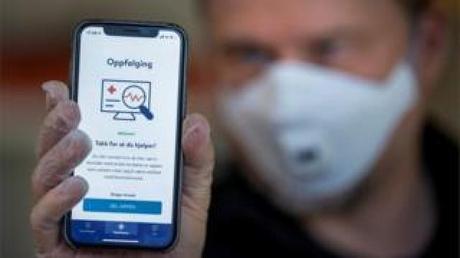
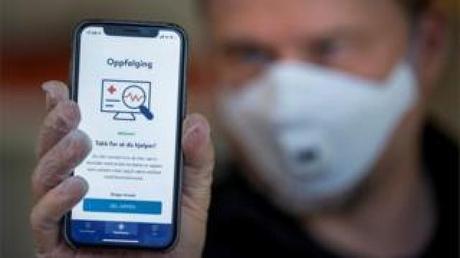
The Norwegian health authority had to delete all data collected through its Covid-19 contact tracking app and stop further use of the tool.
The Norwegian data protection authority determined that the Smittestopp app represented a disproportionate intrusion into user privacy.
The move to a rival design supported by Apple and Google is being considered.
Elsewhere, the researchers say that a bug in the latest version of the Australian app means that many iPhones fail to register matches.
In mid-April, Norway became one of the first places where a contact tracking app was introduced, when the Norwegian Institute of Public Health and the software company Simula implemented their tool in three municipalities in the country.
These apps work by registering when two phones are close together for a longer period of time.
If a user is subsequently diagnosed with the coronavirus, an alert can be sent to the other.
In the case of Smittestopp, users at risk were asked to self-isolate themselves to avoid spreading the infection further.
The developers decided that the best way to do this was to collect Bluetooth and GPS (global positioning system) location data and perform contact matches remotely on a centralized computer server.
But the Norwegian data protection authority said that health officials did not demonstrate that it was "strictly necessary" to collect location data.
Most other contact tracking apps rely solely on Bluetooth signals, although there are problems with this approach.
The regulator also noted that a group of experts who were asked to review the app suggested moving on to the decentralized model of Apple and Google, where the contact matching process is on smartphones within this system, offering users a higher level of anonymity.
While the centralized model offers epidemiologists more data to model the spread of the disease, the watchdog said that this was separate to contact the track and that users had to be able to consent to one but not the other.
The health authority said it disagreed with the watchdog's assessment, warning of "poor control of the spread of the disease" following the intervention.
But he advises users to disable the app on their phones, to save battery life, while deciding whether to appeal.
The Norwegian health authority had been assisted by the Big Data Institute of the University of Oxford, which had also advised the NHS to adopt its "centralized" approach.
Australia launched its CovidSafe app nationwide in late April.
But now, a team of cybersecurity researchers says that version 1.5 of the iOS version contains a flaw which means that iPhones are not detected when they are locked.
"One could imagine that Alice is preparing her bag, inserting her iPhone and going out for a day at a football game," said one team.
"With your device in this state, no one else will register your presence and if someone around you tests positive, you won't be contacted."
Since users cannot view their recorded game history, this would not have been immediately obvious to those who use the software.
The Australian digital transformation agency told the Zdnet news site that it welcomed the feedback.
"The DTA will continue to release updates to the CovidSafe app to offer a number of improvements in performance, security and accessibility as needed," he said.
Last week, Singapore announced that it had awarded a $ 4.3 million (£ 3.4 million) contract to a local electronics manufacturer to build 300,000 wearable dongles that users physically deliver if they are positive, rather than uploading the information via the Internet.
However, ministers are expected to confirm the release of Germany's mobile phone app on Tuesday.
And a spokesman for the Department of Health said he is still engaged in a wider launch of the NHS Covid-19 app across England, despite postponing the second phase of the trial last week.
"There was an extremely positive welcome to the Isle of Wight app, with over 54,000 people downloading the app," he told BBC News
"Their feedback was invaluable before the nationwide launch of the app early."






