


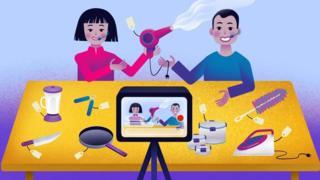
"I'm a little nervous," confessed Li Qiang, the deputy mayor of Wuhan, the Chinese city where the coronavirus was first reported late last year, pending the start of its first live event. streaming TikTok.
It is not the kind of tone that is often heard by a senior Communist party official. But in an attempt to revive the Chinese economy after the devastating epidemic, Li has been decided. He spoke fondly of his long appreciation for Wuhan's local delicacy, hot and dry noodles and urged locals to visit his favorite shop.
The nationwide blockade of two months has put a strain on the economy. It shrank 6.8% in the first three months of 2020 - the first time the country's economy has contracted since the death of President Mao in 1976.
But unlike then, Chinese politicians are more pragmatic these days, particularly when the rapidly growing economy is entering uncharted waters.
In a provincial-level campaign to revive the economy, senior officials from Hubei Province - which is home to 60 million Chinese - are turning into online streaming celebrities. Li and her colleagues are supporting local brands and paying close attention to sales figures.
Is the result? According to Chinese media reports, on the first day of the campaign, April 8, these TikTok streaming sales across the province raised 17.9 million yuan ($ 2.5 million; £ 2 million). They sold nearly 300,000 items in nine hours, including 44,000 parts of Mr. Li's favorite hot and dry noodles.
Hubei isn't the only province to benefit from the expansion of the Chinese live streaming industry. Many local officials in the provinces of Hunan, Shandong and Guangxi have also become sales gurus since social distancing has become a rule in China. They support local produce to help revive the economy - while showing their voters a different side of the communist party politicians.
Sales through live streaming during the outbreak "have certainly provided hope and a new outlet for companies to start investing in marketing, which also supports the service industry and other sectors," said Andrea Fenn, CEO of Fireworks, a Shanghai-based marketing consulting firm.
"Brother Lipstick No. 1"
However, this business model is not just a top-down effort. Even before party officials began appearing on live streaming services, owners of experienced companies were turning to live streaming platforms such as TikTok and Kuaishou, as well as Alibaba's e-commerce giant Taobao, to promote and sell their products in real time.
One of these is the 27 year old Li Jiaqi, whose non-conformist sales technique earned him the nickname "Rossetto Fratello n. 1". Once a mere shop assistant earning a modest salary in Nanchang, southeast China, he now has more than 40 million followers on TikTok.
In one of his live streaming sales sessions he sold 15,000 lipsticks in five minutes. Unlike many beauty bloggers, she always shows the lipsticks she sells on her lips rather than on her arms. It appears to be paying off, given that it now has a net worth of up to $ 5 million (£ 4 million).
There's also 33-year-old Wei Ya, whose April 1 sale of a $ 6 million missile launch on Taobao surprised the nation and attracted international publicity. So much so that Taobao had to issue a statement confirming that the sale was real and not an April Fool's joke.
Wei Ya has been a familiar face in the streaming sales circle in China. Her followers call her "Queen of Goods".
The official China Daily claims that this was "the world's first live broadcast of a missile sale." Over 620,000 Weibo users have used the hashtag #WeiYaSellsARocket and over two million online visitors tuned to attend the sale.
Can it save the Chinese economy?
Foreign brands have also joined. Luxury product maker Louis Vuitton hosted a live streaming sale in March - the first time since the brand entered the Chinese market 30 years ago.
At the height of the Chinese epidemic of Covid-19, Taobao, the platform with the highest number of live streaming sales, only saw a 719% increase in new sellers across the country in February alone.
Not everyone will do it, however. Marketing consulting chief Andrea Fenn says that despite the recent frenzy, the market is becoming increasingly crowded.
"The first few users were able to get results with [often quite amateurish] live streaming activities because the phenomenon was quite new and fresh.
"Now there are thousands of live streams out there and consumers are starting to wonder why we came back to a communication business that looks a lot like a telemarketing show from the 90s.
"I see more and more companies failing to increase sales through live streaming because of consumer fatigue."
One of the most successful online celebrities in China can probably attest to that. In April, 48-year-old former English teacher - and now Internet celebrity - Luo Yonghao made headlines with his inaugural live streaming sales event.
It attracted 50 million viewers across China and in three hours reached an astounding $ 15.5 million in sales.
In the next two weeks, Mr. Luo used live streaming twice to sell goods, but with much less success. Chinese media say that the number of its viewers and sales figures have fallen by 83% and 48% respectively.
Andrea Fenn says, for him, all this confirms that "I don't think we are looking at something that alone can sustain an economic boom".
Illustration by Davies Surya





