


This story is part of CESHere, our editors bring you the latest news and the hottest gadgets of the fully virtual CES 2021.
In my Oculus Quest VR headset, I was in a room surrounded by big brained aliens. Their heads flashed white and black. I turned to one and stared at it. Soon his head exploded. I looked at the others and let their heads explode. Then I looked at a blinking portal marker across the room and was gone. I did this without eye tracking. A tape on the back of my head scanned my visual cortex with electrodes.
I felt like I was living a kind of real virtual version of the David Cronenberg film Scanner. In reality, I tried a neural input device from NextMind.
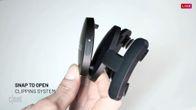
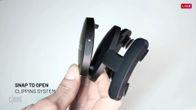
Before the vacation break, I received a large black box with a small package in it. A black disc with a headband. The disc was covered with small rubber foot pads. Announced a year ago at CES 2020, NextMind's $ 399 developer kit targets something that many companies are aiming for: neural input. NextMind aims to read a brain's signals to keep track of attention, control objects, and maybe even more.
It's hard to understand the real potential and possibilities of neural input technology. Also, a lot of the startups in this space do different things. CTRL-Labs, a neurotechnology company that was acquired by Facebook in 2019, developed a bracelet that can be used to send hand and finger input. Another company, Mudra, made a wristband for the Apple Watch later that year that also captures neural input on the wrist.
I wore an early version of the Mudra Band a year ago and saw how it could interpret the movements of my finger and even roughly measure how much pressure I was applying as I squeezed my fingers. Even stranger, mudra's technology can work if you don't move your fingers at all. Applications could include assisting people who don't even have hands, such as B. a portable prosthesis.
NextMind's ambitions are to take a similar path in assistive technology while striving for a world where neural devices can potentially help improve the accuracy of physical input - or combine it with a world of other peripherals. Facebook AR / VR chief Andrew Bosworth sees Facebook's neural input technologies emerging within three to five years, which may be combined with wearable devices like smart glasses.
My NextMind experience was tough, but also fascinating. The development kit includes its own tutorial and demos that can be run on Windows or Mac, as well as a Steam VR demo that I played on the Oculus Quest using a USB-C cable. The compact Bluetooth plastic puck has a headband, but can also be detached from it and, with a little effort, attached directly to the back of a VR headset strap.
All NextMind experiences include viewing large, subtly blinking areas of your screen that can be "clicked" by focusing. Or stare. It was hard to tell how to activate something and I tried to open my eyes more, to breathe, or to concentrate. Sooner or later what I was seeing would click at some point. From a field of about five "buttons" flashing on the screen, this really knew what I was seeing. And again there was no gaze tracking at all, it just rested on the back of my head.
Did i feel uncomfortable? Unsure? Oh yeah. And when my child came in and saw me doing it and I showed him what I was doing, he was as amazed as if I had performed a magic trick.
NextMind's development kit is not yet intended for consumer devices. The Mudra Band is experimentally available as an Apple Watch accessory through the crowdfunding website Indiegogo, but it is also experimental. I have no doubt we will see more technology like this. At this year's virtual CES, there was even a "neural mouse" glove aimed at improving reaction times by capturing click inputs from a hair faster than even the physical mouse could receive. I haven't tried this glove, but neither does the idea sound far removed from what companies like NextMind envision.
Right now, neural input feels like an imperfect attempt to create an input, like algorithms looking for a way to do something I would probably do with just a keyboard, mouse, or touchscreen instead. But this is how speech recognition used to feel. And hand tracking. For now, NextMind's demos are really working. I'm just trying to imagine what will happen next. Whatever it is, I hope more exploding heads won't be part of it.






