


For my Review of the latest Motorola Razr I tested the updated foldable phone for 10 days in September. Occasionally a viewer would react in disbelief when I opened or closed the phone. A woman who worked behind the till of a coffee shop's to-go window actually gathered her (masked and socially distant) staff members and asked me to show them how the Razr folded in half. When I demonstrated the screen fold like paper, she replied, "This is amazing. Where can I get one from?"
And that's the "magic" of the foldable phones at its core. You are doing the seemingly impossible by folding something rectangular and rigid into something smaller than a coaster. That magic comes from years of design, testing, and redesign. And the engineers and designers who worked on the upcoming Motorola Razr know that folding a 6.2-inch phone in half is far from magical.
For more of that
Subscribe to the mobile newsletter, receive notifications and see related articles on CNET.
But all of this work can easily be overshadowed. The 2019 Samsung Galaxy Fold test devices hoisted the flag over how folding screens would work in the real world. Some of them had defects This can cause dust or other particles to get under the screen and wreak havoc. Any concerns people had about folding displays were immediately heightened.
Then in February 2020 after months of delays, Motorola released its Razr (2019) with a foldable screen and CNET's video team tested the display's durability. My colleague Chris Parker used a FoldBot and attempted to open and close the phone 100,000 times. After 27,000 folds the Razr (2019) wasn't able to be tested further. Reflecting on that test and how SquareTrade modified its FoldBot to handle the Razr, Parker concluded:
"Does [it] Do you feel like you have a durable, resilient phone that can withstand extended use in the real world? For me it is. "
With these incidents, you may wonder if foldable screens are permanent. And if so, how do we know? Jeff Snow, General Manager, Innovation Products at Motorola, thinks it's natural to ask questions about the durability of foldable displays.
"The new thing about the phone is the fact that the screen flips open and you can light it up," said Snow. "People are not used to talking on the phone with these flip screens. So the questions in their mind are, 'Will it take?' 'How often can I actually take this action?' "
Motorola claims the screen of its upcoming updated Razr (2020) can be folded 200,000 times. To give you an idea of how often this happens, you can open and close the phone 100 times a day for five years without reaching that number.
To show me how the company measured and tested the number of times the upcoming Razr's screen could be folded, I visited a lab at Motorola in Chicago - wearing a mask and social distancing - to see Snow and Tom Gitzinger, director and director Meet Motorola Innovation & Architecture Engineer. I've seen Motorola test the screen of the upcoming Razr myself.
Motorola's laboratory for folding screen machines
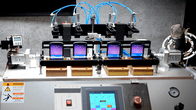
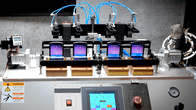
In a room that looks like a college black box theater, a series of lights are shone on a machine about 10 feet wide. There is a camera on a tripod that points at the machine and gives the entire room a strange TV show atmosphere. There are four Razr (2020) phones on the waist-high machine on the back. The device opens and closes all four telephones completely at the same time.
Motorola uses similar machines to test the wrinkles on the Razr (2020) throughout the design and manufacturing process. Unlike the Samsung Galaxy Z Flip, which can be opened to various positions, the Razr is either fully open and flat or fully closed. And unlike the Foldbot, the Motorola machine opens the Razrs perfectly flat with a wire and with one arm. The cable is thin enough to nestle between the two halves of the phone when closed.
To restore those 200,000 wrinkles in less than five years, the device opens and closes the phones completely every 4 seconds. It's comforting to hear four phones close every 4 seconds. It's like a soft sounding metronome. It takes Motorola 10 days to fold each phone with this device 200,000 times.
Owner feedback helps improve the new Razr
For the past six months, Motorola has reached out to people who own the Razr (2019) to learn how to use the phone. According to Snow, Razr owners open and close their phones an average of 40 times a day. And "superuser" (the 99th percentile) an average of 100 times a day. So Motorola created the upcoming Razr (2020) for 200,000 folds.
"We're not changing the test parameters," said Snow. "But we want to make sure we understand people and exceed their expectations."
The screen and hinge allow the Razr to fold in half
The "Zero Gap" design, screen and hinge of the phone allow the Razr to achieve a high level of screen durability. The upcoming Razr (2020) uses largely the same design as the Razr (2019), but with improvements. If you want to learn more about the hinge, check out a video below I made last year about its design and how it allows the Razr (2019) to fold flat.
The screen itself is made up of five different layers and is then sprayed with a hard coating. When the layers are combined, the screen is 3.5 millimeters thick. To give you a feel for how thin that is Motorola Edge Plus uses a similar OLED panel stack for the curved edges of the screen, which is three times the thickness of the Razr's display stack.
And it's not just the display that folds in half. There are a number of connections including the four 5G antennas that need to go through the hinge. And like other foldable phones, the battery in the Razr consists of two batteries, one on each end. Not only does this help with balance, it also adds complexity as the two must be connected via the Razr's hinge mechanism.
How Motorola addressed the squeak / creak
When I checked the Razr (2019) in February, it was suffering from a squeak / creak. It was like a muffled crunch, but loud. During my time with the upcoming Razr (2020), the squeak / creak was mostly absent until Friday - my eighth day on the phone. And when it squeaked, it was a quieter sound, more like breaking a pair of new leather boots. Gitzinger explained the sound by comparing it to a bag of potato chips.
"There's no way you can open a bag of potato chips without making a sound. It's super thin. It's much crisper and wrinkled than something like that [the foldable display]. But the same principle applies, "said Gitzinger." You have this big, significant surface that is moving, and it's pushing air that makes some of the noise. We were able to get rid of other noises by adding some old friction adhesives, tapes, and finishes to make everything easier to slide past each other. "
I asked a friend how they felt about the squeak / creak on the upcoming Razr (2020) and they said they didn't mind. I think when it comes to screen nicks, foldable screen creases, and now foldable phone squeaks, some people will get used to these things while others will get upset.
The new Motorola Razr looks even slimmer when you fold it in half
Only time can tell
With the improvements made, Motorola is confident that the upcoming Razr will have a long life. In fact, the company runs 40 different laboratory tests to test both the design and quality of the phone during design and manufacture.
The real indicator of how durable the screen on the Razr (2020) or any foldable phone is is time. Until then, foldable phones, just like magic, require a little trust.
More information can be found at my Flashback to the upcoming Motorola Razr.






