Do you know who was – ‘Johanna Bertha Julie Jenny von Westphalen’ ? In Das Kapital (1867), Marx proposes that the motivating force of capitalism is in the exploitation of labour, whose unpaid work is the ultimate source of surplus value. I was under a very wrong notion that Marx was deeply routed in Russia, China and other communist countries, perceived by the way the Unionists and Marxists interpreted them here !! Do you know the year in which Karl Marx visited Soviet Russia ? Jenny von Westphalen was born in the small town of Salzwedel in Northern Germany. Her civil servant father, Ludwig von Westphalen was a former widower with four previous children, who served as "Regierungsrat" in Salzwedel and in Trier. Her paternal grandfather Philipp Westphal was himself the son of a Blankenburg postmaster that had been ennobled in 1764 as Edler von Westphalen by Duke Ferdinand of Brunswick for his military services. Das Kapital, ‘A Critique of Political Economy ‘ is a foundational theoretical text in materialist philosophy, economics and politics by Karl Marx. Marx aimed to reveal the economic patterns underpinning the capitalist mode of production in contrast to classical political economists such as Adam Smith, Jean-Baptiste Say, David Ricardo and John Stuart Mill. While Marx did not live to publish the planned second and third parts, they were both completed from his notes and published after his death by his colleague Friedrich Engels. Karl Marx [1818 – 1883) was a German philosopher, economist, journalist and socialist revolutionary. Born in Trier, Germany, Marx studied law and philosophy at university. Due to his political publications, Marx became stateless and lived in exile with his wife and children in London for decades. His best-known titles are the 1848 pamphlet, The Communist Manifesto, and the three-volume Das Kapital. Marx's critical theories about society, economics and politics – collectively understood as Marxism – hold that human societies develop through class struggle. In capitalism, this manifests itself in the conflict between the ruling classes (known as the bourgeoisie) that control the means of production and the working classes (known as the proletariat) that enable these means by selling their labor power in return for wages. Employing a critical approach known as historical materialism, Marx predicted that, like previous socio-economic systems, capitalism produced internal tensions which would lead to its self-destruction and replacement by a new system known as socialism. Now comes the surprise – Marx never visited Moscow.Sometime back, officials at Moscow’s Committee for Monumental Arts put forward a suggestion to remove the monument to Karl Marx from the city center. Architect Ivan Kazansky said that the founder of communism should not be standing in the very center of Moscow just because of the fact that Marx never visited Russia’s capital. Furthermore, it is Britain and Germany that are supposed to erect his monuments, the official added. So 200 years after Karl Marx was born, a country he never visited is marked with reminders of his legacy. Russia’s most popular social network Vkontakte lists hundreds of people named after the German political economist. But nearly 27 years after the fall of the Soviet Union, one of the 19th century’s most influential thinkers has become an afterthought in the first country to implement his ideas as a political system. Leading up to the May 5 anniversary, Russian authorities chose not the mark the occasion at all. “The official stance is that his revolutionary ideas brought misfortune to the Russian people,” said Lev Gudkov, director of the independent Levada Center pollster.“Russians have all but forgotten him.”
 Following the death of his wife in 1881, Marx became ill and was
indisposed for the last 15 months of his
life. Eventually it led to his dying as
a stateless personon 14 March 1883 (age 64), in London. His body was buried in London and it is stated
tahit there were between nine and eleven
mourners at his funeral.
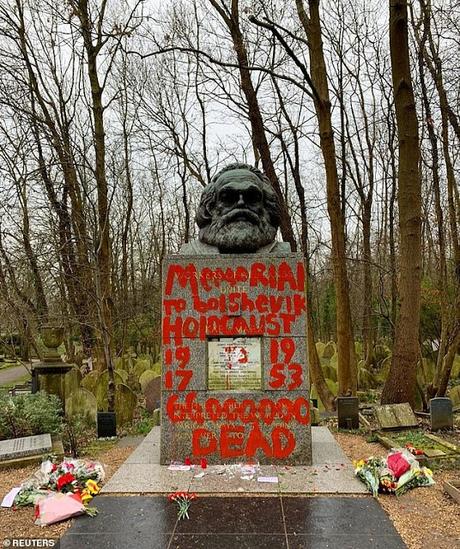
MailOnline reports that CCTV cameras are installed at Highgate
cemetery after vandals target Karl Marx's tomb twice in a year.The severe measure was taken as a last resort
following significant damage to the grave at Highgate cemetery in the last
year. Vandals twice targeted the grave's white marble plaque and it was daubed
in blood red paint spelling out slogans such as 'architect of genocide','doctrine of hate' and 'ideology of starving' !
The decision was taken by the Marx Grave Trust, which owns the monument,
despite concerns that cameras would be intrusive due to recent burials close to
the site. It is the first of the cemetery's 53,000 graves - including notable
figures such as author Douglas Adams and novelist George Eliot - to be
protected with cameras. The current tomb has repeatedly been targeted by
vandals since its erection in 1956 and was damaged by a pipe bomb in 1970,
blowing up part of Marx's face (pictured: Tourists at the grave site)
Following the death of his wife in 1881, Marx became ill and was
indisposed for the last 15 months of his
life. Eventually it led to his dying as
a stateless personon 14 March 1883 (age 64), in London. His body was buried in London and it is stated
tahit there were between nine and eleven
mourners at his funeral.
MailOnline reports that CCTV cameras are installed at Highgate
cemetery after vandals target Karl Marx's tomb twice in a year.The severe measure was taken as a last resort
following significant damage to the grave at Highgate cemetery in the last
year. Vandals twice targeted the grave's white marble plaque and it was daubed
in blood red paint spelling out slogans such as 'architect of genocide','doctrine of hate' and 'ideology of starving' !
The decision was taken by the Marx Grave Trust, which owns the monument,
despite concerns that cameras would be intrusive due to recent burials close to
the site. It is the first of the cemetery's 53,000 graves - including notable
figures such as author Douglas Adams and novelist George Eliot - to be
protected with cameras. The current tomb has repeatedly been targeted by
vandals since its erection in 1956 and was damaged by a pipe bomb in 1970,
blowing up part of Marx's face (pictured: Tourists at the grave site)
PS 1:Marx's book Das Kapital, first published in 1867, was the text that inspired Communist leaders such as Lenin, Trotsky and Stalin.His works, including the Communist Manifesto, are considered by critics to have fuelled political tensions and conflicts throughout the 20th century. The marble plaque, from Marx's original 1883 gravestone with his wife was struck with a hammer during an attack in January. In China and the Soviet Union, Marxism is enshrined as a 'guiding ideology' in the constitutions of both the party and the state.The founding and ruling political party of modern China - the Communist Party - requires members to adopt the reading of Marxist works and the understanding of Marxist theories as a 'way of life' and a 'spiritual pursuit'. PS 2 : Jenny von Westphalen was the wife of Karl Marx.She and Marx regularly met each other as children. She was four years older than Karl.Jenny and Karl became engaged in 1836. They eventually married on 19 June 1843 in the Kreuznacher Pauluskirche (the Kreuznach church of Saint Paul), Bad Kreuznach. With regards – S. Sampathkumar