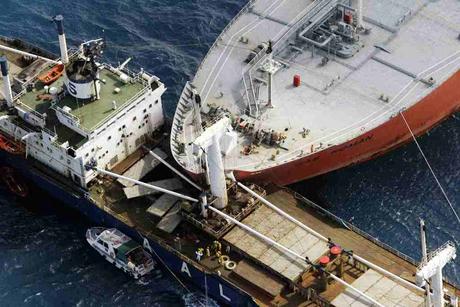
 Collision titled ‘tbone’ – from cargolaw.com
A privy
council is a body that advises the head of state of a nation; "privy" means "private"
or "secret"; thus, a privy council was originally a committee of the
monarch's closest advisors to giveconfidential advice on state affairs. The Privy Council in England was a judicial
committee to advice/recommend the British Crown i.e. British King /Queen, also
called as His/Her Majesty-in-Council, in the matter of law. The Judicial
Committee Act of 1833 introduced certain reforms in the King’s Privy Council.
Later on, the Appellate Jurisdiction Act of 1876 was passed making House of
Lords as the final Court of Appeal in England. The Abolition of Privy Council Jurisdiction Act,
1949 abolished the jurisdiction of Privy Council in England to entertain
appeals and petitions from any judgment, decree or order of any Court or
Tribunal in India.
The appeal before
the Privy Council on 2nd May 1877 before Sir James W Colvile, Sir
Robert Phillimore and others was the
collision by the stern of ‘Dacca’ running amidships into the port side of
‘Michelino’ whilst at anchor – it was sought to check
whether the collision was any consequence of negligence and bad
seamanship. The appeal itself had
been placed against the decree of High Court of West Bengal which reversed a
decree of one of the Judges of the Court of Vice-Admiralty.
Collision titled ‘tbone’ – from cargolaw.com
A privy
council is a body that advises the head of state of a nation; "privy" means "private"
or "secret"; thus, a privy council was originally a committee of the
monarch's closest advisors to giveconfidential advice on state affairs. The Privy Council in England was a judicial
committee to advice/recommend the British Crown i.e. British King /Queen, also
called as His/Her Majesty-in-Council, in the matter of law. The Judicial
Committee Act of 1833 introduced certain reforms in the King’s Privy Council.
Later on, the Appellate Jurisdiction Act of 1876 was passed making House of
Lords as the final Court of Appeal in England. The Abolition of Privy Council Jurisdiction Act,
1949 abolished the jurisdiction of Privy Council in England to entertain
appeals and petitions from any judgment, decree or order of any Court or
Tribunal in India.
The appeal before
the Privy Council on 2nd May 1877 before Sir James W Colvile, Sir
Robert Phillimore and others was the
collision by the stern of ‘Dacca’ running amidships into the port side of
‘Michelino’ whilst at anchor – it was sought to check
whether the collision was any consequence of negligence and bad
seamanship. The appeal itself had
been placed against the decree of High Court of West Bengal which reversed a
decree of one of the Judges of the Court of Vice-Admiralty.
The facts of the case are fully stated in the judgment of their Lordships delivered by Sir Robert Phillimore. "Michelino" was an Italian barque, lying about three miles from the fairwayHart buoy of the pilot's station near the entrance of the Rangoon river. She had been at anchorage there in Feb. The collision took place by the stem of the "Dacca" running amidships into the port side of the other vessel while at anchor. The burden of proof, therefore, lied very heavily upon the "Dacca" to show that the collision so caused with a vessel properly at anchor in a proper place was not the consequence of her (the "Dacca’s) negligence and bad seamanship. The defence tried to portray that the barqueMichelinohad not, at the time, a proper light, in the sense of not being sufficiently bright, and that the light was not placed in a proper place. Those who appeared on behalf of the " Dacca" relied very much upon a rule of the port of Rangoon, which provides that all vessels in the port and in the roadstead there shall carry a light upon their starboard foreyard-arm. However, there was the light hanging on the fore-stay about 19 or 20 feet from the lower deck. There was no dispute at all that this light was carried in that place, and was burning, howsoever, at the time of the collision. Their Lordships by no means satisfied that, in the circumstances of this case, the rule which has been referred to was binding upon the barque. She appeared to have been anchored, perhaps in a fairway, but certainly on the high sea. Their Lordships, therefore, opined that it would be a question deserving of very great consideration whether, in the circumstances, the rule which was binding upon her was not rather the sailing rule, which is of international obligation, and which enjoins that the light shall be carried where it can be best seen, not higher than 20 feet. It was also interred by the Lordships that the barque did carry a light of such a quality and so placed as to apprise approaching vessels that she was lying at anchor. The question, thence, was how dacca on way in the early morning in Feb did not see the vessel lying at anchor, with a light burning. The reasons assigned were : - there was a kind of haze upon the water, which prevented the light being as well observed as it otherwise would have been. - the pilot vessel, called the '*Spy,*' which lay behind the barque at the entrance of the Rangoon river, threw up a blue light ; and the "Dacca" having replied to that light, another blue light was thrown up,; possibly the blue light might have been either in one line with the light of the barque, or that it might have dazzled the eyes of those on board dacca (Lordship consulting nautical assessor opined that blue light would not have such effect) An evidence consisted in a remarkable letter addressed by the Captain of dacca to his agents on the morning of the collision, in which he described the disaster as being attributable to the ship being directly anchored in a line with the pilot schooner, and in the very track of our mail steamers,'' and in which there is no reference, from beginning to end, to the accident being attributable to the absence of light or the improper position of the light on board the barque. The other evidence admitted by consent had been taken before the Court of the Recorder ; and upon that evidence the Appeal Court came to a very clear opinion that while, on the one hand, the negligence of the " Dacca " was clearly made out, in running into this vessel, lying in her proper anchorage water, there was no contributory negligence on the part of the barque. Court was of opinion that the " Dacca" was to blame on various grounds : for having gone at too high a rate of speed, for having put her helm a-starboard, and for not having a proper look-out. Their Lordships were of the opinion that the sentence of the Court of Appeal must be sustained and the appeal before them was dismissed. With regard – Sampathkumar 28th Mar 2o17.