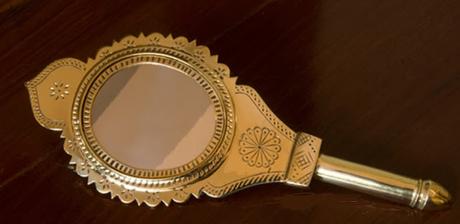
Aranmula kannadiis a handmade metal-alloy mirror, made in Aranmula, in Pathanamthitta district of Kerala.Here is the beautiful temple of Sri Parthasarathi ~ a divyadesam (Thiruvaranvilai – locally Aramula).Unlike the normal "silvered" glass mirrors, it is a metal-alloy mirror or front surface reflection mirror, which eliminates secondary reflections and aberrations typical of back surface mirrors.They are considered to be one of the eight auspicious items or "ashtamangalyam" that play a role in the entry of the bride at a wedding venue.The origins of the Aranmulakannadi are linked to the Aranmula Parthasarathy Temple.
 People spend long time in front of mirrors – and at the first
instance, one would look to see whether the looks are attractive and needs any
correction like combing or make-up – this is but natural for humans (read
women).Do animals react in the same
manner ?The mirror test – sometimes called
the mark test, mirror self-recognition test (MSR)– is a behavioural technique
developed in 1970 by psychologist Gordon Gallup Jr. as an attempt to determine
whether an animal possesses the ability of visual self-recognition. The MSR
test is the traditional method for attempting to measure self-awareness.
However, there has been agreement that animals can be self-aware in ways not
measured by the mirror test, such as distinguishing between their own and
others' songs and scents.
In
the classic MSR test, an animal is anaesthetised and then marked (e.g., painted,
or a sticker attached) on an area of the body the animal cannot normally see.
When the animal recovers from the anesthetic, it is given access to a mirror.
If the animal then touches or investigates the mark, it is taken as an
indication that the animal perceives the reflected image as itself, rather than
of another animal.Very few species have passed the MSR test.
The
most forlorn-looking elephant, ironically named ‘Happy’ caged alone at the Bronx Zoo is also the first
elephant to demonstrate self-awareness via the mirror self-recognition test
(MSR). Jane Goodall, Steven M. Wise and the legal team at the Nonhuman Rights
Project (NhRP) secured another first for the sad elephant becoming the first elephant to be granted a Writ of
Habeus Corpus, before the Orleans County
Supreme Court.For a decade the NhRP has used the legal
pathway of Writ of Habeas Corpuson behalf of nonhumans, making the case that
elephants and other self-aware, cognitively advanced beings are not ‘things,’
they are not merely ‘property’. To
them, it is wrong to treat animalsas if they're basic, inanimate beings.
Happy
is the second cognitively advanced nonhuman to be granted the right to plead
for rights afforded legal persons. That may sound confusing but basically, if
you’re not a person you need to first win the right to ask for rights. Two
chimpanzees, Hercules and Leo, were previously granted Writ of Habeus Corpus.”
The
Asian elephant ‘happy’ 47 years of age,has remained caged alone for more
than a decade at the Bronx Zoo. A writ filed by humans on behalf of other
highly intelligent species is the only viable recourse for creatures like
elephants who can neither legally, nor practically, plead their case before a
judge in court.“Our world-class experts say that, like all elephants, Happy is
an autonomous being who evolved to walk 20 or more miles a day as a member of a
multi-generational large social group,” said Steven M. Wise, via NhRP press
release. “The entirety of the zoo’s elephant exhibit provides far less than
even one percent of the space she would roam in a single day in the wild. She
doesn’t belong to a social group. Her autonomy is thwarted daily. This has got
to stop.”Once used as a pathway to freedom by slaves, a writ of habeas corpus
(known as the Great Writ) sets a precedent for all future considerations of the
rights and freedoms for intelligent beings, be it animals, aliens or artificial
intelligence.
People spend long time in front of mirrors – and at the first
instance, one would look to see whether the looks are attractive and needs any
correction like combing or make-up – this is but natural for humans (read
women).Do animals react in the same
manner ?The mirror test – sometimes called
the mark test, mirror self-recognition test (MSR)– is a behavioural technique
developed in 1970 by psychologist Gordon Gallup Jr. as an attempt to determine
whether an animal possesses the ability of visual self-recognition. The MSR
test is the traditional method for attempting to measure self-awareness.
However, there has been agreement that animals can be self-aware in ways not
measured by the mirror test, such as distinguishing between their own and
others' songs and scents.
In
the classic MSR test, an animal is anaesthetised and then marked (e.g., painted,
or a sticker attached) on an area of the body the animal cannot normally see.
When the animal recovers from the anesthetic, it is given access to a mirror.
If the animal then touches or investigates the mark, it is taken as an
indication that the animal perceives the reflected image as itself, rather than
of another animal.Very few species have passed the MSR test.
The
most forlorn-looking elephant, ironically named ‘Happy’ caged alone at the Bronx Zoo is also the first
elephant to demonstrate self-awareness via the mirror self-recognition test
(MSR). Jane Goodall, Steven M. Wise and the legal team at the Nonhuman Rights
Project (NhRP) secured another first for the sad elephant becoming the first elephant to be granted a Writ of
Habeus Corpus, before the Orleans County
Supreme Court.For a decade the NhRP has used the legal
pathway of Writ of Habeas Corpuson behalf of nonhumans, making the case that
elephants and other self-aware, cognitively advanced beings are not ‘things,’
they are not merely ‘property’. To
them, it is wrong to treat animalsas if they're basic, inanimate beings.
Happy
is the second cognitively advanced nonhuman to be granted the right to plead
for rights afforded legal persons. That may sound confusing but basically, if
you’re not a person you need to first win the right to ask for rights. Two
chimpanzees, Hercules and Leo, were previously granted Writ of Habeus Corpus.”
The
Asian elephant ‘happy’ 47 years of age,has remained caged alone for more
than a decade at the Bronx Zoo. A writ filed by humans on behalf of other
highly intelligent species is the only viable recourse for creatures like
elephants who can neither legally, nor practically, plead their case before a
judge in court.“Our world-class experts say that, like all elephants, Happy is
an autonomous being who evolved to walk 20 or more miles a day as a member of a
multi-generational large social group,” said Steven M. Wise, via NhRP press
release. “The entirety of the zoo’s elephant exhibit provides far less than
even one percent of the space she would roam in a single day in the wild. She
doesn’t belong to a social group. Her autonomy is thwarted daily. This has got
to stop.”Once used as a pathway to freedom by slaves, a writ of habeas corpus
(known as the Great Writ) sets a precedent for all future considerations of the
rights and freedoms for intelligent beings, be it animals, aliens or artificial
intelligence.
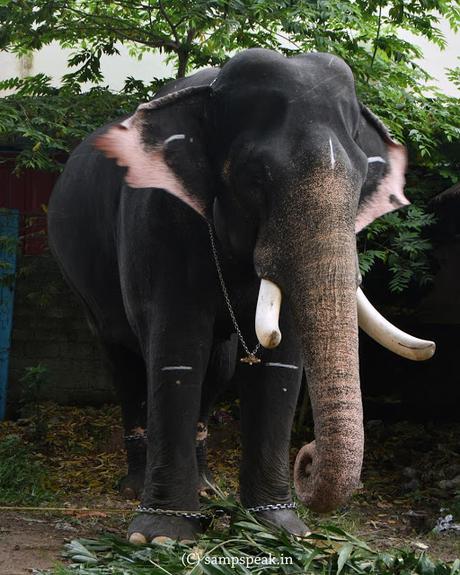 ~ a majestic tusker at Thirupunithura, Kerala (just as illustration - nothing to do with article)
The New York State Supreme Court in Orleans County today ruled that a habeas corpus petition filed by the Non-Human Rights Project (NRP) -- claiming Happy, a 47 year old Asian elephant at the Bronx Zoo, should have the same rights as aperson – would be more properly heard in Bronx County. The ruling wass the latest in a long series of losses for this group as they desperately seek ways to use the courts to advance their agenda. Similar petitions brought by NRP in all four judicial departments in the State of New York, as well as a court in Connecticut, have been rejected on the merits.The NRP shopped for a friendly court to file its lawsuit and chose Orleans County as a stage to advance an academic exercise as to whether Happy is “illegally imprisoned.” Director of the Bronx Zoo and Executive Vice President of Zoos & Aquarium at the Wildlife Conservation Society said - “The NRP has chosen to exploit Happy and capitalize on the Bronx Zoo name to advance its failed political agenda.They continue to waste court resources to promote their radical philosophical view of “personhood.” The NRP’s own filings do not question Happy’s care or our facilities, but seek to have her recognized as an autonomous being and transferred to an elephant sanctuary. “We are pleased our motion for change of venue to Bronx County was granted, and we are confident that the courts will continue to do the right thing in this matter”, said the litigant. With views and counter-views the position of Happy does not seem to have resolved in any manner. With regards – S. Sampathkumar 19th Mar 2019.