


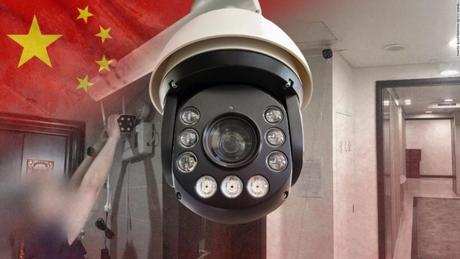
He said that he opened the door during the installation of the camera, without warning.
"(Having a camera outside your door) is an incredible erosion of privacy," said Lahiffe. "It looks like it's a huge data entry. And I don't know how legal it is."
Although there is no official announcement that cameras should be mounted outside the homes of quarantined people, this has been happening in some cities in China since at least February, according to three people who also told their experience with the cameras to CNN. as social media posts and government statements.
China currently has no specific national law to regulate the use of surveillance cameras, but the devices are already part of public life in China: they are often there to watch when people cross the street, enter a center business, dine in a restaurant, board a bus, or sit in a classroom.
More than 20 million cameras were installed across China in 2017, according to the public television channel CCTV. But other sources suggest a much higher number. According to a report from IHS Markit Technology, which is now part of Informa Tech, China had 349 million surveillance cameras installed in 2018, almost five times the number of cameras in the United States.
China also has eight of the 10 most watched cities in the world based on the number of cameras per 1,000 people, according to British technology research company Comparitech.
But now the pandemic has brought cameras closer to people's privacy: from city public spaces to the front doors of their homes - and in rare cases, surveillance cameras inside Their houses.
CNN requested comments from the Chinese National Health Commission. The Department of Public Safety did not accept requests for comment sent by fax to CNN.
Evolution of tactics
China already uses a digital "health code" system to control the movement of people and decide who should go to quarantine. To enforce home quarantine, local authorities again used technology - and were open to the use of surveillance cameras.
A government sub-district office in Nanjing, eastern Jiangsu Province, said it had installed cameras in front of quarantined people to monitor them 24 hours a day - a measure that "made it possible to 'save staff costs and increase work', according to his article of February 16 on Weibo, China's Twitter platform.
In Hebei Province, the Wuchongan County government in Qianan City also said it used surveillance cameras to monitor residents who were quarantined at home, according to a statement on its website. In the northeastern city of Changchun, Jilin Province, Chaoyang District quarantine cameras are powered by artificial intelligence to detect human forms, the district government said on its website.
In eastern China's city of Hangzhou, state-owned telecom operator China Unicom helped local governments install 238 cameras to monitor residents quarantined on February 8, the source said. company in a message to Weibo.
On Weibo, some people posted photos of cameras they say were recently installed outside their doors as they entered home quarantine in Beijing, Shenzhen, Nanjing and Changzhou, among other cities.
Some appeared to accept surveillance, although it is unclear to what extent criticism against the measure is tolerated on the country's closely watched and censored Internet. A Weibo user, who quarantined his home after returning to Beijing from Hubei Province, said his district committee had told him in advance that a camera and an alarm would be installed on his door entry. "(I) fully respect and understand the arrangement," she wrote.
Another Beijing resident said he did not think the camera was necessary, "but as it is a standard requirement, (I'm happy to accept it," wrote a person who identified himself as Tian Zengjun, lawyer in Beijing.
Others, worried about the spread of the virus in their communities, called on local authorities to install surveillance cameras to ensure that people respect the quarantine rules.
Jason Lau, privacy expert and professor at the Baptist University of Hong Kong, said that people across China had gotten used to current surveillance long before the coronavirus.
"In China, people are probably already assuming that the government has access to a lot of their data anyway. If they think the measures will keep them safe, keep the community safe and are in the public interest , they may not overdo it, "he said.
Cameras inside homes
Some people say that cameras have even been placed inside their homes.
In late February, William Zhou, an official, returned to the city of Changzhou in eastern Jiangsu Province from his home province of Anhui. The next day, he said that a community worker and a police officer came to his apartment and installed a camera pointing to his front door - from a cabinet wall inside his house.
Zhou said he didn't like the idea. He asked the community worker what the camera would record and the community worker showed him the pictures on his smartphone.
"I was standing in my living room and the camera clearly captured me in its frame," said Zhou, who asked to use a pseudonym for fear of repercussions.
Zhou was furious. He asked why the camera could not be placed outside instead, but the police told him that it could be vandalized. In the end, he said that the camera remained on the furniture despite his lively protest.
That evening, Zhou said he called the mayor's hotline and the local epidemic control command center to complain. Two days later, two representatives of the local government showed up at his door, asking him to understand and cooperate with the government's epidemic control efforts. They also told him that the camera would only take still images when his door moved and would not record any video or audio.
But Zhou did not remain convinced.
"(The camera) had a huge psychological impact on me," he said. "I tried not to make phone calls, fearing that the camera might record my conversations by accident. I couldn't help but worry even when I fell asleep after I closed the door. bedroom door. "
Zhou said it would have been nice to have the camera in front of his front door, because he wouldn't open it to go out anyway.
"Installing it inside my house is a huge invasion of my privacy," he said.
Zhou said that two other residents who were quarantined at his residential complex told him that they had also installed cameras inside their homes.
The Zhou District Epidemic Control Command Center saw CNN confirmed the use of cameras to enforce home quarantine, but declined to give further details.
In the eastern city of Nanjing, the Chunxi sub-district government posted photos on Weibo showing how the authorities used cameras to carry out quarantine. One photo showed a camera on a cabinet inside an apartment. Another showed a screenshot of four cameras, some of which appeared to have been taken from inside the houses.
The Chuxi sub-district government declined to comment. The district epidemic command center said installing cameras was not a mandatory policy, and some sub-district governments have chosen to adopt the measure themselves.
How do the cameras work?
There is no official count of the number of cameras installed to apply home quarantine in China. But the Chaoyang District government in Jilin, a city of four million people, said in a statement that it installed 500 cameras on February 8.
Governments around the world have adopted less intrusive technologies to find out if someone leaves their apartment. In Hong Kong, for example, all international arrivals subject to home quarantine must wear an electronic bracelet, which connects to a smartphone app that alerts authorities if they are away from their apartments or hotel rooms. South Korea uses an app that tracks locations with GPS and sends alerts when people leave quarantine. Last month, Poland launched an app that allows quarantined people to send selfies to let the authorities know they are staying at home.
Even in Beijing, everyone under quarantine at home has no camera in front of their home. Two residents, who recently returned from Wuhan to the city, said that a magnetic alarm was installed on the doors of their apartment, which would warn community workers if they went out. CNN contacted the Beijing authorities for comments.
Lahiffe, the Irish expatriate who lives in Beijing, thinks that the images of his camera are monitored by the community workers of his residential complex, who are responsible for ensuring that he stays at home and has no visitors - all from a smartphone.
"The guy's phone has an app that (shows) all the doors," said Lahiffe of one of the community workers who came to install the camera. "You can see all the doors of the different cameras that have been installed," he said, adding that he had seen more than 30 doors on the app, all from his residential complex which he said is inhabited by "mainly foreigners".
In China, each urban residential community is managed by a neighborhood committee, a communist legacy from the Mao era which has now become the basis of a social control "network management" system supported by high technology and big data. . Officially, these are autonomous bodies that manage and educate residents. But they also serve as an eye and ear for governments at the local level, helping to maintain stability by monitoring millions of residents nationwide and by reporting suspicious activity.
Since the epidemic, community workers have had a great deal of latitude and have been responsible for controlling the epidemic in residential complexes, enforcing home quarantine, as well as helping quarantined residents with basic needs, such as than delivering food and groceries to their doors and taking out their trash.
Whenever Lina Ali, a Scandinavian expatriate living in the southern city of Guangzhou, opened her front door to receive deliveries of food, she said that a bright light shone from the camera that had been formed on the door of her apartment while she was in quarantine.
She said that property management personnel in her building came to install a surveillance camera outside her front door on the first day of her home quarantine earlier this month.
"I hated the camera shining bright light, they told us it connected to the police station," said Ali. CNN has agreed to refer to her with a pseudonym to protect her safety. "It made me feel like I was really a prisoner in my own house."
CNN has contacted the Guangzhou authorities for comment.
In Shenzhen, cameras used to monitor quarantined residents in a district were connected to the smartphones of police and community workers, according to a report on the district government website.
If someone broke their quarantine, the report said, "the police and community workers will receive an alert immediately letting them know that something is wrong."
Maya Wang, senior China researcher at Human Rights Watch, said governments can take a wide range of measures to protect public health in the pandemic, but "they don't necessarily have to cover society with surveillance devices."
"If you look at China's surveillance measures during the coronavirus epidemic, from developing health codes to installing surveillance cameras to enforce quarantine, we see an increasingly intrusive use of technology surveillance stations that were previously only visible in particularly repressed regions, such as Xinjiang, "she said, referring to the far west region where China's Uyghur minority is found.
"The surveillance measures put in place during Covid-19 will unfortunately - if not postponed - live a very long time with us."
The legal position
China currently has no specific national law to regulate the use of surveillance cameras in public spaces. The Ministry of Public Security published a draft regulation on security cameras in 2016, but the ordinance is still awaiting approval by the country's national legislature. In recent years, some local governments have issued their own camera regulations.
Tong Zongjin, a lawyer based in Beijing, said that the installation of cameras in front of a person's front door has always been in a legal gray area.
"The area in front of a person's front door is not part of their private residence and is considered a common area. But the camera can monitor something personal, for example when the person leaves and returns to the room. house, "he said.
To add to the complexity of the problem, these cameras are installed by authorities during a public health emergency for the purpose of combating the epidemic, so an individual's privacy must be weighed against the 'public interest and safety, said Tong.
On February 4, the China Cyberspace Administration issued a directive, calling on regional cyberspace authorities to "actively use big data, including personal information, to support epidemic prevention and control activities", while protecting people's personal information.
The directive prohibits the collection of personal data for the control of epidemics without the consent of organizations that have not received the approval of the health authorities of the Chinese cabinet, the Council of State.
He also stated that the collection of personal information should be limited to "key groups" such as confirmed or suspected Covid-19 patients and their close contacts, and that the information collected should not be used for others nor be made public without consent. Organizations that collect personal information should take strict measures to protect data from theft or leakage, the document said.
Lau, the privacy expert, said that under Chinese law, organizations empowered to collect and disclose personal information about public health emergencies include national and regional health authorities, institutions medical, disease prevention and control authorities, as well as local authorities such as cantons and resident committees authorized by the government and emergency command headquarters.
"Of course, the government will try to collect as much data as possible to help stop the spread of the virus, but this must be done through appropriate, proportionate data collection and (if applicable) other intrusions. in privacy. methods of doing the same, "he said.
A new era of digital surveillance?
Earlier this month, more than 100 rights and privacy organizations around the world released a joint statement calling on governments to ensure that the use of digital technologies to track and monitor citizens during the pandemic is consistent with human rights.
"State efforts to contain the virus should not be used as a cover to usher in a new era of significantly expanded invasive digital surveillance systems," the statement said.
"Technology can and should play an important role in this effort to save lives, for example to disseminate public health messages and increase access to health care. However, an increase in the digital surveillance powers of the State, like access to location data from mobile phones, threatens privacy, freedom of expression and freedom of association, in a way that could violate rights and damage confidence in public authorities - undermining the effectiveness of any public health response, "he said.
For now, it seems that the surveillance cameras on people's front doors are not here to stay. After Ali and Zhou finished their quarantine, they said the cameras had been removed.
Community workers told Zhou that he could keep the camera for free. But Zhou was so angry that he had to live under his gaze for two weeks that he said he had pulled out a hammer and smashed the device in front of the community workers.
"If surveillance cameras are placed in public places, there is no problem - they can monitor and deter illegal acts. But they should not appear in our private spaces," he said.
"I cannot bear the idea that our daily lives are completely exposed to the scrutiny of the government."
Shawn Deng in Beijing contributed to the report.






