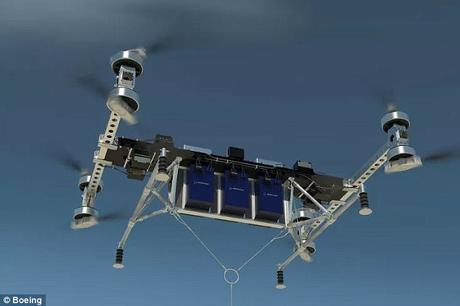
 A huge autonomous
drone that can carry the weight of two baby elephants has been unveiled by
Boeing. The heavy-duty quadrocopter (pictured) can transport payloads up to
quarter-of-a-ton, and Boeing says it may use the craft to shift cargo in future.
BOEING'S CAV
PROTOTYPE : Powered by an electric
propulsion system, Boeing's CAV prototype has eight helicopter-like rotors,
allowing for vertical take-off and landing. The craft weighs 339 kg (747 lbs),
but is capable of carrying a further 226 kg (500 lbs) of cargo. It measures
4.6m long (15 ft), 5.5m wide (18 ft) and 1.2m (4 ft) tall. Boeing may use the
heavy-duty quadrocopter to shift heavy cargo in future.
The aerospace firm,
based in Chicago, Illinois, calls the vehicle an electric
vertical-takeoff-and-landing (eVTOL) cargo air vehicle (CAV) prototype. It
dwarfs the average drone, measuring 4.6 meters long (15 ft), 5.5 metres wide
(18 ft) and 1.2 metres (4 ft) tall.
A huge autonomous
drone that can carry the weight of two baby elephants has been unveiled by
Boeing. The heavy-duty quadrocopter (pictured) can transport payloads up to
quarter-of-a-ton, and Boeing says it may use the craft to shift cargo in future.
BOEING'S CAV
PROTOTYPE : Powered by an electric
propulsion system, Boeing's CAV prototype has eight helicopter-like rotors,
allowing for vertical take-off and landing. The craft weighs 339 kg (747 lbs),
but is capable of carrying a further 226 kg (500 lbs) of cargo. It measures
4.6m long (15 ft), 5.5m wide (18 ft) and 1.2m (4 ft) tall. Boeing may use the
heavy-duty quadrocopter to shift heavy cargo in future.
The aerospace firm,
based in Chicago, Illinois, calls the vehicle an electric
vertical-takeoff-and-landing (eVTOL) cargo air vehicle (CAV) prototype. It
dwarfs the average drone, measuring 4.6 meters long (15 ft), 5.5 metres wide
(18 ft) and 1.2 metres (4 ft) tall.
The cargo can be attached to the drone with cables. Boeing says the drone is a precursor to its future autonomous flying craft. 'This flying cargo air vehicle represents another major step in our Boeing eVTOL strategy,' said Boeing chief technology officer Greg Hyslop in a statement. 'We have an opportunity to really change air travel and transport, and we'll look back on this day as a major step in that journey.' Powered by an electric propulsion system, Boeing's CAV prototype has eight helicopter-like rotors, allowing for vertical flight. The craft weighs 339 kg (747 lbs), but is capable of carrying a further 226kg (500 lbs) of cargo. The quadrocopter has completed initial tests at a Boeing autonomous research laboratory in St Charles, Missouri, but the firm did not provide details of the flights. Today's commercial airplanes already use sophisticated computer systems that have automated key aspects of flying. But Aurora aims to go far beyond that, aspiring to a completely autonomous flight, from take-off to landing. In April last year, Aurora was selected by Uber to develop its on-demand urban air transportation system. Interesting and innovative ~ how much % it is going to have market share of cargo movement would remain to be seen. In between, as an Insurer, do you foresee any new challenges in this new form of transit; what could be the recovery and whether there could be new perils added ‘cargo dropped and damaged’ and whether there could be liability scenario from such mishandled heavy cargo ??? With regards – S. Sampathkumar 11th Jan 2018.