


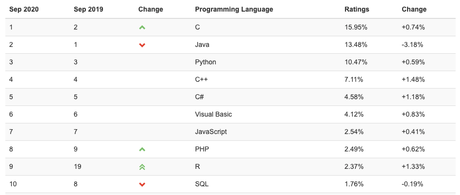
The TIOBE index for the most popular programming languages is out for September 2020. Although C has managed to beat Java and Python this time around to take the top spot, the most important highlight of this update is C + +. Despite its share of ups and downs over 35 years, C ++ has become the fastest growing programming language on the index.
C ++ scored 7.11%, up 1.48% from September 2019, which is the biggest gain to date among all languages this month. For those unfamiliar with the TIOBE index, it is an indicator of the popularity of programming languages each month. Ratings are based on the number of qualified engineers, courses, and third-party vendors around the world.
Meanwhile, the popularity of Java has been declining since September 2019, the largest drop of 3.18% seen in this month's index. Despite this, Java remains in second place, behind C, but ahead of Python, C ++, C #, Visual Basic, JavaScript, PHP, R and SQL.
Why is C ++ the fastest growing programming language this time around?
C ++ is currently in fourth place behind C, Java and Python and "is doing very well" according to TIOBE CEO Paul Jansen. He adds that C ++ peaked in 2003 with a share of 17.53% placing it directly in the top three programming languages.
The arrival of C ++ 20 is one of the plausible reasons for this renewed interest in C ++. The two key features of C ++ 20 are "modules" and "coroutines". Jansen hopes that "the new functionality of modules... will replace the dreaded inclusion mechanism".
Also Read: Learn To Code For Free With Best Free Coding Sites
This week, the finalized version of C ++ 20 was approved by the C ++ Group of the International Organization for Standardization (ISO) and Working Group 21 (WG21). C ++ 20 is the first major update in the programming language's three-year release cycle after C ++ 17 in 2017. In fact, some engineers consider C ++ 20 to be the most important release since C ++ 11.
What is your opinion? Which programming language do you prefer? Leave your comments below!
C ++ release is the fastest growing programming language In September 2020, first appeared on Fossbytes.






